


BRAND NAME:
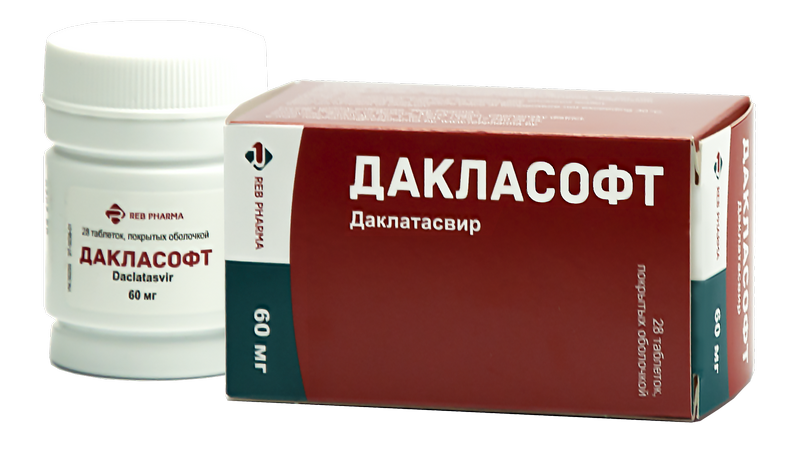
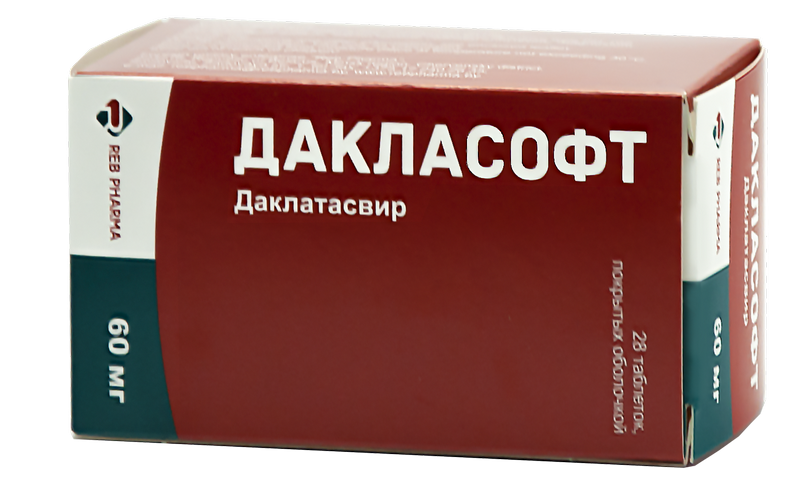
Daclasoft
INTERNATIONAL NONPROPRIETARY NAME:
Daclatasvir
DRUG FORM: film-coated tablets.
Description: oval biconvex green colour film-coated tablets, smooth on both sides.
COMPOSITION:
1 coated tablet contains:
Active substance: Daclatasvir (in a form of Daclatasvir dihydrochloride – 60 mg.
Excipients: anhydrous lactose, microcrystalline cellulose type RN-102, sodium croscarmellose, silicon colloidal anhydrous dioxide, magnesium stearate;
Tablet film composition: Opadry II 31F21443green (lactose monohydrate, hypromellose, macrogol/polyethylene glycol, titanium dioxide, dye D&C yellow No., dye orange yellow, 10 brilliant blue).
PHARMACOTHERAPEUTIC GROUP:
Direct effect antiviral drugs. Other antiviral agents
ATC CODE: J05AX14.
PHARMACOLOGICAL PROPERTIES:
PHARMACODYNAMICS:
Mechanism of action
Daclatasvir is a highly specific direct-acting agent for hepatitis C virus (HCV) elimination, which does not possess pronounced activity against other RNA and DNA-contained viruses, including human immunodeficiency virus (HIV). Daclatasvir is a non-structural protein 5A(1\185A) inhibitor, a multifunctional protein necessary for HCV replication able to suppress two stages of the virus life cycle – viral RNA replication and virion assembly. Based on in vitro studies and computer simulation data, it has been demonstrated that Daclatasvir interacts with the N-terminus within domain 1 of the protein which can cause structural distortions preventing NS5A protein functions implementation. The drug was found to be a potent pangenotypic inhibitor of replication complex of hepatitis C virus Genotype 1a, 1b, 2a, 3a, 4a, 5a and 6a with concentration values (50% decrease, EC50) from picomolar to low nanomolar. In cell quantitative analyzes of replicons, Daclatasvir EC50 values in a range from 0.001 to 1.25 nM for genotypes 1a, 1b, 3a, 4a, 5a and 6a and from 0.034 to 19 nM for genotype 2a. In addition, Daclatasvir inhibits hepatitis C virus Genotype 2a (JFH-1) with EC50 value of 0.020 nM. In previously non-treated patients infected with HCV Genotype 1a the treatment with a single dose of Daclatasvir 60 mg resulted in an average decrease in viral load measured in 24 hours by 3.2 log10 IU/ml.
Elementary cell studies have also shown an increase in the drug antiviral effect when taken with interferon alpha and NS3 protease inhibitors, non-nucleoside HCV inhibitors NS5B, nucleoside analogues of NS5B. Antagonism to antiviral effect was not observed with all specified drug groups.
Absorption
Absorption is fast. Daclatasvir maximal concentration observed in 1-2 hours after ingestion. The drug AUC, Cmax and Cmin in plasma are dose-dependent; Daclatasvir steady plasma concentration was observed on the 4th day of the drug oral administration taken once a day.
Excretion
After oral administration by healthy volunteers of a single dose of Daclatasvir labeled with C14 radioactive carbon ([14C] - Daclatasvir), 88% of all radioactive elements was excreted in the feces (53% unchanged) and 6.6% was excreted in the urine (mainly unchanged).
Children
Daclatasvir pharmacokinetics in children has not been evaluated.
INDICATIONS TO USE
Daclasoft in combination with other drugs is indicated for chronic hepatitis C (CHC) treatment in adults.
DOSAGE AND ADMINISTRATION:
Daclasoft tablets should be taken orally and swallowed whole. Tablets cannot be chewed or crushed for unpleasant taste of the active substance. Treatment should be initiated and monitored by a physician with experience in treating patients with chronic hepatitis C.
Recommended Dosage Regimen
The recommended dose of Daclasoft is 60 mg once a day, with or without food. The drug should be used in combination with other drugs. Recommendations for doses of other drugs are given in instructions for medical use. Therapy is recommended for patients non-treated for chronic hepatitis C as well as for those whose previous treatment was unsuccessful.
Children population
Daclatasvir safety and efficacy in children and adolescents under 18 years old have not been established.
Elderly patients
In patients over 65 years old the drug dose adjustment is not required.
CONTRAINDICATIONS:
- The drug should not be used as a monotherapy;
- Hypersensitivity to Daclatasvir and/or any of drug excipients;
- In combination with powerful inducers of CYP3A4 isoenzyme (due to decrease of Daclatasvir plasma concentration and its efficacy) such as: antiepileptic drugs (phenytoin, carbamazepine, phenobarbital, oxcarbazepine); antibacterial agents (rifampicin, rifabutin, rifapentin); systemic glucocorticosteroids (dexamethasone); herbal remedies (products based on Hypericum perforatum);
- Concomitant use of moderate CYP3A4 isoenzyme inductors is contraindicated in treatment schemes with Asunaprevir;
- If there are contraindications for combined use of (Asunaprevir and/or Peginterferon alpha + Ribavirin);
- Lactase deficiency, lactose intolerance, glucose-galactose malabsorption;
- Pregnancy and lactation.
PRECAUTIONARY MEASURES
Due to the drug administration in combined therapy it should be used with caution in conditions described in a leaflet for each drug involved in the therapy (Asunaprevir and/or Peginterferon alfa and Ribavirin). The safety of combination therapy has not been studied in patients with decompensated liver disease as well as in post-liver transplantation patients. The combined use of Daclasoft with other drugs can lead to a change in both: Daclatasvir and the other drugs substances concentration.
Special instructions
Daclasoft should not be used as a monotherapy
SIDE EFFECTS:
Daclatasvir in combination with Sofosbuvir
Most common adverse reactions were fatigue, headache and nausea.
Daclatasvir in combination with Peginterferon alfa and Ribavirin
Most common adverse reactions were fatigue, headache, itching, anemia, flu-like symptoms, nausea, insomnia, neutropenia, asthenia, rash, decreased appetite, dry skin, alopecia, fever, myalgia, irritability, cough, diarrhea, shortness of breath and arthralgia.
Daclatasvir safety profile when used in combination with Peginterferon alfa and Ribavirin was similar to Peginterferon alfa and Ribavirin, including patients with cirrhosis.
The frequency of adverse reactions is defined as follows: very often (≥1/10); often (≥ 1/100, up to <1/10); infrequently (≥ 1/1000, up to <1/100); rarely (≥ 1/10000, up to <1/1000); very rare (<1/10000); frequency is unknown (cannot be estimated from data available).
Daclatasvir + Sofosbuvir + Ribavirin:
Blood and lymphatic system disorders: very often - anemia.
Metabolic and nutrition disorders: often - loss of appetite.
Mental disorders: often - insomnia, irritability.
Nervous system disorders: very often - headache; often - dizziness, migraine.
Blood vessels disorders: often - flushing
Respiratory system, chest and mediastinum: often - shortness of breath, dyspnoea exertional, cough, nasal congestion.
Gastrointestinal tract disorders: very often - nausea; often - diarrhea, vomiting, abdominal pain, gastroesophageal reflux disease, constipation, dry mouth, flatulence.
Skin and subcutaneous tissue disorders: often – skin rash, alopecia, itching, dry skin.
Musculoskeletal and connective tissue disorders: often - arthralgia, myalgia.
General disorders: very often - tiredness.
Daclatasvir + Sofosbuvir:
Mental disorders: often - insomnia.
Nervous system disorders: very often - headache; often - dizziness, migraine.
Gastrointestinal tract disorders: often - nausea, diarrhea, abdominal pain.
Musculoskeletal and connective tissue disorders: often - arthralgia, myalgia.
General disorders: very often - tiredness
Laboratory Results
Pathological deviations in laboratory test results from a normal range – 3-4th degree observed in patients with HCV received combined therapy with Daclatasvir.
Heart arrhythmia
Cases of severe bradycardia and heart attack have been observed in Daclatasvir therapy combined with sofosbuvir and concomitant use of Amiodarone and/or other drugs that reduce heart rate.
If any adverse reactions occur or worsen immediately consult the doctor.
OVERDOSE
Symptoms of overdose have not been reported. In clinical studies of phase 1 with the drug used in healthy volunteers at doses up to 100 mg within 14 days period or a single dose of 200 mg, unpredictable adverse reactions have not been registered. There is no antidote to Daclatasvir. Treatment of the drug overdose should include general supportive measures, including patient’s vital signs and clinical condition observation. Due to Daclatasvir high binding capacity to plasma proteins dialysis is not recommended in case of overdose.
No clinically significant effects are expected in pharmacokinetic parameters of any drug in concomitant use of Daclatasvir with any of the following drug groups: PDE-5 inhibitors, ACE inhibitors (for example, enalapril), angiotensin receptor antagonist class II (for example, losartan, irbesartan, olmesartan, candesartan, valsartan), disopyramide, propafenone, flecainide, mexilitin, quinidine or antacids.
STORAGE CONDITIONS:
Store in a place protected from moisture at a temperature not above 30°C.
Keep out of reach of children!
SHELF LIFE:
Shelf life is 2 years. Should not be uses after the expiration date indicated on the label.
PRESCRIPTION STATUS
By prescription
PACKAGING
28 tablets in a plastic bottle made of high density polyethylene (HDPE) with aluminium foil membrane, sealed with a screw cap made of HDPE with silica gel.
1 bottle with a leaflet in a cardboard box
Manufacturer Information
Foreign production and trade unitary enterprise “Reb-Pharma”, 223216, Republic of Belarus, Minsk region, Chervensky district, Smilovichi, Sadovaya st., 1, tel./fax: (+375) 17 240 26 35,
e-mail: rebpharma@rebpharma.by, http://www.rebpharma.by
Comment type is not specified in the component properties.