
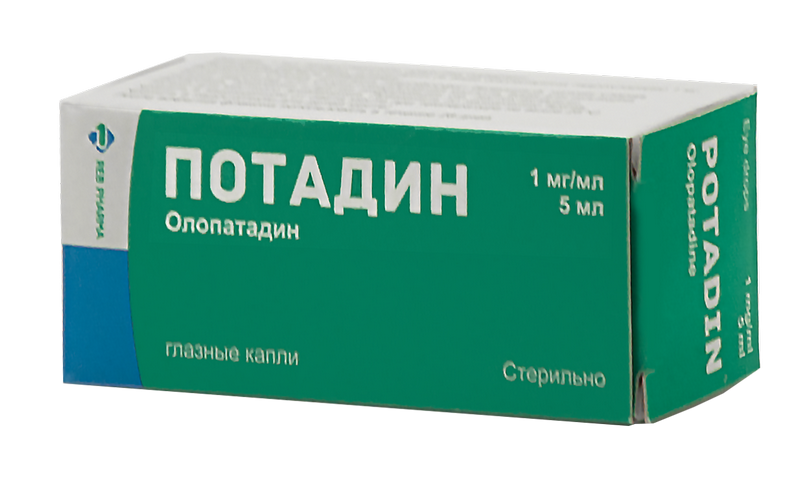
Potadin
INTERNATIONAL NONPROPRIETARY NAME:
Olopatadine
DRUG FORM: eye drops
Description: clear colorless solution.
COMPOSITION:
1 ml contains:
Active substance: Olopatadine - 1.0 mg;
Excipients: benzalkonium chloride, disodium hydrogen phosphate anhydrous, sodium chloride, sodium hydroxide and/or hydrochloric acid, water for injections.
PHARMACOTHERAPEUTIC GROUP:
Inflammatory edema (decongestants) and allergy treatment agents
ATC CODE: S01GX09
PHARMACOLOGICAL PROPERTIES:
PHARMACODYNAMICS:
Olopatadine, an active substance of Potadin is a strong selective anti-allergic medicine with several different mechanisms of action. It is an antagonist of histamine (the primary mediator of allergic reaction development in human) which prevents histamine-induced cytokines synthesis by human conjunctival epithelial cells. In vitro studies suggest that Olopatadine can affect conjunctiva mast cells in human inhibiting the release of pro-inflammatory mediators. It has also been demonstrated that local application of Olopatadine into the eye area in patients with open nasolacrimal canals helps to reduce nasal symptoms and disorders that often accompany seasonal allergic conjunctivitis.
Olopatadine does not cause clinically significant deviation in pupil diameter.
PHARMACOKINETICS:
Absorption and distribution. Olopatadine undergoes systemic absorption. However systemic absorption is insignificant and plasma concentration can vary in a range 50-200 times lower than concentrations observed after oral administration of well-tolerated doses.
Metabolism and excretion. According to pharmacokinetic studies, Olopatadine half-life in plasma after oral administration is about 8-12 hours and the drug is mainly excreted by the kidneys. Approximately 60-70% of active substance oral dose is presented in the urine in unchanged form.
Since Olopatadine is excreted mainly by the kidneys in unchanged form, impaired renal function affects Olopatadine pharmacokinetic.
Olopatadine pharmacokinetic studies demonstrated that after oral administration of Olopatadine 10 mg no significant differences had been found between young (average age 21) and elderly (average age 74) in Olopatadine plasma concentration, protein binding capacity and excretion in unchanged form or in a form of metabolite.
Olopatadine studies of the drug oral administration in patients with severe impaired renal function showed a higher plasma level in this group of patients. Due to the fact that Olopatadine plasma concentration after Potadin application in the eye is 50-100 times lower than after oral administration in well-tolerated doses, dose adjustment in elderly patients or patients with impaired renal function is not required.
Hepatic metabolism is a secondary route of drug elimination therefore the dose adjustment in case of impaired liver function is not required.
INDICATIONS FOR USE:
The treatment of ophthalmic manifestations and symptoms of seasonal allergic conjunctivitis.
CONTRAINDICATIONS:
Hypersensitivity to the drug components.
SIDE EFFECT:
Nervous system: headache, taste distortion.
Eye disorders: pain in the eye, irritation, dry eye syndrome, impaired eye sensitivity.
Respiratory system, chest and mediastinal organs disorders: dry nose.
DOSAGE AND ADMINISTRATION:
Potadin is indicated for local use in ophthalmology only.
Shake the vial before use.
Adults and children at age 3 years and above: 1 drop into a conjunctival sac of the affected eye (s) twice a day (with 8 hours interval). If necessary, the treatment can be continued for up to 4 months.
When several local ophthalmic drugs have been prescribed, an interval between instillations should be within 5 to 10 minutes.
To prevent drug contamination the tip of the dropper-dispenser should not touch any surface (eyelids, eye area, etc.) After use keep the bottle tightly closed.
Elderly patients, patients with impaired liver and/or kidney function dosage regimen should not be adjusted.
Compliance with the following recommendations would ensure the safety of drug instillation:
• Wash hands thoroughly before eye-drops instillation.
• Tilt your head back.
• Pull the lower eyelid and look back.
• Gently press down on the base of the vial to make one drop. Do not squeeze the vial as it is designed in such a way that a slight pressure on the base is enough.
• Make one drop into the space between the eyelid and the eyeball.
• Do not touch the tip of the bottle to the eyelids, eyelashes and do not touch it with your hands.
• Close your eye and pat it with a dry cotton swab.
• If you use the drug for two eyes, repeat the same steps for the second eye.
• Close the vial with a cap immediately after use.
PRECAUTIONARY MEASURES:
In case of serious reactions or hypersensitivity develops Potadin administration should be discontinued.
Contact lenses can be worn no earlier than in 10-15 minutes after Potadin instillation. Potadin should not be instilled when contact lenses are in the eyes.
EFFECT ON ABILITY TO DRIVE AND OPERATE MACHINERY:
If the patient’s visual clarity is temporarily reduced after the drug application it is not recommended to drive and carry out activities required an increased attention until it is restored.
USE IN PREGNANCY AND LACTATION:
There is no data available on olopatadine effect in pregnancy. The drug administration in pregnancy should be carried out with caution.
It has not been proved whether olopatadine can undergo significant systemic absorption and be detected in breast milk after topical application in nursing women. Olopatadine is not recommended for use in nursing women.
INTERACTION WITH OTHER MEDICINES:
No studies on Potadin interaction with other drugs have been conducted.
STORAGE AND SHELF LIFE
Store in a place protected from sunlight and moisture at a temperature not above 25°C.
Keep out of reach of children!
SHELF-LIFE
3 years from the production date. Not to be used after the expiration date stated on the label. Use the vial content in 28 days period after opening.
PRESCRIPTION STATUS
By prescription
Manufacturer Information
Foreign production and trade unitary enterprise “Reb-Pharma”, 223216, Republic of Belarus, Minsk region, Chervensky district, Smilovichi, Sadovaya st., 1, tel./fax: (+375) 17 240 26 35,
e-mail: rebpharma@rebpharma.by, http://www.rebpharma.by
Comment type is not specified in the component properties.