
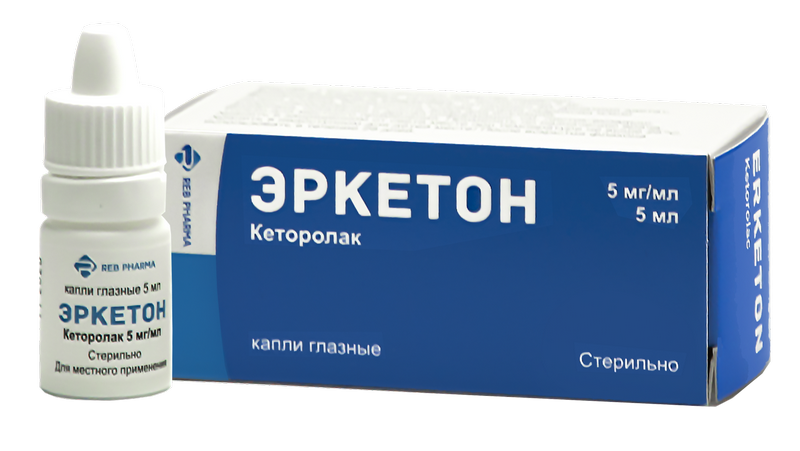
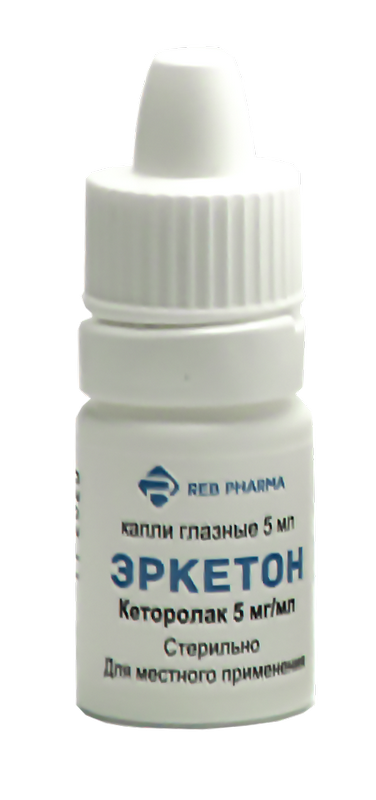
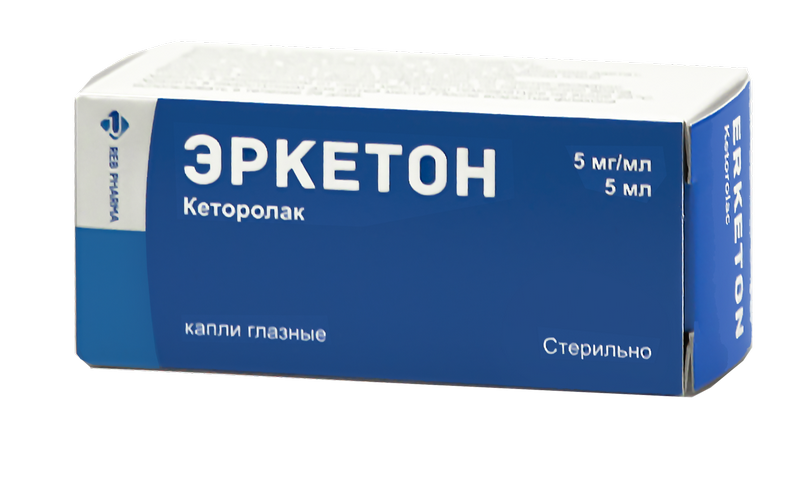


Erketon, Erketon
INTERNATIONAL NOPROPRIETARY NAME:
Ketorolac
DRUG FORM:
Eye drops
Description: Transparent colorless or light yellow solution.
COMPOSITION:
1 ml contains:
Active substance: ketorolac tromethamine - 5.0 mg;
Excipients: 40, disodium edetate, sodium chloride, benzalkonium chloride, hydrochloric acid or sodium hydroxide, water for injection.
PHARMACOTHERAPEUTIC GROUP:
Nonsteroidal antiinflammatory drugs.
ATC Code: S01BC05
PHARMACOLOGICAL PROPERTIES:
PHARMACODYNAMICS:
Erketon is a non-steroidal antiinflammatory drug (NSAID) with analgesic and antiinflammatory effect caused by inhibition of cyclooxygenase, the main enzyme necessary for prostaglandin biosynthesis. When applied topically in ophthalmology, it reduces prostaglandin concentration in aqueous humour.
Clinical trials have shown that Erketon has no significant effect on intraocular pressure. In systemic use it does not cause pupil constriction.
PHARMACOKINETICS:
Ketorolac tromethamine solution was instilled in the form of eye drops approximately 12 hours and 1 hour before surgery. At the time of the operation samples were taken to determine the content of ketorolac in aqueous humour. An average ketorolac concentration in aqueous humour was equal to 95 ng/ml. Prostaglandin E2 concentration in aqueous humour was equal to 28 ng/ml.
Higher concentrations of ketorolac in aqueous humour and a very low or unrecognized plasma level after instillation into the conjunctival sac indicate minimal drug absorption into the systemic circulation after local administration.
INDICATIONS FOR USE:
Pain release and reduction of inflammation after cataract surgery.
Erketon is indicated for use in adult patients.
CONTRAINDICATIONS:
Hypersensitivity to the drug active substance and excipients.
Risk of cross-sensitivity to acetylsalicylic acid (aspirin) and other non-steroidal antiinflammatory drugs.
Erketon is contraindicated in patients observed to be sensitive to the above mentioned drugs.
SIDE EFFECTS:
Immune system disorders: hypersensitivity, including local allergic reactions.
Central nervous system: - headache.
Eye disorders: eye irritation, pain in the eye; superficial (point) keratitis, eye and/or eyelids swelling, eye itching, conjunctival hyperemia, eye infections, inflammation, iris inflammation, keratin precipitates, bleeding in the retina, cystic macular edema, eye injury, increased intraocular pressure, blurry and/or impaired vision.
None of adverse reactions associated with systemic use of NSAIDs (including ketorolac tromethamine) was observed in topical drug application when used in therapeutic doses.
DOSAGE AND ADMINISTRATION:
To reduce pain and inflammation after surgery 1 drop of the drug should be instilled into an affected eye 3 times a day, started 24 hours before surgery and continue for up to 2 weeks after surgery. 1 drop of the drug should be instilled into the conjunctival sac of an affected eye. At the time pull the lower eyelid down and look up. Erketon is indicated for topical use. When several local ophthalmic drugs are prescribed the interval between instillations should be at least 5 minutes.
The following instructions must be followed when using Erketon:
1. Wash your hands, bend your head back and look up.
2. Gently pull the lower eyelid down to form a small space between the eyelid and the eye.
3. Turn the vial upside down then squeeze the vial and instill one drop of the drug into each affected eye.
4. Release the lower eyelid and keep your eye closed for 30 seconds.
If drops do not fall into the targeted space, repeat the procedure.
If you have applied more Erketon than the stated dosage:
If you have applied more Erketon drops than prescribed it is unlikely to cause adverse events. Use the next dose without changing the standard time of application. In case of accidental intake of Erketon it is necessary to drink some fluid to reduce ketorolac concentration and consult a doctor.
If you missed the dose of Erketon:
If you missed the dose of Erketon, take it as soon as you remembered, except cases when there was not enough time left before the next dose, then do not take the missed dose. Take the next dose at usual time according to the current regimen.
If you stop using Erketon:
Erketon should be taken as prescribed by your doctor. If you have questions about the treatment regimen contact your doctor or pharmacist.
Pediatric use. There are no data about Erketon administration in children according to indications: pain relief and reduction of inflammation after cataract surgery.
Use in elderly patients. No differences in safety and efficacy have been established between elderly, young and middle-aged patient groups.
PRECAUTIONARY MEASURES
NSAIDs administration for topical use can cause keratitis.
In patients after complex ophthalmic surgery, corneal denervation, corneal epithelial defects, diabetes mellitus, eye surface diseases (for example, dry eye syndrome), rheumatoid arthritis or repeated ophthalmic surgery over a short period the risk of corneal side effects may increase resulting in sight-threatening. Caution should be exercised in this group of patients on NSAIDs therapy (topical application).
Topical application of NSAIDs for a longer period than 24 hours before surgery or 14 days after surgery may increase the risk and severity of corneal side effects.
Caution is advised when applying Erketon eye drops to patients with a known predisposition to bleeding or patients on drugs therapy that can prolong the bleeding time.
There is a possibility of cross-sensitivity to acetylsalicylic acid, phenylacetic acid derivatives and other NSAIDs. Therefore caution should be exercised when treating the patients sensitive to such drugs if that has previously been observed.
Caution should be exercised when Erketon is coadministered with topical corticosteroids in patients with predisposition to corneal epithelial damage.
Erketon eye drops contain a preservative Benzalkonium chloride which is able to accumulate in contact lenses and have a negative effect on the eyes. Before using the drug lenses should be removed and reinserted no earlier than in 15 minutes after instillation. Moreover, Benzalkonium chloride may cause discoloration of soft contact lenses, so contact with this type of lens should be avoided.
Side effects can be minimized by using the drug in minimum effective dose and in the shortest period necessary to eliminate the pain syndrome.
Erketon eye drops safety and efficacy in children under 12 years has not been established.
EFFECT ON ABILITY TO DRIVE AND OPERATE MACHINERY:
Due to possible visual impairment that occurs immediately after instillation you should avoid driving and operating potentially dangerous machinery until eyesight normalization.
USE IN PREGNANCY AND LACTATION:
During pregnancy and lactation Erketon eye drops is contraindicated.
PEDIATRIC USE:
Erketon eye drops safety and effectiveness in children under 12 years old have not been established.
INTERACTION WITH OTHER DRUGS:
Concomitant use of Erketon with eye drops containing antibiotics, sedatives, beta-blockers, carbonic anhydrase inhibitors, myotics, mydriatics, local anesthetics and cycloplegics is accepted. In this case it is necessary to maintain an interval between instillations of at least 5 minutes. When combined with topical corticosteroids, the wound healing process elongates.
Concomitant use of Erketon with other NSAIDs, pentoxifylline, anticoagulants may result in an increase in the risk of postoperative bleeding.
STORAGE AND SHELF LIFE
Store in a place protected from sunlight and moisture at a temperature not above 25°C.
Keep out of reach of children!
SHELF-LIFE
3 years from the production date. Not to be used after the expiration date stated on the label. Opened vials must be used within 28 days.
PRESCRIPTION STATUS
By prescription
Manufacturer Information
Foreign production and trade unitary enterprise “Reb-Pharma”, 223216, Republic of Belarus, Minsk region, Chervensky district, Smilovichi, Sadovaya st., 1, tel./fax: (+375) 17 240 26 35,
e-mail: rebpharma@rebpharma.by, http://www.rebpharma.by
Comment type is not specified in the component properties.