
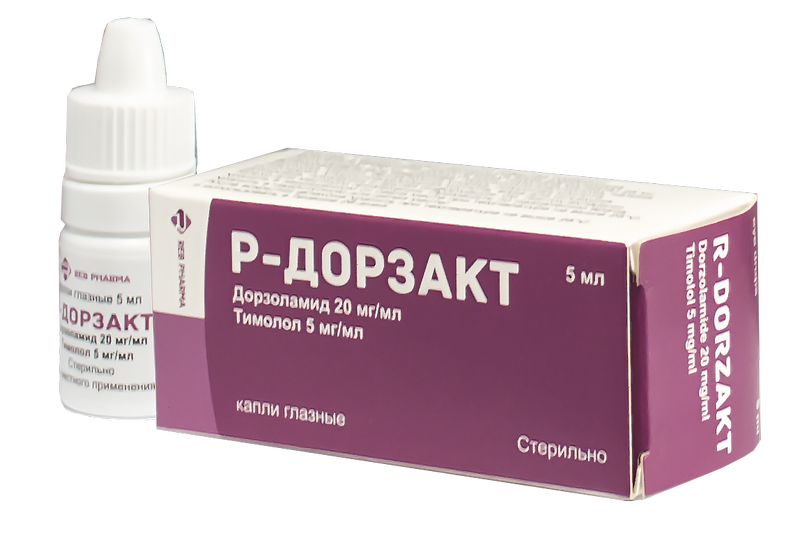
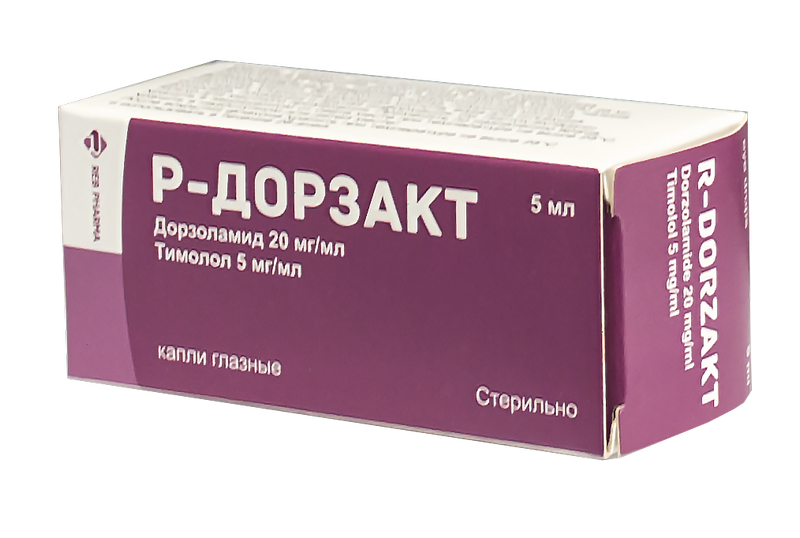


R-Dorzakt
INTERNATIONAL NONPROPRIETARY NAME:
Timolol, combinations
DRUG FORM:
Eye drops.
Description: Clear, colorless or almost colorless slightly viscous solution.
COMPOSITION:
1 ml of the drug contains:
Active substance: Dorzolamide – 20.00 mg and timolol – 5.00 mg;
Excipients: hydroxyethyl cellulose, mannitol, citric acid monohydrate, sodium hydroxide, benzalkonium chloride, hydrochloric acid, water for injection.
PHARMACOTHERAPEUTIC GROUP:
Antiglaucoma preparations and miotics. Beta- blockers.
ATC CODE: S01ED51
PHARMACOLOGICAL PROPERTIES:
PHARMACODYNAMICS:
R-Dorzact contains two active substances: Dorzolamide and Timolol which decrease elevated IOP by reducing aqueous humor secretion. The combined effect of these substances contained in R-Dorzact results in additional IOP reduction.
Dorzolamide is a selective inhibitor of human type II carbonic anhydrase. Inhibition of carbonic anhydrase in the ciliary body decreases aqueous humor secretion by reducing bicarbonate ions formation with subsequent reduction in sodium and fluid transfer.
Timolol is a non-selective beta-adrenergic-blocker. Timolol mechanism of action is mainly presented in aqueous humor secretion reduction and a slight increase in its outflow.
PHARMACOKINETICS:
Dorzolamide hydrochloride
Dorzolamide when applied topically enters the systemic blood circulation. In prolonged administration Dorzolamide accumulates in red blood cells followed by selective binding to type II carbonic anhydrase and maintains in extremely low plasma free fraction. The metabolite also accumulates in red blood cells. About 33% of Dorzolamide binds to plasma proteins. Dorzolamide is excreted into the urine in unchanged form and as a metabolite. After withdrawal Dorzolamide washes out from red blood cells in a non-linear dependency, which at first results in a rapid decrease in its concentration and then elimination rate reduction. T1/2 is about 4 months.
Timolol maleate
Timolol maleate when applied topically enters the systemic blood circulation.
Dorzolamide and timolol combined application results in additional therapeutic effect. IOP decrease occurs in 20 minutes after instillation with a maximum reduction in 2 hours which lasts at least 24 hours.
INDICATION FOR USE
Increased intraocular pressure in patients with open-angle glaucoma or pseudoexfoliation glaucoma when beta-blocker monotherapy is not efficient enough.
CONTRAINDICATIONS:
- Hypersensitivity to the drug components;
- Respiratory tract hyperactivity, bronchial asthma, a history of bronchial asthma, severe chronic obstructive pulmonary disease;
- Sinus bradycardia, sinus node weakness syndrome, sinoatrial block, atrioventricular block II-III degree without a pacemaker, severe heart failure, cardiogenic shock;
- Severe renal failure (creatinine clearance less than 30 ml/min) or hyperchloremic acidosis;
- Dystrophic processes in the cornea;
- Children under 18 years (safety and efficacy are not well established);
- Pregnancy;
- Lactation period.
SIDE EFFECT:
Possible side effects for Dorzolamide hydrochloride:
Eye disorders: eyelid inflammation, irritation and crusting, iridocyclitis, point keratitis, transient myopia (which occurs after drug withdrawal);
Central and peripheral nervous system: headache, asthenia/fatigue, paresthesia;
Allergic reactions: angioedema, bronchospasm, urticaria, itching;
Others: nosebleeds, pharyngeal irritation, dry mouth, rash.
Possible side effects for Timolol maleate when applied topically:
Eye disorders: conjunctivitis, blepharitis, keratitis, decreased sensitivity of the cornea, dryness; visual impairment, including changes in the eye refractive power (in some cases due to decrease in myotics), diplopia, ptosis;
Central and peripheral nervous system: tinnitus, paresthesia, headache, asthenia, fatigue, dizziness; depression, insomnia;
Cardiovascular system disorders: arrhythmia, hypotension, fainting, cardiovascular disorders, rhythm disturbances, cardiac arrest, edema, Raynaud’s syndrome, lowering temperature in arms and legs;
Respiratory system disorders: bronchospasm (mainly in patients with previous bronchial obstruction), cough, chest pain;
Dermatological reactions: alopecia, psoriasis-like rashes or exacerbation of psoriasis;
Allergic reactions: anaphylaxis, angioedema, urticaria, local or generalized rashes;
Digestive system disorders: diarrhea, dyspepsia, dry mouth;
Possible side effects in systemic use of Timolol maleate:
Cardiovascular system: pain in the limbs, decreased tolerance to physical activity, atrioventricular block II and III degree, sinoauricular block, pulmonary edema, peripheral circulation disorders and angina pectoris aggravation, vasodilation;
Dermatological reactions: skin itching, increased sweating, exfoliative dermatitis;
Central nervous system: dizziness, weakness, lack of concentration, drowsiness;
Laboratory parameters deviation: clinically significant changes in systemic use of Timolol maleate were extremely rare.
DOSAGE AND ADMINISTRATION
R-Dorzakt is indicated for topical use only.
R-Dorzakt is prescribed to be instilled1 into the conjunctival sac of the affected eye – 1 drop BID.
In case of combined use with other local ophthalmic agents the interval between instillations should be at least 10 minutes.
When R-Dorzact is prescribed as a replacement therapy for glaucoma treatment, another drug should be canceled a day before R-Dorzact therapy.
In case of nasolacrimal occlusion (eyelids closing) for 2 minutes after the drug instillation its systemic absorption decreases, which can lead to topical action increase.
Avoid the dropper tip contact with any surface to prevent microbial contamination of the vial contents.
Patients with impaired liver function: no studies have been performed therefore the drug should be prescribed with caution.
Elderly patients: there have not been registered any difference in the drug safety and efficacy compared to younger patients.
PRECAUTIONARY MEASURES:
Dorzolamide and Timolol when applied topically, penetrate into the systemic blood circulation. In this regard, adverse reactions can be similar to reactions that are characteristic to beta-blockers and sulfonamides. If such hypersensitivity to the drug appears, its administration should be discontinued.
Treatment with beta-blockers can exacerbate the symptoms of myasthenia gravis.
As with other anti-glaucoma drugs, the decrease in sensitivity to Timolol in topical administration with long-term treatment has been reported.
Cardiovascular and respiratory system disorders
Patients with a history of severe heart disease and signs of heart failure should be closely monitored. In such patients it is necessary to control the pulse.
For patients with mild to moderate chronic obstructive pulmonary disease, P-Dorzact should be prescribed with caution and only if the intended benefits of the treatment outweigh the potential risk.
R-Dorzakt should be prescribed with caution for patients with severe peripheral circulation disorders (severe forms of Raynaud’s disease or Raynaud’s syndrome).
Hypoglycemia in patients with diabetes mellitus
Beta-blockers should be used with caution in patients predisposed to spontaneous hypoglycemia or in patients with diabetes mellitus while taking insulin or oral hypoglycemic drugs, since beta-blockers can mask the signs and symptoms of acute hypoglycemia.
Thyrotoxicosis
Beta-blockers may mask some clinical signs of hyperthyroidism (such as tachycardia). If thyrotoxicosis is suspected, patients should be closely monitored. Abrupt drug withdrawal should be avoided due to the risk of thyrotoxicosis crisis development.
Impaired liver function
Since there is no data on the drug administration in patients with impaired liver function, such patients should be treated with caution.
Allergy and hypersensitivity
Like other topical ophthalmic drugs, P-Dorzact can penetrate the systemic circulation. Dorzolamide which is the drug component – is a sulfanilamide. Thus, adverse reactions specific for systemic use of sulfonamides can be observed in topical administration of P-Dorzact.
Concomitant therapy
When using R-Dorzakt in patients on systemic beta-blockers therapy, it is necessary to take into account the possible mutual enhancement of the drugs pharmacological action such as known systemic effects and a decrease in intraocular pressure. Combined use of R-Dorzakt with beta-blockers is not recommended.
Treatment Discontinuation
In necessity to cancel Timolol for topical administration, similar to the situation with systemic beta-blockers, therapy discontinuation in patients with coronary heart disease should be carried out gradually.
Corneal Disorders
Beta-blockers used in ophthalmology can cause dry eyes syndrome.
R-Dorzact contains preservative benzalkonium chloride thus persons wearing hard contact lenses should remove them before using the drug and reinsert them no earlier than in 15 minutes after installation. The drug should not be used together with soft contact lenses as benzalkonium chloride is able to accumulate in lenses and have a negative effect on the eye.
Surgery
The necessity of beta-blockers withdrawal prior to extensive surgical intervention has not been proven. As the circumstances require, during the surgery the effects of beta-blockers can be eliminated with the use of sufficient doses of adrenergic agonists.
EFFECT ON ABILITY TO DRIVE AND OPERATE MACHINERY
Due to the fact that Dorzolamide can cause dizziness and visual impairment, during the treatment period, especially at the beginning potentially dangerous activities associated with mental alertness and quick psychomotor reactions should be avoided.
USE IN PREGNANCY AND LACTATION:
R-Dorzact is contraindicated in pregnancy and lactation. In case of its application during lactation period breastfeeding should be discontinued.
PEDIATRIC USE:
R-Dorzakt is contraindicated in children under 18 years old.
INTERACTION WITH OTHER DRUGS:
There is a possibility of enhanced the hypotensive effect and/or severe bradycardia in combined use of Timolol maleate ophthalmic solution and systemic calcium channel blockers, catecholamine-depleting agents, beta-blockers, antiarrhythmic drugs (including amiodarone), digitalis glycosides, parasympathomimetic antioxidants and mono-antioxidants MAO).
Combined use of Timolol and CYP2D6 isoenzyme inhibitors (e.g., quinidine or selective serotonin reuptake inhibitors) the potentiated inhibitory effect on beta-adrenoreceptors has been reported (e.g., decreased heart rate, depression).
Systemic beta-blockers can enhance the hypoglycemic effect of antidiabetic drugs and hypertension, as a result of Clonidine (Clophelin) withdrawal.
Combined use of R-Dorzakt and systemic carbonic anhydrase inhibitors is not recommended.
STORAGE CONDITIONS AND SHELF LIFE:
Store at a temperature not above 25°C.
Opened vials must be used within 28 days.
2 years from the production date.
Not to be used after the expiration date.
Keep out of the reach of children!
PRESCRIPTION STATUS
By prescription
Manufacturer Information
Foreign production and trade unitary enterprise “Reb-Pharma”, 223216, Republic of Belarus, Minsk region, Chervensky district, Smilovichi, Sadovaya st., 1, tel./fax: (+375) 17 240 26 35,
e-mail: rebpharma@rebpharma.by, http://www.rebpharma.by
Comment type is not specified in the component properties.