
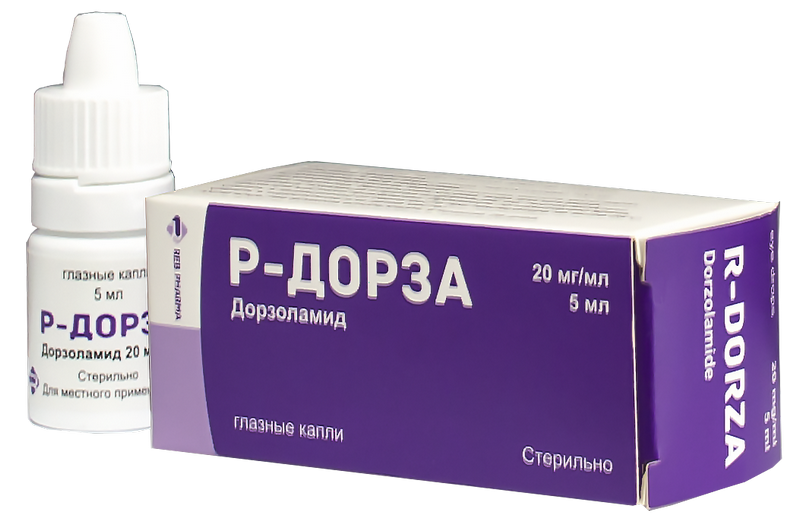
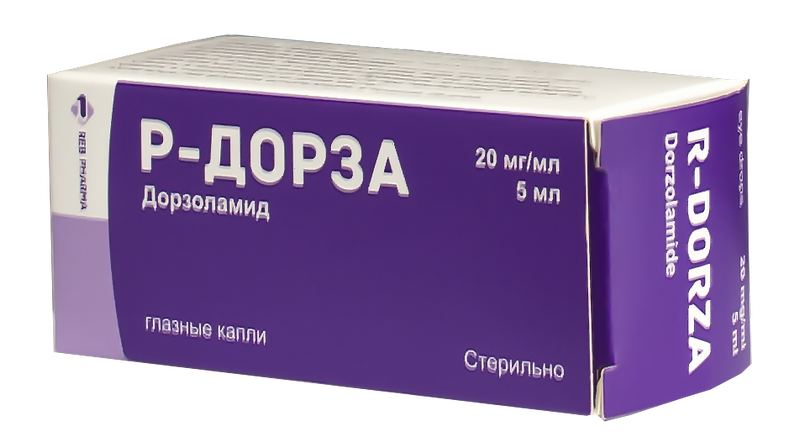


R-Dorza
INTERNATIONAL NOPROPRIETARY NAME:
Dorzolamide
DRUG FORM:
Eye drops
Description: White to off-white suspension
Clear, colorless or almost colorless slightly viscous solution
COMPOSITION:
1 ml of the drug contains:
Active substance: Dorzolamide – 20 mg;
Excipients: hydroxyethyl cellulose, mannitol, citric acid monohydrate, sodium hydroxide, benzalkonium chloride, water for injection.
PHARMACOTHERAPEUTIC GROUP:
Ophtalmologicals, Antiglaucoma preparations and miotics
ATX CODE: S01EC03
PHARMACOLOGICAL PROPERTIES:
PHARMACODYNAMICS:
P-Dorza active substance – Dorzolamide is an inhibitor of carbonic anhydrase. Inhibition of carbonic anhydrase in the ciliary body of the eye decreases aqueous humour secretion. When applied locally in a form of 2% eye drops, Dorzolamide reduces increased ocular pressure, which is a main risk factor in optic nerve damage pathogenesis and glaucomatous deterioration of visual functions (loss of visual fields).
PHARMACOKINETICS:
Distribution
When applied locally, Dorzolamide undergoes the systemic circulation.
In prolonged use Dorzolamide selectively accumulates in red blood cells as a result of selective binding to carbonic anhydrase II, while free Dorzolamide plasma concentration remains extremely low.
Dorzolamide forms a single metabolite, to a lesser extent than Dorzolamide which suppresses carbonic anhydrase II and carbonic anhydrase I enzymes. The metabolite accumulates in red blood cells, binding mainly to carbonic anhydrase I.
Dorzolamide to a moderate extent binds to plasma proteins (about 33%).
Metabolism and excretion
Dorzolamide and its metabolite are excreted mainly unchanged through the kidneys. After treatment Dorzolamide is excreted from red blood cells with a non-linearly dependency, resulted in a rapid decrease in drug concentration at the initial stage, followed by a decrease in elimination with a half-life of about 4 months.
INDICATIONS FOR USE:
Increased ocular pressure including patients with open-angle glaucoma.
CONTRAINDICATIONS:
Hypersensitivity to the drug components;
- Severe renal failure (creatinine clearance less than 30 ml/min);
- Hyperchloremic acidosis.
SIDE EFFECT:
Local: burning, tingling or discomfort immediately after use.
Eye disorders: superficial punctate keratitis, symptoms of eye allergic reactions, conjunctivitis and eyelids irritation, blurred vision, red eyes, lacrimation, dry eyes and photophobia.
If these adverse reactions occur, as well as reactions not listed in instruction for use, consult a doctor.
DOSAGE AND ADMINISTRATION:
R-Dorza is indicated for topical use only.
As a monotherapy 1 drop of R-Dorza is prescribed into the affected eye 3 times a day.
In combined therapy with β-adrenergic blockers for topical application 1 drop of R-Dorza is prescribed into the affected eye twice a day.
In combined use with other local ophthalmic agents an interval between administrations should be at least 10 minutes.
When changing the treatment from another ophthalmic drug to R-Dorza, the previous drug should be canceled after the usual daily dose administration. R-Dorza therapy shall begin from the next day.
Patients with impaired liver function: no studies have been conducted on drug administration in this group of patients (should be used with caution).
Patients with impaired renal function: no studies have been conducted in patients with CC <30 ml/min; drug administration in this group of patients is not recommended.
Elderly patients: no special problems related to drug administration have been recorded.
PRECAUTIONARY MEASURES:
Local side effects, mainly conjunctivitis and eyelids reactions have been reported in prolonged use of Dorzolamide eye drops; many of them had clinical manifestations of an allergic type and disappeared after the drug withdrawal. If such hypersensitivity reactions occur, discontinue the drug therapy and consult a doctor.
Benzalkonium chloride contained in P-Dorza, may cause eye irritation. Contact with soft contact lenses should be avoided (they must be removed before instillation and reinserted at least 15 minutes later). Benzalkonium chloride may cause soft contact lenses discoloration.
Concomitant use of Dorzolamide and oral carbonic anhydrase inhibitors is not recommended.
Dorzolamide is a sulfonamide and, despite topical route of application undergoes systemic absorption. Side effects characteristic to systemic use of sulfonamides may occur on topical use of Dorzolamide. Hypersensitivity may occur in case of repeated sulfonamide administration regardless the method of application. In case of serious side effects or hypersensitivity reaction it is necessary to stop using the drug.
EFFECT ON ABILITY TO DRIVE AND OPERATE MACHINERY
Due to the fact that Dorzolamide can cause dizziness and visual impairment during the treatment period, especially at the beginning, potentially dangerous activities associated with high concentration and quick psychomotor reactions should be avoided.
USE IN PREGNANCY AND LACTATION:
R-Dorza can be used in pregnant women only if possible benefits outweigh the potential risk to the fetus.
There is no data on Dorzolamide excretion into breast milk. The decision to discontinue R-Dorza therapy or to stop lactation should be made in each case, taking into account the patient’s need in this medicine.
PEDIATRIC USE:
Dorzolamide safety and effectiveness in children has been demonstrated in a 3-month multicenter double-blind controlled study.
INTERACTION WITH OTHER DRUGS:
Dorzolamide potentiates the effect of other anti-glaucoma drugs.
Acetazolamide when taken orally increases the risk of systemic side effects of P-Dorza.
The effect of acetylcholinesterase inhibitors such as physiostigmine, galantamine, neostigmine or pyridostigmine (often used for myasthenia gravis therapy) can be reduced by Dorzolamide.
When combined with diuretics, significant decrease in potassium level is possible.
Concomitant use of phenytoin can aggravate osteoporosis condition.
The combined use of P-Dorza and oral carbonic anhydrase inhibitors is not recommended.
STORAGE CONDITIONS:
Store in a dark place at a temperature not above 25°C.
Keep out of the reach of children!
SHELF LIFE:
Shelf life is 3 years. Not to be used after the expiration date indicated on the package. Open vial should be used within 28 days.
PRESCRIPTION STATUS
By prescription
Manufacturer Information
Foreign production and trade unitary enterprise “Reb-Pharma”, 223216, Republic of Belarus, Minsk region, Chervensky district, Smilovichi, Sadovaya st., 1, tel./fax: (+375) 17 240 26 35,
e-mail: rebpharma@rebpharma.by, http://www.rebpharma.by
Comment type is not specified in the component properties.