
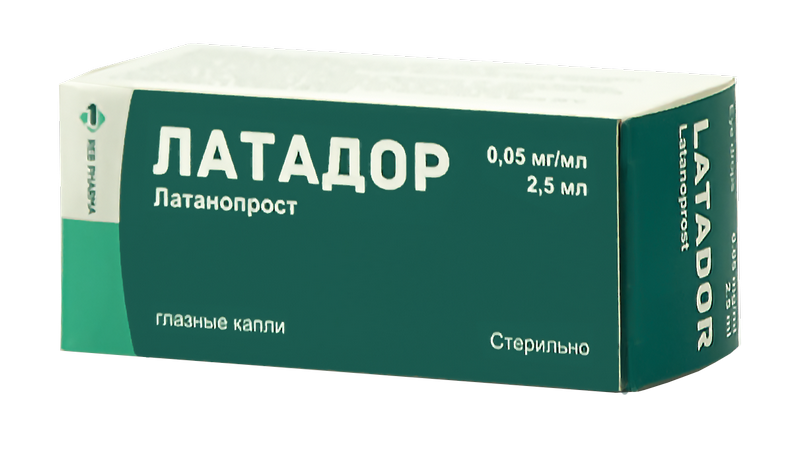
BRAND NAME:
Latador
INTERNATIONAL NONPROPRIETARY NAME:
Latanoprost
DRUG FORM:
Eye drops.
Description: Clear, colorless or almost colorless solution.
COMPOSITION:
1 ml of the drug contains:
Active substance: Latanoprost – 0.05 mg;
Excipients: disodium phosphate dodecahydrate, sodium dihydrogen phosphate dihydrate, benzalkonium chloride, sodium chloride, water for injection.
PHARMACOTHERAPEUTIC GROUP:
Medicines used in ophthalmology. Antiglaucoma drugs and myotics. Prostaglandin analogues.
ATC CODE: S01EE01
PHARMACOLOGICAL PROPERTIES:
PHARMACODYNAMICS:
Latanoprost – the drug’s active substance is a prostaglandin F2α analogue and a selective agonist of FP prostanoid receptors. Latanoprost reduces intraocular pressure by increasing aqueous humour outflow, mainly by uveoscleral route and trabecular network. The decrease in intraocular pressure starts in about 3-4 hours after administration with the maximum effect observed in 8-12 hours; intraocular pressure reduction is maintained for at least 24 hours.
Latanoprost does not significantly affect aqueous humour secretion and does not affect the blood-ophthalmic barrier.
In a short-term treatment Latanoprost does not cause leakage of fluorescin into the eye posterior segment in case of pseudophakia.
When used in therapeutic doses, Latanoprost does not demonstrate a significant pharmacological effect on cardiovascular and respiratory systems.
PHARMACOKINETICS:
Absorption
Latanoprost is a prodrug. It penetrates well through the cornea changing into a biologically active by hydrolysis. Aqueous humour maximal concentration is reached in about 2 hours after topical application.
Distribution
It is distributed primarily in the anterior segment of the eye, in conjunctiva and eyelids. Only a small amount of the drug reaches the eye posterior cavity.
Excretion
Latanoprost acid is rapidly excreted from plasma when applied topically (half-life is 17 minutes).
INDICATIONS FOR USE:
Increased ocular pressure (IOP) reduction in patients with open-angle glaucoma and increased ophthalmotonus.
IOP reduction in children with ocular hypertension and glaucoma.
CONTRAINDICATIONS:
Hypersensitivity to the drug components.
SIDE EFFECT:
Eye disorders: increased pigmentation of the iris, conjunctival hyperemia, mild to moderate eye irritation (burning sensation, sand sensation in the eye, itching, foreign body sensation in the eye), changes in eyelashes and vellus hair (length, thickness increase, eyelash pigmentation and quantity increase), point epithelial erosion, blepharitis and pain in the eye.
Skin and subcutaneous tissue disorders: skin rash, allergic reactions on the eyelids, eyelid skin darkening.
In case of adverse reactions including not indicated in instructions for use, it is necessary to discontinue the drug and consult a doctor.
DOSAGE AND ADMINISTRATION:
Latador is indicated for topical use only.
Adult patients: 1 drop into the affected eye(s) once a day. The optimal effect is achieved when applied in the evening. Latador should be used not more often than once a day, as more frequent use may decrease the intraocular pressure (IOP) lowering effect. If one dose is missed, the next dose should be continued as normal.
When several local ophthalmic agents are prescribed, an interval between instillations should be at least 5 minutes.
Contact lenses should be removed prior to eye drops administration and may be reinserted 15 minutes after instillation.
Children: Latador eye drops can be used in children in the same dose as in adults. Data on drug administration in premature infants (at gestational age less than 36 weeks) are not available. Data in the age group up to 1 year old is limited (4 patients).
Elderly patients do not need to adjust the dosage regimen.
Compliance with the following recommendations will be useful for the drug instillation:
• Wash hands thoroughly before using the eye drops.
• Tilt your head back.
• Gently pull the lower eyelid down with your finger and look up.
• Hold the dropper tip close to the eye, but do not touch it.
• Gently press the dropper base down to make one drop. Do not squeeze the dropper as it is designed in such a way that a slight pressure on the base is enough.
• Place one drop into the space between the eyelid and the eyeball.
• Close the eye and gently press with your finger on the lower edge of the eyelid, closer to the nose. Hold your finger in this position for 1 minute.
• Close the dropper with a cap immediately after use.
PRECAUTIONARY MEASURES:
This medicine contains benzalkonium chloride which can be adsorbed on contact lenses, changing their colour.
Latador may cause a gradual increase in brown pigment contained in the iris. Patients should be informed of the eye color change possibility prior to the treatment. Patients used the eye drops to treat only one eye may develop heterochromia.
Latanoprost can cause gradual changes in eyelashes and vellus hair. Changes are reversible and disappear after the treatment discontinuation.
Associated with the use of Latanoprost, cases of eyelid skin darkening which may be reversible have been registered.
Data on drug safety and efficacy in children under 1 year old is very limited. Data on premature babies are not available.
In children aged 0 to 3 years suffering mainly from PVG (primary congenital glaucoma), surgery remains the primary way of treatment.
EFFECT ON ABILITY TO DRIVE AND OPERATE MACHINERY:
In case of patient’s vision clarity temporarily decreases followed by drug application, it is not recommended to drive and perform some activities required high concentration until it is restored.
USE IN PREGNANCY AND LACTATION:
The safety of Latanoprost in pregnancy has not been established. An adverse effect on pregnancy, fetus development and a newborn is possible. The drug is contraindicated in pregnancy.
Latanoprost and its metabolites can pass into breast milk, thus it is contraindicated for use in breastfeeding women. In case of necessity to use Latanoprost during the lactation period, breastfeeding should be discontinued.
INTERACTION WITH OTHER DRUGS:
Combined use of two or more prostaglandins and their analogues in cases of increased IOP mentioned above is not recommended.
The study of drugs interaction was conducted only in adults.
Latanoprost is incompatible with eye drops contained Thiomersal (precipitate formation is possible).
STORAGE CONDITIONS:
Store in a dark place at a temperature ranged from 2°C to 8°C.
Keep out of the reach of children!
SHELF LIFE:
Shelf life is 3 years. Not to be used after the expiration date.
Opened dropper with the drug should be stored at a temperature not above 25°C and used within 28 days.
PRESCRIPTION STATUS
By prescription
Manufacturer Information
Foreign production and trade unitary enterprise “Reb-Pharma”, 223216, Republic of Belarus, Minsk region, Chervensky district, Smilovichi, Sadovaya st., 1, tel./fax: (+375) 17 240 26 35,
e-mail: rebpharma@rebpharma.by, http://www.rebpharma.by
Comment type is not specified in the component properties.