


BRAND NAME:
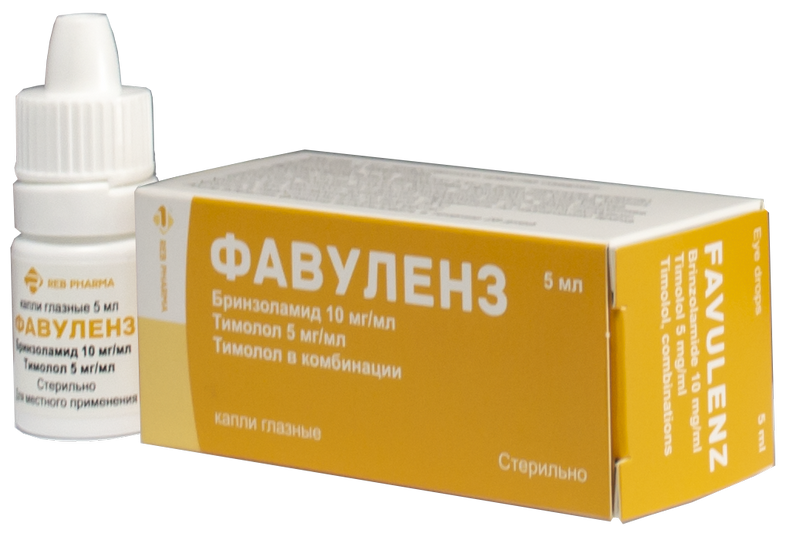
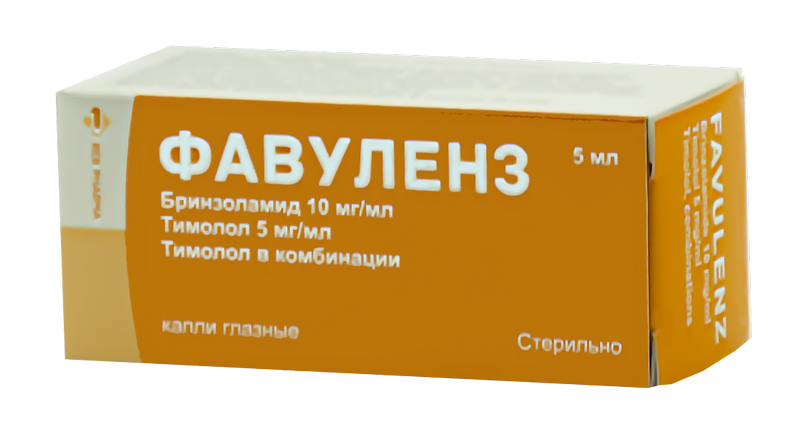
Favulenz
INTERNATIONAL NOPROPRIETARY NAME:
Timolol, combinations
DRUG FORM:
Eye drops
Description: White to off-white suspension
COMPOSITION:
1 ml of suspension contains:
Active substance: 10 mg Brinzolamide and 5 mg Timolol (as Timolol maleate).
Excipients: 40, disodium edetate, sodium chloride, benzalkonium chloride, hydrochloric acid or sodium hydroxide, water for injection.
PHARMACOTHERAPEUTIC GROUP:
Ophtalmologicals, Antiglaucoma preparations and miotics
ATC Code: S01ED51
PHARMACOLOGICAL PROPERTIES:
PHARMACODYNAMICS:
Favulenz contains two active substances: Brinzolamide and Timolol maleate. These two components decrease elevated IOP primarily by reducing aqueous humour secretion, but do so by different mechanisms of action. The combined effect of these two active substances results in additional IOP reduction compared to either compound alone.
Brinzolamide is an antiglaucoma agent of sulfanilamide structure, an inhibitor of carbonic anhydrase II for topical use.
Carbonic anhydrase is an enzyme that presents in many body tissues, including the eye. Carbonic anhydrase is a catalyst of reversible reaction that includes carbon dioxide hydration and carbonic acid dehydration. Inhibition of carbonic anhydrase in the ciliary body of the eye decreases aqueous humour secretion (presumably by slowing the formation of bicarbonate ions with subsequent reduction in sodium and fluid transport). As a result, there is a decrease in intraocular pressure, which reduces the risk of to the optic nerve damage and loss of visual fields.
Timolol is a non-selective β-adrenergic blocking agent that has no intrinsic sympathomimetic, direct myocardial depressant or membrane-stabilizing activity. Timolol reduces intraocular pressure by reducing aqueous humour formation and a slight increase in outflow facility.
PHARMACOKINETICS:
Following topical ocular administration, Brinzolamide and Timolol are absorbed into the systemic blood circulation.
Brinzolamide accumulates in red blood cells due to selective binding to carbonic anhydrase II and to a lesser extent – carbonic anhydrase I. Its active metabolite N-desethylbrinzolamide binds mainly to carbonic anhydrase I and also accumulates in red blood cells (RBCs). Brinzolamide and N-desethylbrinzolamide plasma concentration is low, binding to plasma proteins is about 60%.
At steady state Timolol is found in human plasma within 12 hours after drug instillation. Timolol slightly binds to plasma proteins.
INDICATIONS FOR USE:
Decrease of intraocular pressure (IOP) in adult patients with ocular hypertension, open-angle 5glaucoma for whom monotherapy provides insufficient IOP reduction.
CONTRAINDICATIONS:
- Hypersensitivity to the active substances or to any of the excipients;
- Hypersensitivity to other β-blockers;
- Hypersensitivity to sulfonamides;
- Reactive respiratory disease including bronchial asthma or a history of bronchial asthma, severe chronic obstructive pulmonary disease;
- Sinus bradycardia, sick sinus syndrome, sino-atrial block, second or third degree atrioventricular block not controlled with pacemaker, overt heart failure, cardiogenic shock;
- Severe allergic rhinitis;
- Hyperchloremic acidosis;
- Severe renal impairment (creatinine clearance <30 ml / min).
SIDE EFFECT:
From the nervous system: dysgeusia
From the side of the organ of vision: blurred vision, eye pain, eye irritation
From the vessels: lowering blood pressure
Laboratory and instrumental data: infrequently - hyperkalemia, an increase in the level of lactate dehydrogenase in the blood.
SIDE EFFECTS:
Nervous system disorders: dysgeusia
Eye disorders: blurred vision, pain in the eye, eye irritation
Blood vessels disorders: blood pressure decrease
Laboratory and instrumental data: not often - hyperkalemia, increased plasma lactate dehydrogenase levels.
POSOLOGY AND THE METHOD OF ADMINISTRATION:
For topical administration
Shake well before use!
Use in adults, including the elderly
One drop of Favulenz is instilled into the conjunctival sac of the affected eye(s) twice a day.
When substituting another ophthalmic medicinal product with Favulenz, the interval between instillations should be at least 5 minutes. Eye ointments should be used last. If a dose is missed, therapy should be continued with the next dose as planned.
With nasolacrimal occlusion or closure of the eyelids within 2 minutes, systemic absorption decreases. This can lead to increased local activity and reduced risk of systemic side effects.
Use in patients with hepatic and renal failure
No dosage adjustment is necessary in patients with hepatic impairment or in patients with mild to moderate renal impairment. In patients with severe hepatic insufficiency the drug should be used with caution. Since brinzolamide and its main metabolite are excreted mainly by the kidneys, the drug is contraindicated in patients with severe renal failure (creatinine clearance <30 ml/min).
PRECAUTIONARY MEASURES:
Brinzolamide and timolol are absorbed systemically. Due to the beta-adrenergic blocking component, timolol, the same types of cardiovascular, pulmonary and other adverse reactions seen with systemic beta-adrenergic blocking agents may occur. Due to brinzolamide used in topical application, unwanted adverse reactions characteristic of sulfonamides may occur.
Patients with cardiovascular diseases (for example, coronary heart disease, Prinzmetal angina and heart failure) and during antihypertensive therapy using β-blockers should be carefully assessed and the therapy with other active substances should be considered. Such patients should be monitored for signs of deterioration of cardiovascular disease and of adverse reactions.
Due to its negative effect on conduction time, beta-blockers should only be given with caution to patients with first degree heart block.
Patients with severe peripheral circulatory disturbance/disorders (i.e. severe forms of Raynaud’s disease or Raynaud’s syndrome) should be treated with caution.
Beta-blockers may also mask the signs of hyperthyroidism.
Beta-blockers should be administered with caution in patients subject to spontaneous hypoglycemia or to patients with labile diabetes, as beta-blockers may mask the signs and symptoms of acute hypoglycemia.
This medicinal product should be used with caution in patients with risk of renal impairment because of the possible risk of metabolic acidosis. If signs of serious reactions or hypersensitivity occur, discontinue the use of Favulenz.
Favulenz should be used with caution in patients with severe hepatic impairment.
While taking beta-blockers, patients with a history of atopy or a history of severe anaphylactic reaction to a variety of allergens may be more reactive to repeated challenge with such allergens and unresponsive to the usual doses of epinephrine used to treat anaphylactic reactions.
Before surgery the anesthetist should be informed when the patient is receiving Favulenz, as it can block the effect of β-agonists, for example, epinephrine.
The effect on intra-ocular pressure or the known effects of systemic beta-blockade may be potentiated when timolol is given to the patients already receiving a systemic beta-blocking agent. The response of these patients should be closely observed. There is potential for an additive effect on the known systemic effects of carbonic anhydrase inhibition in patients receiving an oral carbonic anhydrase inhibitor and Favulenz. The use of two topical beta-adrenergic blocking agents or two local carbonic anhydrase inhibitors is not recommended.
When treating patients with pseudoexfoliative glaucoma or pigmentary glaucoma, caution should be exercised and it is recommended to constantly monitor the level of intraocular pressure.
Studies on Favulenz effect in patients with angle-closure glaucoma have not been conducted and its use in such patient group is not recommended.
Favulenz can be prescribed to patients wearing contact lenses provided that they are closely monitored, since carbonic anhydrase inhibitors can affect corneal hydration and contact lenses might increase the risk of cornea metabolic disorders.
Favulenz contains benzalkonium chloride which can irritate the mucous membrane of the eye and is known to discolour soft contact lenses. Contact with soft contact lenses should be avoided. Patients should be instructed to remove contact lenses before application of Favulenz and wear and reinsert them no earlier than in 15 minutes later.
INTERACTION WITH OTHER DRUGS:
Concomitant use with oral carbonic anhydrase inhibitors is not recommended, as there is a possibility of increased systemic adverse reactions.
High-dose salicylates increase the risk of systemic adverse reactions.
CYP3A4 inhibitors such as ketoconazole, itraconazole, clotrimazole, ritonavir and troleandomycin are expected to inhibit Brinzolamide metabolism associated with CYP3A4 isoenzyme. Caution should be exercised with concomitant use of CYP3A4 inhibitors. However, accumulation of Brinzolamide is unlikely as it is mainly excreted by the kidneys.
With the combined use of ophthalmic β-blockers and calcium channel blockers, systemic β-blockers, antiarrhythmic drugs (including amiodarone), digitalis glycosides, parasympathomimetics or guanethidine, there is the possibility of an additive effect leading to hypotension and / or severe bradycardia.
Beta-blockers can decrease the response to adrenaline, used to treat anaphylactic shock. Special caution should be exercised in patients with a history of atopy or anaphylaxis.
In case of concomitant use of ophthalmic β-blockers and epinephrine mydriasis may occur.
The hypertensive reaction to sudden withdrawal of clonidine can be potentiated when taking β-blockers.
Potentiated systemic effect of β-blockade (e.g. reduced heart rate, depression) has been reported in combined treatment with CYP2D6 inhibitors (e.g., quinidine, fluoxetine, paroxetine) and timolol.
Beta-blockers may increase the hypoglycemic effect of antidiabetic drugs and mask the signs and symptoms of hypoglycemia.
EFFECT ON ABILITY TO DRIVE AND OPERATE MACHINERY
Favulenz has minor influence on the ability to drive and operate machinery.
Temporary blurred vision and other visual impairments may affect the ability to drive or operate machinery, therefore, if such situation occurs, the patient must wait until the vision clears before driving or operating any equipment.
Oral carbonic anhydrase inhibitors may impair the ability to perform tasks requiring mental alertness and/or physical coordination. Such an effect may occur with topical application caused by systemic absorption of Brinzolamide.
USE IN PREGNANCY AND LACTATION
There are no data on the use of Brinzolamide and Timolol combination in pregnant women. Favulenz should not be used during pregnancy unless clearly necessary. If the drug is prescribed in pregnancy, the neonate should be carefully monitored during the first days of life due to possible manifestations of β-blockers, e.g. bradycardia, hypotension, respiratory distress and hypoglycemia.
The decision to stop breastfeeding or to discontinue/abstain from Favulenz therapy should be made taking into account the ratio of the benefits of breastfeeding for the child and the benefit of therapy for the woman.
PEDIATRIC USE:
Favulenz effectiveness and safety in infants, children and adolescents aged 0 to 18 years have not been established, therefore Favulenz administration in these patient groups is not recommended.
INTERACTION WITH OTHER MEDICINES:
Concomitant use with oral carbonic anhydrase inhibitors is not recommended, since there is a possibility of increased systemic adverse reactions.
High-dose salicylates increase the risk of systemic adverse reactions.
Combined use of ophthalmic β-blockers and calcium channel blockers, systemic β-blockers, antiarrhythmic drugs (including amiodarone), digitalis glycosides, parasympathomimetics or guanethidine may cause an additive effect resulting in hypotension and/or severe bradycardia.
Beta-blockers can decrease the response to adrenaline used to treat anaphylactic shock. Special caution should be exercised in patients with a history of atopy or anaphylaxis.
Concomitant use of ophthalmic β-blockers and epinephrine may cause mydriasis.
Beta-blockers may increase hypoglycemic effect of antidiabetic drugs and mask the signs and symptoms of hypoglycemia.
STORAGE AND SHELF LIFE
Store at a temperature not above 25°C.
Opened vials must be used within 28 days.
2 years from the production date. Keep out of reach of children!
PRESCRIPTION STATUS
By prescription
Manufacturer Information
Foreign production and trade unitary enterprise “Reb-Pharma”, 223216, Republic of Belarus, Minsk region, Chervensky district, Smilovichi, Sadovaya st., 1, tel./fax: (+375) 17 240 26 35,
e-mail: rebpharma@rebpharma.by, http://www.rebpharma.by
Comment type is not specified in the component properties.