


BRAND NAME:
Pirrocet
INTERNATIONAL NONPROPRIETARY NAME
Levetiracetam
DRUG FORM: film-coated tablets
Description:
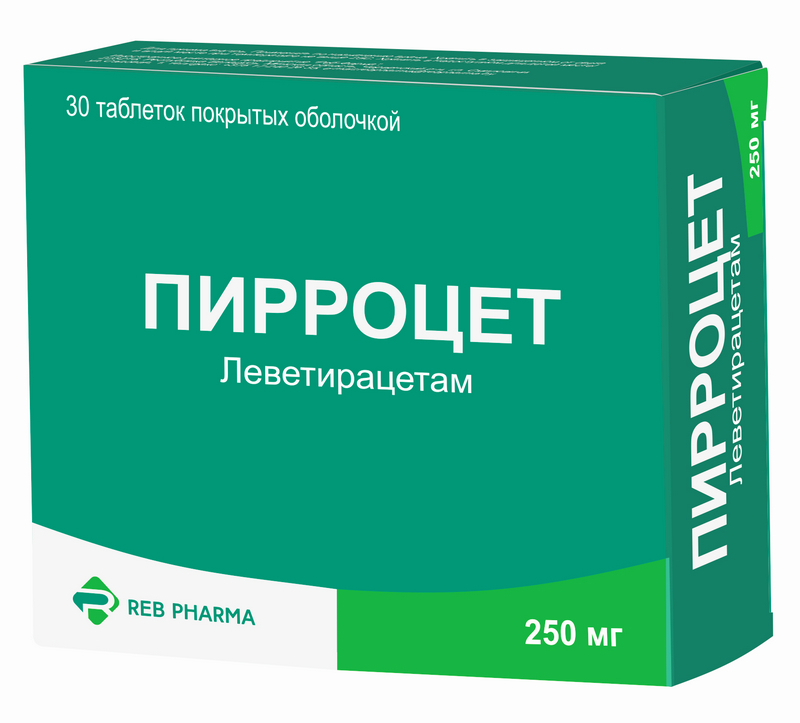
Pirrocet 250 mg: oval biconvex blue colour film coated tablets, scored on one side.
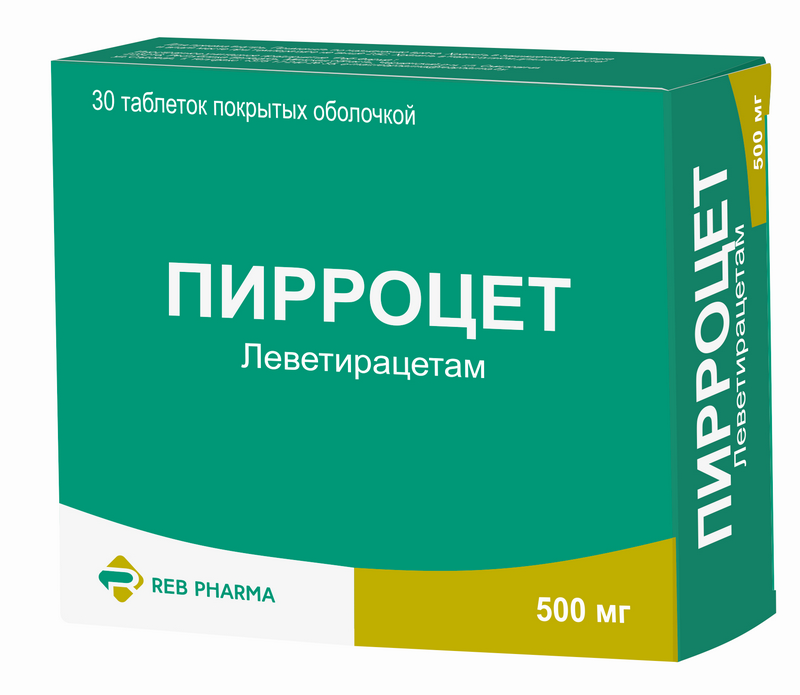
Pirrocet 500 mg: oval biconvex blue colour film coated tablets, scored on one side.
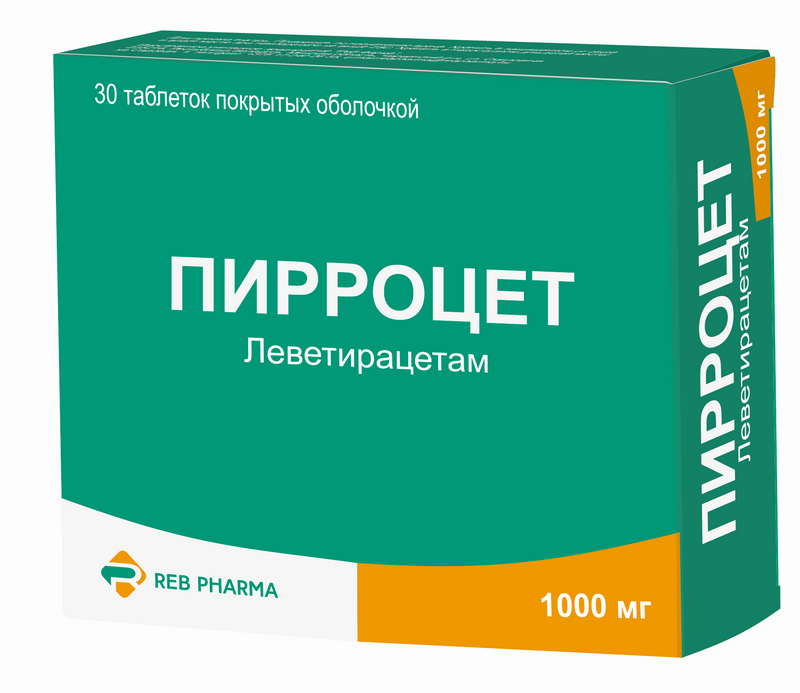
Pirrocet 1000 mg: oval biconvex blue colour film coated tablets, scored on one side.
COMPOSITION:
1 film-coated tablet contains:
Active ingredients: – levetiracetam 250mg, 500 mg, 1000 mg.
PHARMACOTHERAPEUTIC CATEGORY:
Other antiepileptic drugs
ATC code: N03AX14.
PHARMACOLOGICAL PROPERTIES
PHARMACODYNAMICS:
Levetiracetam – an active substance of Pirrocet, pyrrolidone derivative. One of the proposed mechanisms is based on the proven binding capacity of synaptic vesicles SV2A to glycoprotein contained in the gray matter of the brain and spinal cord. It is believed that anticonvulsant effect is realized in this way by expression of counteracting hypersynchronization of neural activity. Levetiracetam also takes effect on GABA receptors and glycine receptors, modulating these receptors through various endogenous agents. It does not alter neurotransmission but suppresses epileptiform neuronal bursts induced by GABA agonist bicuculline and excitation of glutamate receptors. The drug activity is confirmed for both focal and generalized epileptic seizures treatment.
PHARMACOKINETICS:
After oral administration levetiracetam is well absorbed from the gastrointestinal tract. Absorption takes place completely. The level of absorption does not depend on dose and time of food intake. Bioavailability is approximately 100%. Maximum plasma concentration is achieved in 1.3 hours after oral administration of 1000 mg levetiracetam. The steady state is reached in 2 days of the drug double dose intake. In children maximum concentration is achieved in 0.5-1 hours.
Levetiracetam and its main metabolite binding to plasma proteins is less than 10%.
The drug plasma half-life in adult patients is 7 ± 1 hrs. and does not depend on the route of administration and dosage regimen. In elderly patients the half-life is 10-11 hours which is associated with impaired renal function in this category of patients. Elimination period in children after a single oral dose intake – 20 mg/kg body weight is 5-6 hours.
INDICATIONS FOR USE:
As a monotherapy (first-choice drug) in treatment of:
- partial seizures with or without secondary generalization in adults and adolescents over 16 years with newly diagnosed epilepsy.
As a part of complex therapy in treatment of:
- partial seizures with or without secondary generalization in adults and children over 6 years suffering from epilepsy;
- myoclonic seizures in adults and adolescents over 12 years suffering from juvenile myoclonic epilepsy;
- primary generalized convulsive (tonic-clonic) seizures in adults and adolescents over 12 years , suffering from idiopathic generalized epilepsy.
CONTRAINDICATIONS:
- Hypersensitivity to levetiracetam or other pyrrolidone derivatives as well as to any drug component.
SIDE EFFECT:
Infectious and parasitic diseases: rhinopharyngitis.
Nervous system disorders: drowsiness, headache.
Mental disorders: depression, hostility/aggression, anxiety, insomnia, nervousness/irritability.
Metabolic and nutritional disorders: often – anorexia.
DOSAGE AND ADMINISTRATION:
Pirrocet should be taken orally, with or without food, with a sufficient amount of fluids. Daily dose should be taken in two portions.
If the patient forgot to take Pirrocet tablet, it should be taken as soon as possible, before the next dose intake time. If the next dose time has come do not double it to make up for the missed one. From this point the drug should be taken according to the recommended dosage regimen.
As a monotherapy
Adults and adolescents over 16 years: the recommended initial dose of 250 mg twice a day after two weeks should be increased to an initial therapeutic dose of 500 mg twice a day. In the future the dose can be increased by 250 mg twice a day every two weeks depending on the clinical response. Maximum dose is 1500 mg twice a day.
Adjunctive therapy
Adults (18 years and older) and adolescents (12 to 17 years old) with a body weight of 50 kg or more: the initial therapeutic dose is 500 mg twice a day. It is possible to start with this dose on the first day of treatment. Depending on the clinical response and tolerance the daily dose may be increased to 1500 mg twice a day. Dose adjustment can be performed by increasing or decreasing by 500 mg twice a day every two to four weeks period.
Drug withdrawal
According to this clinical practice, in case of necessity to stop taking levetiracetam it is recommended to stop it gradually (for example, for adults: a decrease of 500 mg twice a day every two to four weeks; for children and adolescents with body weight under 50 kg – the dose should not be reduced by more than10 mg/kg twice a day every two weeks period).
Children and adolescents under 18
The doctor should prescribe the most acceptable dosage form with concentration in accordance with body weight and recommended dosage regimens.
Solid drug forms are not recommended for use in children under 6 years. In addition, tablets: 250 mg, 500 mg, 750 mg and 1000 mg cannot provide adequate dosage of levetiracetam in children with a body weight under 25 kg and in children unable to swallow tablets. In these cases it is recommended to use a solution for oral administration.
Monotherapy: levetiracetam effectiveness and safety as a monotherapy in children and adolescents under 16 years has not been established.
Additional therapy in children aged 6-11 years and adolescents aged 12-17 years with a body weight less than 50 kg: for children aged 6 years and older an oral solution should be prescribed if the dose is less than 250 mg, or the dose is not a multiple of 250 mg, i.e. not achievable by taking a few tablets of 250 mg, or if the patient cannot swallow the tablet. The smallest drug dose should be used. The initial dose for children and adolescents with a body weight of 25 kg is 250 mg twice a day. Maximum drug dose is 750 mg twice a day.
For children with body weight 50 kg or more the dosage should be the same as for adults.
PRECAUTIONARY MEASURES:
The drug should be prescribed with caution to elderly patients (over 65 years) with liver diseases at decompensation stage and with renal failure.
Impaired renal function
Patients with kidney disease and decompensated liver disease are recommended to perform kidney function test before starting the treatment. In case of impaired renal function dose adjustment may be required.
Drug withdrawal
When requested to stop taking the drug it is recommended to stop the treatment gradually. In adults and adolescents with a body weight more than 50 kg a single dose should be reduced by 500 mg every 2-4 weeks. In children and adolescents with body weight less than 50 kg dose reduction should not exceed 10 mg/kg body weight and the drug is to be taken 2 times a day every 2 weeks.
Concomitant antiepileptic drugs (during patients’ treatment with levetiracetam) should preferably be withdrawn gradually. Available information on the drug use in children does not indicate any negative effect on development and puberty.
EFFECT ON ABILITY TO DRIVE AND OPERATE MACHINERY:
The drug effect on ability to drive and operate machinery has not been specifically studied. However, due to different individual sensitivity of the central nervous system to the drug during the treatment period, it is necessary to avoid driving and to be involved into potentially dangerous activities required an increased concentration and psychomotor reactions.
PREGNANCY AND LACTATION:
The drug should not be prescribed in women at reproductive age who do not use effective contraception during pregnancy, except cases of obvious necessity.
As with other antiepileptic drugs physiological changes during pregnancy can affect levetiracetam level. The decrease in levetiracetam plasma concentration during pregnancy has been reported. This decrease is most observed in the third trimester (up to 60% of the initial concentration before pregnancy). Appropriate clinical observation of pregnant women taking levetiracetam should be established. Antiepileptic therapy discontinuation may lead to disease exacerbation which can be harmful to the mother and fetus.
Levetiracetam is excreted into the breast milk, thus breastfeeding is not recommended during the treatment. However, if treatment with levetiracetam in breastfeeding period is necessary, the treatment benefit/risk ratio should be evaluated taking into account the importance of breastfeeding.
PEDIATRIC USE:
Pirrocet coated tablets are not prescribed in children under 6 years old. It is recommended to use oral levetiracetam solution in this group of patients.
INTERACTION WITH OTHER MEDICINES:
The drug does not interact with antiepileptic drugs (phenytoin, carbamazepine, valproic acid, phenobarbital, lamotrigine, gabapentin and primidone).
As in adults there is no evidence of clinically significant drug interactions in pediatric patients receiving up to 60 mg/kg/day of levetiracetam.
Daily dose of 1000 mg levetiracetam does not alter pharmacokinetics of oral contraceptives (ethinyl estradiol and levonorgestrel). Daily dose of levetiracetam 2000 mg does not change the digoxin and warfarin pharmacokinetics. Digoxin, oral contraceptives and warfarin do not affect levetiracetam pharmacokinetics.
When taking probenecid 500 mg four times a day the decrease of the main metabolite clearance (but not levetiracetam) have been observed. However the concentration of this metabolite was low.
Simultaneous administration of levetiracetam and methotrexate may lead to methotrexate clearance decrease, following an increase in its plasma concentration to potentially toxic levels. Therefore careful monitoring of methotrexate and levetiracetam plasma level in patients taking these drugs combination is necessary.
There are separate reports of levetiracetam effectiveness decrease in concomitant oral use of osmotic laxative macrogol with levetiracetam. Therefore, macrogol should not be taken orally one hour before and after levetiracetam intake.
Levetiracetam absorption capacity does not change when taken with food, while the rate of absorption slightly decreases.
There are no data on levetiracetam interaction with alcohol.
STORAGE CONDITIONS:
Store at a temperature not exceeding 25 °C
Keep out of the reach of children!
SHELF LIFE:
Shelf life – 3 years from the production date. Not to be used after an expiration date.
PRESCRIPTION STATUS:
By prescription
* For more information see the patient information leaflet.
Manufacturer Information
Foreign production and trade unitary enterprise “Reb-Pharma”, 223216, Republic of Belarus, Minsk region, Chervensky district, Smilovichi, Sadovaya st., 1, tel./fax: (+375) 17 240 26 35,
e-mail: rebpharma@rebpharma.by, http://www.rebpharma.by
Comment type is not specified in the component properties.