


- acute and recovery period of ischemic and hemorrhagic strokes;
- acute and recovery period of traumatic brain injury;
- cognitive disorders associated with stroke and traumatic brain injury.
BRAND NAME:
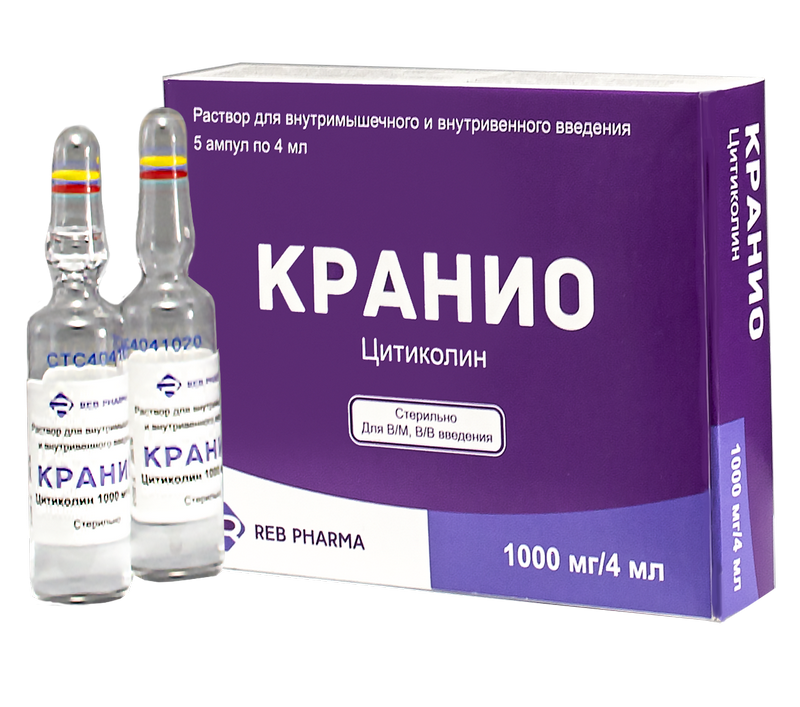
Kranio
INTERNATIONAL NONPROPRIETARY NAME:
Citicoline
DRUG FORM:
Solution for intravenous and intramuscular injections 500 mg/4 ml and 1000 mg/4 ml.
Description: clear, colorless or slightly yellow colour solution.
COMPOSITION:
1 ampule with the drug dose 500 mg contains:
Active substance: citicoline (in a form of sodium citicoline 522.52 mg) – 500.00 mg;
Excipients: hydrochloric acid 1M or sodium hydroxide 1M, water for injection.
1 ampule with the drug dose 1000 mg contains:
Active substance: citicoline (in a form of sodium citicoline 1045.04 mg) – 1000.00 mg;
Excipients: hydrochloric acid 1M or sodium hydroxide 1M, water for injection.
THERAPEUTIC GROUP:
Other psychostimulants and nootropics.
ATC code: N06BX06
PHARMACOLOGICAL PROPERTIES:
PHARMACODYNAMICS:
Citicoline stimulates biosynthesis of structural phospholipids of neurons membrane and, due to this effect improves the function of ion-exchange pumps and receptors involved in this process, which modulation is necessary for nerve signals transmission.
Due to its ability to stabilize membranes citicoline promotes reabsorption of cerebral edema.
Citicoline preserves neuronal energy reserve, inhibits apoptosis and stimulates acetylcholine synthesis.
It has been experimentally confirmed that citicoline also possesses prophylactic neuroprotective effect on models of focal cerebral ischemia.
Clinical studies have confirmed that citicoline significantly improves functional activity in patients with acute ischemic stroke which correlates with decrease in ischemic brain damage demonstrated in neuroimaging tests.
In patients with traumatic brain injuries citicoline accelerates the recovery process and reduces the duration and severity of post-traumatic coma.
Citicoline increases the level of attention and consciousness and demonstrates a beneficial effect in amnesia, as well as in cognitive and neurological disorders associated with cerebral ischemia.
PHARMACOKINETICS:
Absorption
Citicoline is well absorbed by intravenous and intramuscular administration.
Distribution
Citicoline is well distributed in brain structures with rapid integration of choline fractions into structural phospholipids and cytidine fractions – into cytidine nucleotides and nucleic acids. Citicoline penetrates into the brain and actively integrates into cellular, cytoplasmic and mitochondrial membranes, forming a fractional part of structural phospholipids.
Metabolism
At intravenous and intramuscular administration citicoline undergoes metabolism in the intestine and in the liver with choline and cytidine formation. Plasma choline concentration after its intake increases significantly.
Excretion
Only 15% of the consumed citicoline dose is excreted from the body: less than 3% - with urine and feces and about 12% with exhaled CO2.
INDICATIONS FOR USE:
- acute and recovery period of ischemic and hemorrhagic strokes;
- acute and recovery period of traumatic brain injury;
- cognitive disorders associated with stroke and traumatic brain injury.
CONTRINDICATIONS:
- повышенная чувствительность к компонентам лекарственного средства;
- ваготония (преобладание тонус парасимпатической части вегетативной нервной системы).
- Hypersensitivity to the drug components;
- vagotonia (predominant parasympathetic tone of the vegetative nervous system).
SIDE EFFECTS:
Very rare (<1/10 000):
Mental disorders: hallucinations.
Nervous system disorders: headache, dizziness.
Cardiovascular system disorders: arterial hypertension, arterial hypotension.
Digestive system disorders: nausea, vomiting, sometimes diarrhea.
Skin and soft tissues disorders: hyperemia, urticaria, exanthema, purpura.
Respiratory, thoracic and mediastinum-related disorders: dyspnea.
General disorders and the injection site conditions: chills, edema.
In case of these side effects or reactions not mentioned in instruction consult the doctor.
DOSAGE AND ADMINISTRATION:
Cranio is administered intramuscularly (i/m) and intravenously (i/v). I/v drug administration should be performed slowly (in 3 to 5 minutes, depending on the dose) or by dripping (40-60 drops per minute). Therapy duration is determined by the doctor.
In case of intramuscular drug administration the same place of injection should be avoided.
Adult patients: 500 mg to 2000 mg per day, depending on symptoms severity.
Elderly patients: dose adjustment is not required.
Patients with liver and (or) kidney function impaired: dose adjustment is not required.
Children under 18 years: due to the lack of sufficient data the drug is not recommended for use in children under 18 years.
The drug solution is for single use only! Injection should be done immediately upon the opening of ampoules!
Cranio is compatible with isotonic saline and glucose solution.
PRECAUTIONARY MEASURES:
The drug solution is for single use only! Injection should be done immediately upon the opening of ampoules!
Cranio is compatible with isotonic saline and glucose solution.
I/v drug administration should be performed slowly (in 3 to 5 minutes, depending on the dose) with a dripping rate 40-60 drops per minute.
In case of ongoing intracranial bleeding, it is prohibited to exceed 1000 mg daily dose of citicoline which should be injected very slowly (30 drops per minute).
Use in pregnancy and lactation
Cranio should not be prescribed in pregnancy unless it is absolutely necessary. The drug may be used only in case when the expected benefit to the mother outweighs the potential risk to the fetus.
When necessary to prescribe the drug during lactation, breast-feeding should be stopped, since there is no data on citicoline excretion into breast milk.
Pediatric use
There is insufficient data on the drug efficacy and safety in children and adolescents.
EFFECT ON ABILITY TO DRIVE AND USE MACHINERY:
In some cases certain adverse reactions of central nervous system may affect the ability to drive and use machinery.
USE IN PREGNANCY AND LACTATION:
Cranio should not be prescribed in pregnancy unless it is absolutely necessary. The drug may be used only in case when the expected benefit to the mother outweighs the potential risk to the fetus.
When necessary to prescribe the drug during lactation, breast-feeding should be stopped, since there is no data on citicoline excretion into breast milk.
INTERECTIONS WITH OTHER DRUGS:
Citicoline enhances levodopa effects.
The drug should not be prescribed together with medicines containing meclofenoxate.
STORAGE CONDITION:
Store at the temperature not higher than 25°С.
Keep out of reach of children!
SHELF-LIFE:
Shelf life is 5 years.
Do not use after an expiry date indicated on the pack.
PRESCRIPTION STATUS:
By prescription
Manufacturer Information
Foreign production and trade unitary enterprise “Reb-Pharma”, 223216, Republic of Belarus, Minsk region, Chervensky district, Smilovichi, Sadovaya st., 1, tel./fax: (+375) 17 240 26 35,
e-mail: rebpharma@rebpharma.by, http://www.rebpharma.by
Comment type is not specified in the component properties.