


Indications for use:
- dissolution of gallbladder cholesterol stones. Cholesterol stones should not look like blackouts on X-ray photograph and should not exceed 15 mm in diameter. Despite the stones presented the gallbladder function should not be impaired;
- treatment of gastritis with a bile reflux;
- symptomatic treatment of primary biliary cirrhosis (PBC) without decompensation signs.
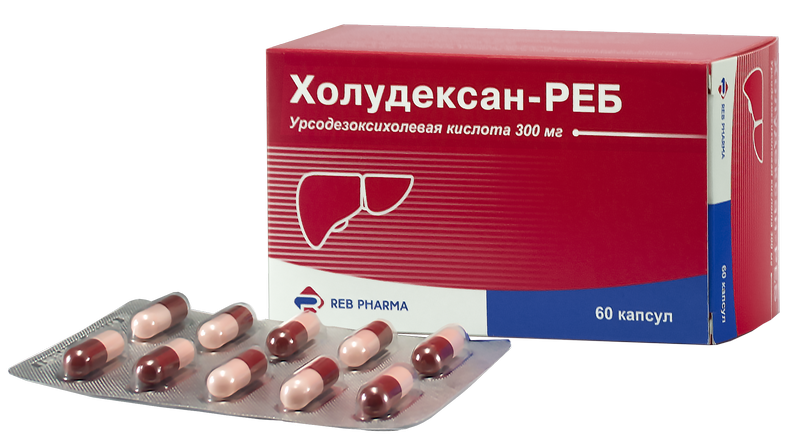
Brand name: Choludexan-reb
International nonproprietary name: Ursodeoxycholic acid
Drug form: capsules
Composition:
One capsule contains:
Active substance: ursodeoxycholic acid 300 mg.
Excipients: corn starch, silicon dioxide colloidal anhydrous, magnesium stearate, purified water.
Capsule shell composition: titanium dioxide (E171), iron oxide red (E172), gelatin.
Pharmacotherapeutic group: Drugs for the treatment of liver and biliary tract disease. Bile acids medicines.
ATC code: А05АА02.
Pharmacological properties
Pharmacodynamics
A small amount of ursodeoxycholic acid is found in human bile. Following oral administration the drug reduces bile saturation with cholesterol by inhibiting cholesterol absorption in the intestine and reducing cholesterol secretion in bile. Presumably, as a result of cholesterol dispersion and formation of liquid crystals gradual dissolution of cholesterol stones occur. According to general knowledge the effect of ursodeoxycholic acid on liver and cholestatic diseases is achieved by an equal exchange of lipophilic, detergent-like toxic bile acids to hydrophilic, cytoprotective, non-toxic ursodeoxycholic acid leading to an improvement in hepatocytes secretory function and immunoregulatory processes.
Ursodeoxycholic acid possesses the direct cytoprotective membrane-stabilizing effect on hepatocytes, cholangiocytes and epithelial cells of the GIT. It forms double molecules that interact with lipophilic membrane structures, integrate with the cell membranes and stabilize them. It protects liver cells and bile duct cells from damaging factors and makes them immune to cytotoxic micelles.
It also possesses an immunomodulatory activity, reduces the severity of immunopathological reactions in the liver by reducing the expression of histocompatibility antigens HLA-1 on hepatocytes and HLA-2 on bile duct cells and reducing the exposure to immunoglobulins (primarily IgM). It reduces the number of cytotoxic T lymphocytes.
By stimulating exocytosis in hepatocytes during cholestasis by activation of a Ca2 + -dependent α-protein kinase ursodeoxycholic acid reduces concentration of bile acids toxic to hepatocytes and induces choleresis with a high content of bicarbonates which leads to an increase in bile passage.
By reducing cholesterol synthesis in the liver as well as its absorption in the intestine, ursodeoxycholic acid reduces the bile lithogenicity, reduces the cholate-cholesterol index (lithogenicity index), helps to dissolve cholesterol stones and prevents formation of new ones.
For successful dissolution of gallstones one condition is necessary – the stones should be composed from cholesterol only, their size should not exceed 15-20 mm, and the gallbladder (filled with stones by no more than half in volume) and bile ducts should retain their function completely.
Ursodeoxycholic acid significantly delays the progression of fibrosis in patients with primary biliary cirrhosis, cystic fibrosis and alcoholic steatohepatitis. It reduces the risk of esophageal varicose veins dilatation.
Regulates apoptosis processes (aging and cells death) that are impaired by liver and other organ pathologies. Ursodeoxycholic acid inhibits the growth of colon cancer cells.
Pharmacokinetics
Following the drug intake ursodeoxycholic acid undergoes absorption in the small intestine by passive diffusion and in the ileum by active transport. Maximum plasma concentration is reached within 30-60 minutes after intake with the level of adsorption of 60-80%.
At regular intake ursodeoxycholic acid becomes the main bile acid of the blood plasma, at about 48% of the total amount of bile acids in the blood.
Ursodeoxycholic acid is excreted mainly with feces. When used at high doses the level of ursodeoxycholic acid excretion in urine increases, although this value remains insignificant (less than 1%), with an exception in case of severe cholestatic lesions in the liver. The half-life of ursodeoxycholic acid is 3.5 – 5.8 days.
Indications to use
- dissolution of gallbladder cholesterol stones. Cholesterol stones should not look like blackouts in an X-ray photograph and should not exceed 15 mm in diameter. Despite the stones presentation the gallbladder function should not be impaired;
- treatment of gastritis with a bile reflux;
- symptomatic treatment of primary biliary cirrhosis (PBC) without decompensation features.
Dosage and Administration
The capsule should be taken orally at once, without chewing with a sufficient amount of liquid (with food or a light snack).
There is no age restriction for taking Choludexan-Reb capsules in a dosage of 300 mg, but for patients with weight less than 47 kg or who have difficulty in swallowing it is recommended to administer ursodeoxycholic acid in a form of oral suspension.
For cholesterol gallstones dissolution – approximately 10 mg of ursodeoxycholic acid/kg body weight is recommended.
Capsules should be swallowed in a whole, with water, 1 time per day in the evening before bedtime. Capsules should be taken regularly.
The time required to dissolve gallstones is usually 6-24 months. If a decrease in size of bile stones is not observed in 12 months of therapy it should not be continued.
Treatment result should be checked every 6 months using ultrasound or X-ray examination. With the help of additional studies, it is necessary to check whether the stones calcification took place over the time. In case of calcification the treatment should be discontinued.
Gastritis with a bile reflux – 300 mg of the drug should be taken at bedtime. The course of treatment is usually 10-14 days. The duration of treatment depends on the patient's condition. The doctor must decide on the treatment duration in each case individually.
In symptomatic treatment of primary biliary cirrhosis (PBC) the daily dose depends on body weight and is determined based on 14 ± 2 mg of ursodeoxycholic acid per kg of the body weight.
Use in elderly: there is no data on dose adjustment in people of this age group. However, precautions should be taken during the treatment.
Children: despite the fact that there are no fundamental age restrictions for the use of ursodeoxycholic acid, capsules are not recommended to use in children with the weigh under 47 kg and / or at age under 6 years due to possible difficulty in swallowing. If the child weighs less than 47 kg or has difficulty in swallowing it is recommended to use ursodeoxycholic acid in a form of suspension.
Side effect
The side effects frequency parameters used below are defined as follows: very often (≥1/10), often (from ≥1/100 to <1/10), infrequently (from ≥1/1000 to <1/100), rarely (from ≥1/10000 to <1/1000), very rarely (<1/10000).
Gastrointestinal tract disorders: in clinical trial reports cases of doughy stool or diarrhea are very common.
During the treatment of primary biliary cirrhosis severe abdominal pain on the right side observed very rarely.
Liver and biliary tract disorders: during the treatment with ursodeoxycholic acid stones calcification observed very rarely.
During the treatment in the late stages of primary biliary cirrhosis decompensation of liver cirrhosis disappeared after the drug withdrawal, observed very rarely.
Hypersensitivity reactions: in very rare cases an allergic rash (urticaria) may occur.
Contraindications
- hypersensitivity to the active substance or other ingredients of the drug composition;
- X-ray positive (with high calcium contain) gallstones;
- non-functioning gall bladder;
- obstruction of the bile ducts, frequent biliary colic;
- acute inflammatory diseases of the gallbladder, bile ducts and intestines;
- liver cirrhosis in a decompensation stage;
- severe hepatic and / or renal failure;
- pancreatitis;
- first trimester of pregnancy;
- children under 6 years.
Precautionary measures
Before starting the treatment female patients should make sure that they are not pregnant. Choludexan-Reb administration should be carried out under the doctor supervision.
Pregnancy and lactation
The drug is contraindicated in the first trimester of pregnancy. The drug administration in the II and III trimesters of pregnancy is possible only if the benefit to the mother exceeds the potential risk to the fetus (adequate strictly controlled studies of ursodeoxycholic acid use in pregnant women have not been conducted).
Data on ursodeoxycholic acid excretion into the breast milk are currently not available. In case of necessity to prescribe the drug during lactation it should be decided to stop the breastfeeding. The decision on Choludexan-Reb should be made by the doctor.
Pediatric Use
Due to the fact that Holudexan Rebvy is available in a form of 300 mg capsules, it is not to be used in children under 6 years (less than 20 kg of body weight).
Overdose
In case of overdose diarrhea can be observed. In general case an overdose is unlikely, since the absorption of ursodeoxycholic acid decreases with the dose increase, and it is mainly excreted with the feces.
Условия хранения и срок годности
Store at the temperature not higher than 25°С.
Keep out of the reach of children!
3 years from the date of production. Do not use after the expiration date.
Packaging
On 10 capsules in a blister made of PVC / PVDC and flexible packaging with aluminum foil base. 2, 4 or 6 blisters together with a leaflet in a cardboard pack.
Manufacturer information
Foreign production and trade unitary enterprise “Reb-Pharma”, 223216, Republic of Belarus, Minsk region, Chervensky district, Smilovichi, Sadovaya st., 1, tel./fax: (+375) 17 240 26 35,
e-mail: rebpharma@rebpharma.by, http://www.rebpharma.by
Comment type is not specified in the component properties.