
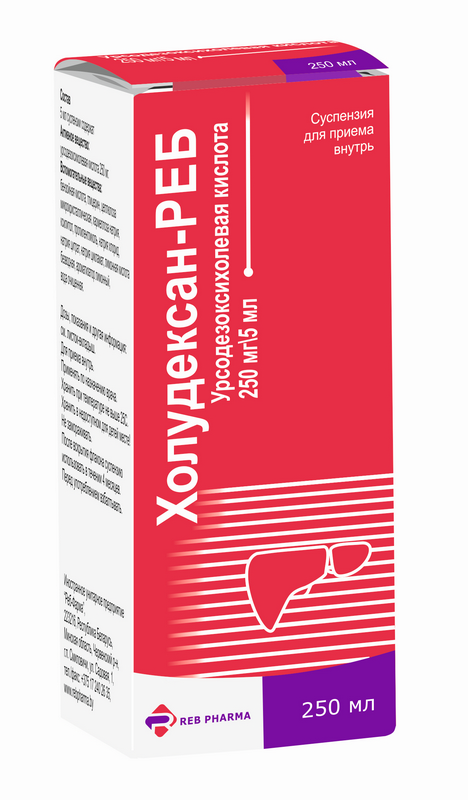
Brand name: Choludexan-reb
International nonproprietary name: Ursodeoxycholic acid (UDCA)
Drug form: Oral suspension 250 mg/5 ml.
Composition:
5 ml of the drug product contains:
Active substance: ursodeoxycholic acid 250 mg.
Excipients: Benzoic acid, glycerin, microcrystalline cellulose, sodium carmellose, xylitol, propylene glycol, sodium chloride, sodium citrate, sodium cyclamate, citric acid anhydrous, "Lemon" flavoring (maltodextrin, flavoring agent, gum arabic (E414), silicon dioxide (E551), alpha-tocopherol (E307)), purified water.
Pharmacotherapeutic group: Drug products for the treatment of liver and biliary tract diseases. Bile acids drug product.
ATC code: А05АА02.
Pharmacological properties
Pharmacodynamics
Ursodeoxycholic acid possesses a direct cytoprotective membrane-stabilizing effect on hepatocytes, cholangiocytes and epitheliocytes presented in the gastrointestinal tract. Presumably there is a gradual dissolution of cholesterol stones as a result of cholesterol dispersion and liquid crystals formation.
It is generally accepted that the effect of ursodeoxycholic acid on liver disease and cholestatic disease is achieved by equal metabolism of lipophilic, detergent-like toxic bile acids, resulting in improved hepatocyte secretory capacity and immunoregulatory processes.
Pediatric use:
Cystic fibrosis
According to clinical reports of long-term ursodeoxycholic acid administration (up to 10 years and above) the treatment of pediatric patients suffering from cystic fibrosis associated with hepatobiliary diseases is possible. It was proved that ursodeoxycholic acid therapy can help in reduction of bile duct proliferation, stop progression of histologic lesions, and even promote regression of hepatobiliary changes in case the drug product was administered at the early stage of disease. In order to optimize the treatment efficiency, ursodeoxycholic acid should be administered as soon as cystic fibrosis (associated with hepatobiliary disease) is diagnosed.
Pharmacokinetics
After oral administration ursodeoxycholic acid is rapidly absorbed in the jejunum and proximal ileum by passive diffusion and then in the distal ileum by active transport mechanism. About 60-80% of the ingested volume is absorbed. After absorption in the liver ursodeoxycholic acid is almost completely conjugated with glycine and taurine and then excreted with the bile. At first stage of passing through the liver up to 60% of UDCA is metabolized.
Depending on the daily dose, type of disease and liver condition, more or less amount of ursodeoxycholic acid accumulates in the bile. At the same time there is a relative decrease in content of other, more lipophilic bile acids.
Ursodeoxycholic acid is partially broken down by intestinal bacteria to form 7-keto-lithocholic acid and lithocholic acid. Lithocholic acid is hepatotoxic; in some animal species causes damage to the liver parenchyma. In the human body it is absorbed in small amounts only. During the process of metabolism it is sulfated in the liver thus neutralized before excretion into the bile, then eliminated from the body with feces.
The half-life of ursodeoxycholic acid is 3.5 to 5.8 days.
Indications to use
Treatment of primary biliary cirrhosis (PBC) in patients without decompensated cirrhosis
Cholesterol stones dissolution. These stones must be radiopaque (invisible on plain radiographs) and not above 15 mm in diameter. Despite the stones presented in the gallbladder its function should be preserved;
Children and adolescents:
For the treatment of hepatobiliary diseases associated with cystic fibrosis in children 1 month – 18 years old.
Dosage and Administration
There are no age restrictions for Choludexan-Reb administration.
Shake the bottle before use. A measuring cup or a measuring syringe is used for dosing.
The following daily dose is recommended for various indications:
For cholesterol stones dissolution
About 10 mg of ursodeoxycholic acid per body weight (kg) per day which corresponds to:
|
Body weight, kg |
Corresponding amount, ml |
|
5-7 |
1.25 |
|
8-12 |
2.50 |
|
13-18 |
3.75 |
|
19-25 |
5.00 |
|
26-35 |
7.50 |
|
36-50 |
10.00 |
|
51-65 |
12.50 |
|
66-80 |
15.00 |
|
81-100 |
20.00 |
|
Above 100 |
25.00 |
Choludexan-Reb should be taken in the evening before going to bed. It should be taken on a regularly basis.
As a rule, treatment duration for gallstones dissolution is 6-24 months. If the stone size does not decrease in 12 months of treatment, the drug intake should be discontinued. Every 6 months the success of treatment should be monitored by sonography or radiology methods. At subsequent examinations, attention should be paid whether stones calcification has occurred during this period of time. If this has happened, the drug administration should be stopped.
For the treatment of biliary liver cirrhosis
The daily dose depends on body weight and is 14 ± 2 mg ursodeoxycholic acid/kg body.
In the first 3 months of treatment with the drug product, the daily dose should be divided into several doses. After improvement of laboratory parameters (liver tests), the drug product can be taken once a day, in the evening:
|
Body weight, kg |
Corresponding amount, ml |
|||
|
First 3 months of treatment |
Further on |
|||
|
Morning |
Day time |
Evening |
Evening (once a day) |
|
|
8-11 |
- |
1.25 |
1.25 |
2.5 |
|
12-15 |
1.25 |
1.25 |
1.25 |
3.75 |
|
16-19 |
2.5 |
- |
2.5 |
5 |
|
20-23 |
1.25 |
2.5 |
2.5 |
6.25 |
|
24-27 |
2.5 |
2.5 |
2.5 |
7.5 |
|
28-31 |
1.25 |
2.5 |
5 |
8.75 |
|
32-39 |
2.5 |
2.5 |
5 |
10 |
|
40-47 |
2.5 |
5 |
5 |
12.5 |
|
48-62 |
5 |
5 |
5 |
15 |
|
63-80 |
5 |
5 |
10 |
20 |
|
81-95 |
5 |
10 |
10 |
25 |
|
96-115 |
10 |
10 |
10 |
30 |
|
Above 115 |
10 |
10 |
15 |
35 |
Correspondence of measured suspension volume and ursodeoxycholic acid concentration:
|
Oral suspension |
Ursodeoxycholic acid |
|
35 ml |
1 750 mg |
|
30 ml |
1 500 mg |
|
25 ml |
1 250 mg |
|
20 ml |
1 000 mg |
|
15 ml |
750 mg |
|
12.5 ml |
625 mg |
|
10 ml |
500 mg |
|
8.75 ml |
437.5 mg |
|
7.5 ml |
375 mg |
|
6.25 ml |
312.5 mg |
|
5 ml |
250 mg |
|
3.75 ml |
187.5 mg |
|
2.5 ml |
125 mg |
|
1.25 ml |
62.5 mg |
The drug product should be taken according to the schedule of administration stated above. It is necessary to take the drug product regularly. Drug product administration in case of liver cirrhosis can be unlimited in time duration. In rare cases in patients suffered from liver cirrhosis clinical symptoms may worsen at the beginning of the treatment, for example, there might be an increase in intensity of itching sensation (pruritus). In such case the treatment should be continued with a reduced daily dose at the beginning, and then gradually increased dose (increase the daily dose weekly) until the prescribed dosage regimen is achieved.
Children and adolescents:
Children with cystic fibrosis – 1 month to 18 years old:
For children with cystic fibrosis aged 1 month to 18 years old, the daily dose is 20 mg/kg divided by 2-3 with subsequent increase to 30 mg/kg/day as needed.
Children with body weight less than 10 kg are very rarely affected. In this case, commercially available disposable syringes should be used.
Special precautions for use in children
Single doses for children with a body weight less than 10 kg should be taken with a syringe from the measuring cup provided. For this purpose, a syringe for single use with a volume of 2 ml with a scale graduation of 0.1 ml is used. Disposable syringes are not provided in the package, but are always available in pharmacies.
In order to administer the required dose using the syringe, the following steps should be followed:
1. Shake the glass bottle before opening.
2. Then pour a small amount of suspension into the measuring cup.
3. Pour a little more suspension into the syringe than it is necessary.
4. Press the syringe piston with your finger to remove air bubbles from the syringe.
5. Check the volume of suspension in the syringe and adjust if necessary.
6. Carefully inject the contents of the syringe directly into the child's mouth.
Do not take the drug with the syringe directly from the bottle. Do not return unused suspension from the measuring cup or syringe back into the bottle.
For children with body weight less than 10 kg: 20 mg ursodeoxycholic acid/kg/day.
Measuring device: disposable syringe
|
Body weight, kg |
Choludexan-Reb 250 mg/5 ml suspension, ml |
|
|
Morning |
Evening |
|
|
4 |
0.8 |
0.8 |
|
4.5 |
0.9 |
0.9 |
|
5 |
1.0 |
1.0 |
|
5.5 |
1.1 |
1.1 |
|
6 |
1.2 |
1.2 |
|
6.5 |
1.3 |
1.3 |
|
7 |
1.4 |
1.4 |
|
7.5 |
1.5 |
1.5 |
|
8 |
1.6 |
1.6 |
|
8.5 |
1.7 |
1.7 |
|
9 |
1.8 |
1.8 |
|
9.5 |
1.9 |
1.9 |
|
10 |
2.0 |
2.0 |
For body weight above 10 kg: 20-25 mg of ursodeoxycholic acid/kg/day
Measuring devices: beaker and syringe from the package.
|
Body weight, kg |
Daily dose of ursodeoxycholic acid, mg/kg body weight |
Choludexan-Reb 250 mg/5 ml suspension, ml |
|||
|
Morning |
Daytime |
||||
|
Per ml |
Dosing |
Per 1 ml |
Dosing |
||
|
11-12 |
21-23 |
2.5 ml |
with a syringe provided |
2.5 ml |
with a syringe provided |
|
13-15 |
21-24 |
2.5 ml |
with a syringe provided |
3.75 ml |
with a syringe provided |
|
16-18 |
21-23 |
3.75 ml |
with a syringe provided |
3.75 ml |
with a syringe provided |
|
19-21 |
21-23 |
3.75 ml |
with a syringe provided |
5 ml |
with a syringe provided |
|
22-23 |
22-23 |
5 ml |
with a syringe provided |
5 ml |
with a syringe provided |
|
24-26 |
22-23 |
5 ml |
with a syringe provided |
6.25 ml |
with a syringe provided (filled + 1.25 ml) |
|
27-29 |
22-23 |
6.25 ml |
with a syringe provided (filled + 1.25 ml) |
6.25 ml |
with a syringe provided (filled + 1.25 ml) |
|
30-32 |
21-23 |
6.25 ml |
with a syringe provided (filled + 1.25 ml) |
7.5 ml |
dosing cup provided |
|
33-35 |
21-23 |
7.5 ml |
dosing cup provided |
7.5 ml |
dosing cup provided |
|
36-38 |
21-23 |
7.5 ml |
dosing cup provided |
8.75 ml |
with a syringe provided (filled + 3.75 ml) |
|
39-41 |
21-22 |
8.75 ml |
with a syringe provided (filled + 3.75 ml) |
8.75 ml |
with a syringe provided (filled + 3.75 ml) |
|
42-47 |
20-22 |
8.75 ml |
with a syringe provided (filled + 3.75 ml) |
10 ml |
dosing cup provided |
|
48-56 |
20-23 |
10.25 ml |
7.5 ml in a cup + 3.75 ml in a syringe provided |
10.25 ml |
7.5 ml in a cup + 3.75 ml in a syringe provided |
|
57-68 |
20-24 |
13.75 ml |
12.5 ml in a cup + 1.25 ml in a syringe provided |
13.75 ml |
12.5 ml in a cup + 1.25 ml in a syringe provided |
|
69-81 |
20-24 |
16.25 ml |
15 ml in a cup + 1.25 ml in a syringe provided |
16.25 ml |
15 ml in a cup + 1.25 ml in a syringe provided |
|
82-100 |
20-24 |
20 ml |
dosing cup provided |
20 ml |
dosing cup provided |
|
>100 |
21.25 ml |
20 ml in a cup + 1.25 ml in a syringe provided |
21.25 ml |
20 ml in a cup + 1.25 ml in a syringe provided |
|
Contraindications
The drug product should not be prescribed for treatment of patients with:
- acute inflammation of the gallbladder and biliary tract
- biliary tract obstruction (common bile duct or bladder duct)
- frequent biliary colic
- radiopaque, calcified gallstones
- impaired ability of the gallbladder to contract; hypersensitivity to bile acids or any of the excipients listed in section 6.1.
Children and adolescents:
- failed hepaticoenterostomy or failure to restore normal bile flow in children with biliary atresia
Side effect
The parameters used below for side effects frequency determination are defined as follows: very frequent (≥1/10), frequent (≥1/100, but <1/10); infrequent (≥1/1000, but <1/100); rare (≥1/10000, but < 1/1000); very rare (<1/10000)
Gastrointestinal tract: often - pasty stools, diarrhea; very rare - severe right-sided abdominal pain during the treatment of primary biliary cirrhosis (PBC).
Liver and biliary tract: very rare - stones calcification, decompensation of liver cirrhosis during the treatment of PBC at late stages which disappears after drug withdrawal.
Skin and subcutaneous tissues disorders: very rare – urticaria.
Precautionary measures
The drug product contains sodium, which should be taken into account in patients on sodium diet (5 ml of suspension contains 0.50 mmol (11.39 mg) of sodium).
Choludexan-Reb administration hould be carried out under the doctor supervision. Liver function tests ACT (SGOT), ALT (SGPT) and γ-GT should be monitored every 4 weeks during the first three months of treatment and then every 3 months thereafter. Besides detectability of patients responded and not responded to the treatment, this monitoring will help to early detection of potential liver function disease, especially in patients at the late stage of primary biliary cirrhosis.
When used to dissolve cholesterol gallstones
In order to assess progress in treatment and for timely detection of signs of stone calcification, depending on the size of stones, the gallbladder should be visualized (oral cholecystography) with obscuration examination in standing and supine position (ultrasound) 6-10 months after the beginning of treatment.
If the gallbladder cannot be visualized by X-rays in cases of stones calcification, weak contractility of the gallbladder or frequent attacks of colic, the drug product Choludexan-Reb should not be used.
Women who take Choludexan-Reb for stones dissolution should use non-hormonal methods of contraception, because hormonal contraceptives may promote gallstone formation.
Treatment of patients at advanced stages of primary biliary cirrhosis
Decompensation of liver cirrhosis was extremely rare. After therapy discontinuation partial reversal of decompensation manifestations was observed.
In patients with primary biliary cirrhosis in rare cases clinical symptoms may worsen at the beginning of the treatment, for example, intensity of itching (pruritus) may increase. In this case, the dose of Choludexan-Reb should be reduced to 250 mg a day and then gradually increased as described in the section "Administration and dosage".
In patients with diarrhea the drug dose should be reduced. In persistent diarrhea, the treatment should be discontinued.
Effect on the ability to drive and operate machinery
Choludexan-Reb does not affect the ability to drive a car and perform work requiring high speed psychomotor reactions.
Fertility, pregnancy and lactation
No effect of ursodeoxycholic acid on fertility has been shown in animal studies. No data are available for the ursodeoxycholic acid effect on fertility in humans following the treatment with ursodeoxycholic acid.
No or limited data are available on the use of ursodeoxycholic acid in pregnant women. Animal studies have shown reproductive toxicity in early pregnancy. The drug product Choludexan-Reb 250 mg/5 ml suspension should not be used during pregnancy unless absolutely necessary. Women of childbearing age (WCBA) can take the drug only if they use reliable contraception.
Non-hormonal contraceptives or low estrogen oral contraceptives are recommended. In patients taking the drug for gallstones dissolution, effective non-hormonal contraception should be used, as hormonal oral contraceptives may increase gallstones formation. The possibility of pregnancy should be excluded before treatment.
According to the data of few described cases of drug administration in breast-feeding women, ursodeoxycholic acid concentration in breast milk is very low, and probably adverse reactions in breast-fed infants are not expected.
Drug-to-drug interactions
The drug product Choludexan-Reb should not be used together with cholestyramine, cholestipol, antacids containing aluminum hydroxide and/or smectite (aluminum oxide), because these drugs bind with ursodeoxycholic acid in the intestinal tract and thus inhibit absorption and efficacy. In case of necessity to use the drug containing one of these substances, it should be taken at least 2 hours before or after taking Choludexan-Reb.
The drug Choludexan-Reb may affect the absorption of cyclosporine from the intestine. In patients receiving therapy with cyclosporine, blood concentrations of this substance should be monitored by a physician, and the dose of cyclosporine should be adjusted.
In some cases, the drug product Choludexan-Reb may reduce ciprofloxacin absorption.
In a clinical study with healthy volunteers, co-administration of ursodeoxycholic acid (500 mg/day) and rosuvastatin (20 mg/day) resulted in a slight increase in rosuvastatin plasma concentration. Clinical significance of this interaction and interactions with other statins is unknown.
It has been demonstrated that ursodeoxycholic acid may reduce peak plasma concentrations (Cmax) and area under the concentration-time curve (AUC) of calcium antagonist nitrendipine in healthy volunteers. Close monitoring is recommended in concomitant use of nitrendipine and ursodeoxycholic acid. Nitrendipine dose increase may be necessary. Drugs interactions resulted in decreased therapeutic efficacy of dapsone have also been reported.
These observations are consistent with in vitro results and may indicate the ability of ursodeoxycholic acid to induce enzymes of cytochrome P450 3A system. However, induction has not been observed in carefully designed interaction studies with budesonide, which is a well-known substrate of cytochrome P450 3A.
Drug products such as estrogenic hormones and hypocholesterolemic agents (such as clofibrates) increase cholesterol secretion in the liver and thus may promote gallstone formation, which is the opposite effect to ursodeoxycholic acid used for gallstones dissolution.
Overdose
In case of overdose, diarrhea may occur. In general, other symptoms of overdose are unlikely because ursodeoxycholic acid absorption decreases at the dose increase followed by its excretion with feces.
Special prophylactic measures are not required, and the effect of diarrhea should be treated symptomatically by restoring water-salt balance.
Additional information on special groups of population
Long-term therapy with high-dose ursodeoxycholic acid (28-30 mg/kg/day) in patients with primary sclerosing cholangitis (use outside the registered indications) was associated with a higher incidence of serious adverse effects.
Storage conditions and shelf life
Store at temperature not above 25°C
Keep out of reach of children! Do not freeze. After opening, the drug product in the bottle should be used in a 4 months period.
Shelf life is 3 years. Do not use after expiration date indicated on the package.
Prescription status
By prescription
Packaging
100 ml or 250 ml of the drug product in umber glass bottle with a polymeric screw cap with the first opening control ring. 1 bottle with an oral syringe and dosing cup together with an insert leaflet placed into a cardboard pack.
Manufacturer Information
Foreign production and trade unitary enterprise “Reb-Pharma”, 223216, Republic of Belarus, Minsk region, Chervensky district, Smilovichi, Sadovaya St., 1, tel./fax: (+375) 17 240 26 35,
e-mail: rebpharma@rebpharma.by, http://www.rebpharma.by
Comment type is not specified in the component properties.