
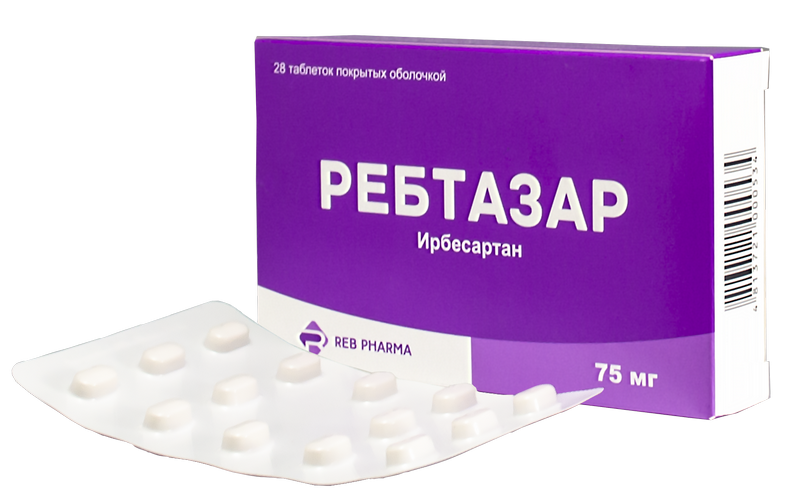

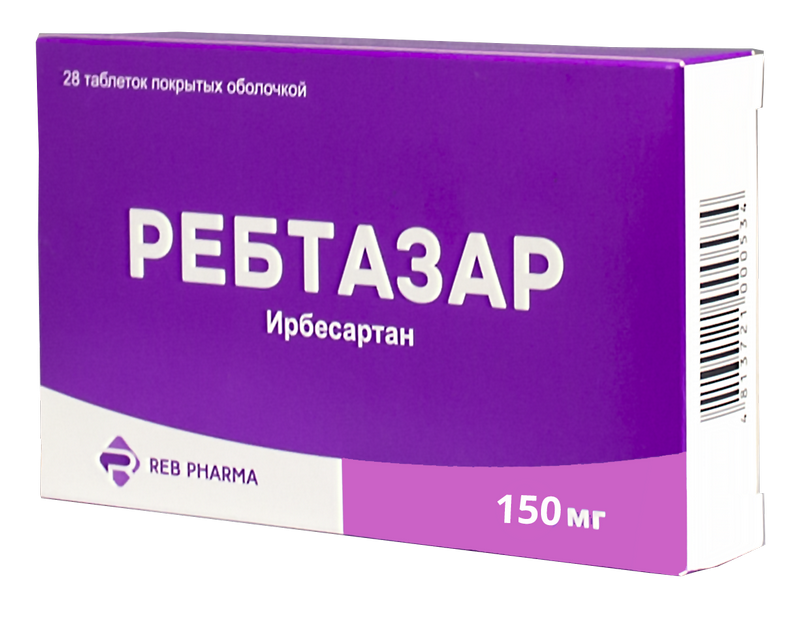
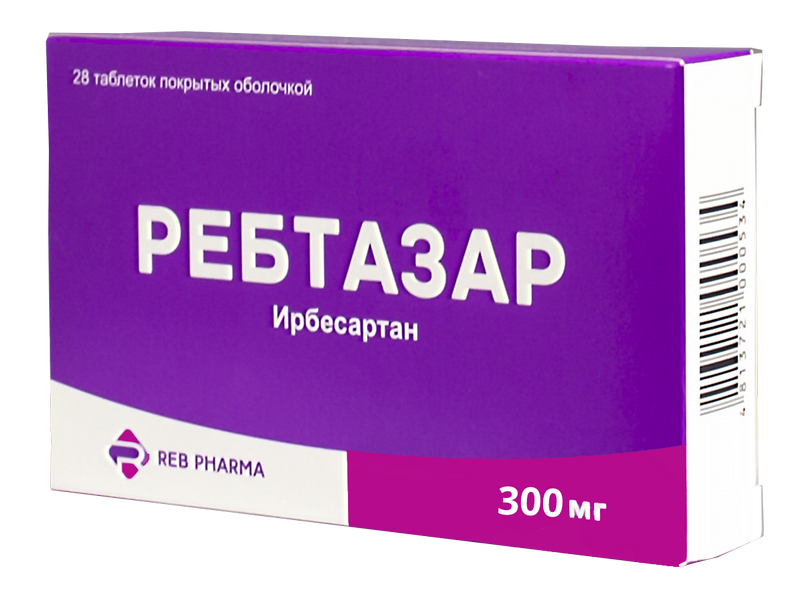


BRAND NAME: Rebtazar
INTERNATIONAL NONPROPRIETARY NAME: Irbesartan
COMPOSITION:
1 coated tablet contains:
Active ingredient: Irbesartan 75 mg, 150 mg, 300 mg.
Excipients: croscarmellose sodium, lactose monohydrate, magnesium stearate, microcrystalline cellulose type 102, corn starch partially pregelatinized 1500, poloxamer 188, anhydrous colloidal silicon dioxide, purified water, polyvinyl alcohol, polyethylene glycol, titanium dioxide and talc.
PHARMACOTHERAPEUTIC GROUP
Drugs affecting renin-angiotensin system. Angiotensin II Antagonists
ATC Code: C09CA04
PHARMACOLOGICAL PROPERTIES
PHARMACODYNAMICS
Rebtazar is an antihypertensive drug, the selective angiotensin II receptor antagonist (type AT1). It blocks all physiologically significant effects of angiotensin II realized through AT1 receptors, regardless the source or route of angiotensin II synthesis. The specific antagonistic effect on AT1 receptors results in increase in renin and angiotensin II plasma concentration and decrease in the aldosterone plasma concentration. When used in recommended doses, potassium ion concentration does not significantly change.
Rebtazar active component – Irbesartan does not inhibit kininase II (ACE), involved in angiotensin II formation and bradykinin destruction to inactive metabolites. Irbesartan does not require metabolic activation for its activity manifestation.
Irbesartan lowers blood pressure (BP) with a minimal change in heart rate (HR). When taken once a day at doses up to 300 mg the decrease in blood pressure is dose-dependent; however, with a further dose increase hypotensive effect potentiation is insignificant.
Maximal decrease in blood pressure is achieved in 3-6 hours after oral drug intake. Antihypertensive effect persists for at least 24 hours. When taken at recommended doses in 24 hours the decrease in blood pressure is 60-70% compared to maximal decrease in diastolic and systolic blood pressure on drug response. When taking once a day at the dose of 150-300 mg blood pressure reduction (systolic/diastolic) at the end of interdose interval (i.e. 24 hours after the drug intake) in a patient’s lying or sitting position at average was 8-13/5-8 mm Hg (respectively) more in comparison with placebo.
Intake of oral dose 150 mg once a day results in equal antihypertensive effect (lowering blood pressure before taking the next drug dose and an average decrease in blood pressure in 24 hours), as the same dose divided in 2 portions.
Rebtazar hypotensive effect develops within 1–2 weeks with maximal therapeutic effect achieved in 4-6 weeks from the treatment beginning. Antihypertensive effect persists through a long-term treatment. After treatment discontinuation blood pressure gradually returns to its initial value; withdrawal syndrome has not been observed. Irbesartan does not affect uric acid plasma concentration or uric acid excretion into the urine.
Rebtazar efficacy does not depend on age and gender.
PHARMACOKINETICS
Absorption
After oral administration the drug is well absorbed from the gastrointestinal tract (GIT). The maximal Irbesartan plasma concentration is achieved in 1.5-2 hours after ingestion. Absolute bioavailability is 60-80%. Simultaneous food intake does not significantly affect the drug bioavailability
Excretion
Total clearance and renal clearance are 157-176 ml/min and 3-3.5 ml/min, respectively. The final half-life (T1/2) is 11-15 hours. Irbesartan and its metabolites are excreted into the bile and urine. After ingestion of 14C-Irbesartan about 20% of radioactivity is detected in the urine and the rest – in the feces. Less than 2% of the administered dose is excreted into the urine in a form of unchanged Irbesartan.
Pharmacokinetics in special clinical cases
Slightly higher plasma concentrations of Irbesartan are observed in women (compare to men). However differences in Irbesartan T½ and accumulation have not been established. Irbesartan dose adjustment in women is not required. AUC and the maximum concentration of Irbesartan were slightly higher in elderly patients (≥ 65 years) than in young patients, however values of final T½ did not show significant differences.
In patients with impaired renal function or hemodialysis patients Irbesartan pharmacokinetics did not change significantly. Irbesatan is not excreted from the body by dialysis.
In patients with a mild to moderate severity liver cirrhosis the drug pharmacokinetic parameters do not change significantly. Pharmacokinetic studies in patients with severe hepatic insufficiency have not been performed.
INDICATIONS FOR USE
- essential arterial hypertension;
- nephropathy in patients with arterial hypertension and type 2 diabetes mellitus (as a part of combination antihypertensive therapy).
DOSAGE AND ADMINISTRATION
The drug should be taken orally. The tablet is swallowed whole with water.
Initial and maintenance dose is 150 mg once a day, with or without meal. This dose provides more optimal 24-hour BP control than the dose 75 mg per day. However in some cases, especially in hemodialysis patients or in patients above 75 years the initial dose should be 75 mg.
With insufficient therapeutic effect of Rebtazar 150 mg once a day the dose can be increased up to 300 mg or another antihypertensive drug should be prescribed. In particular it was shown that prescription of diuretic, e.g. hydrochlorothiazide enhances Rebtazar efficacy.
In patients with arterial hypertension and type II diabetes mellitus the treatment should start with the dose 150 mg once a day and gradually increase up to 300 mg – the preferred maintenance dose for nephropathy treatment.
In patients with water-electrolyte imbalance circulating blood volume of (CBV) and/or hyponatremia should be stabilized before taking the drug.
In patients with impaired renal function dose adjustment is not required. For patients on hemodialysis the initial dose should be 75 mg per day.
In patients with impaired liver function of mild to moderate severity no dose adjustment is required. There is no clinical experience on the drug administration in patients with severe liver function impairment.
Despite the fact that the initial recommended dose in patients over 75 years is 75 mg; usually dose adjustment is not required.
SIDE EFFECT
Side effect frequency parameters stated below are determined as follows:
very often (≥ 1/10);
often (≥ 1/100 to <1/10);
infrequently (≥ 1/1000 to <1/100);
rarely (≥1 / 10,000, <1/000);
very rare (<1/10000);
unknown frequency – cannot be calculated from the data available.
Immune system disorders: unknown frequency: hypersensitivity reactions such as angioedema, rash, urticaria.
Metabolic and nutritional disorders: frequency unknown: hyperkalemia.
Nervous system disorders: often: dizziness, orthostatic dizziness *; unknown frequency: vertigo, headache.
Ear and the vestibular labyrinth disorders: frequency unknown: tinnitus.
Heart disorders: infrequently: tachycardia.
Blood vessels disorders: often: orthostatic hypotension *; infrequently: hot flashes.
Respiratory, chest and mediastinum disorders: infrequently: cough.
Gastrointestinal Disorders: Often: nausea and/or vomiting; infrequently: diarrhea, dyspepsia/heartburn; frequency unknown: dysgeusia.
Hepatobiliary system disorders: infrequently: jaundice; frequency unknown: hepatitis and impaired liver function.
Skin and subcutaneous tissue disorders: frequency unknown: leukocytoclastic vasculitis.
Musculoskeletal system and connective tissue disorders: often: musculoskeletal pain*; frequency unknown: arthralgia, myalgia (in some cases associated with an increase in creatine kinase plasma concentration), muscle cramps.
Kidneys and urinary tract disorders: frequency unknown: impaired renal function, including renal failure in patients at risk.
Reproductive system and the mammary (mammary) glands: infrequently: sexual dysfunction.
General disorders and injection site condition: often: weakness; infrequently: chest pain.
Laboratory parameters: very often: hyperkalemia more common observed in patients with diabetes received Irbesartan than patients on placebo. In patients with diabetes mellitus with high blood pressure, microalbuminuria and normal renal function hyperkalemia (> 5.5% mmol/L) was observed in 29.4% of patients in 300 mg Irbesartan group and in 22% of patients in placebo group. In patients with diabetes mellitus and increased blood pressure, chronic renal failure and severe proteinuria hyperkalemia (> 5.5% mmol/L) was observed in 46.3% of patients in Irbesartan group and 26.3% of patients in placebo group.
Often: significant increase in plasma creatine kinase level was observed (1.7%) in patients received Irbesartan. None of these cases increase was accompanied with clinically proved musculoskeletal system disorders.
Clinically insignificant hemoglobin level decrease was observed in 1.7% of patients with elevated blood pressure and diabetic renal failure received Irbesartan.
Children population: in a randomized clinical trial, during 3-weeks double-blind phase, in 318 children and adolescents aged 6 to 16 years suffering from hypertension the following adverse reactions had been observed: headache (7.9%), hypotension ( 2.2%), dizziness (1.9%), cough (0.9%). During 26-weeks of the study open period the most frequent changes in laboratory parameters had been an increase in creatinine (6.5%) and creatinine clearance (2%) in the treated group.
CONTRAINDICATIONS
- Hypersensitivity to the components of the drug;
- hereditary galactose intolerance, lactase deficiency or malabsorption of glucose and galactose;
- pregnancy;
- lactation period;
- children and adolescents under 18 years (efficacy and safety not established). Concomitant use of Rebtazar with drugs containing Aliskiren in patients with diabetes mellitus or renal failure (if glomerular filtration rate (GFR) is <60 ml/min/1.73 m2 of body surface).
PRECAUTIONARY MEASURES
The drug contains lactose, so it should not be used in patients with rare hereditary diseases such as galactose intolerance, Lapp-lactase deficiency or glucose-galactose malabsorption.
Patients with sodium and/or fluid deficiency
In patients with significant sodium deficiency and/or reduced circulating blood volume, for example, due to large doses of diuretics intake, in rare cases at the beginning of Irbesartan therapy may develop hypotension with clinical manifestations, especially after taking the first dose. Before Rebtazar therapy these conditions should be controlled.
Renovascular hypertension
In patients with bilateral renal artery stenosis or renal artery stenosis with a single functional kidney therapy with drugs affected renin-aldosterone-angiotensin system is associated with an increased risk of severe hypotension and renal failure. Although Rebtazar did not have such effects they might be expected with any angiotensin II receptor antagonists.
Renal failure and kidney transplant
When Rebtazar therapy is administered in patients with impaired renal function, it is recommended to monitor serum potassium and creatinine level regularly. There is no experience with Rebtazar therapy in patients who have recently had kidney transplantation.
Patients with diabetes type 2, hypertension and kidney impairment
In a study analysis among patients with advanced kidney disease Irbesartan effects on both renal and cardiovascular conditions were different in various patient subgroups. Beneficial effect was less significant in women and colored races.
Double blockade of renin-angiotensin-aldosterone system
Double blockade of renin-angiotensin-aldosterone system (RAAS) (for example, in concomitant use of Irbesartan and Aliskiren) is not recommended due to an increased risk of hypotension, hyperkalemia and impaired renal function. Rebtazar in combination with Aliskiren is contraindicated in patients with diabetes mellitus or renal failure (GFR <60 ml/min/1.73 m2 of the body surface) (see sec. “Interactions with other drugs”).
Hyperkalemia
As with other drugs that affect the renin-angiotensin system, Rebtazar therapy may develop hyperkalemia, especially in kidney damage, severe proteinuria due to diabetic kidney disease and/or heart failure. In patients at risk of developing hyperkalemia it is recommended to monitor serum potassium level regularly.
Lithium preparations
Rebtazar is not recommended to be combined with lithium preparations.
Aortic and mitral valves stenosis, obstructive hypertrophic cardiomyopathy
As with other vasodilators, the drug should be used with extreme caution in patients with aortic or mitral valve stenosis or with a hypertrophic form of cardiomyopathy.
Primary hyperaldosteronism
In patients with primary hyperaldosteronism antihypertensive drugs which effect on the renin-angiotensin system are usually not effective. In this regard, Rebtazar is not recommended for primary hyperaldosteronism.
Common conditions
In patients with vascular tone depended mainly on renin-angiotensin-aldosterone system activity (for example, patients with severe congestive heart failure, kidney diseases, including renal artery stenosis) treatment with angiotensin converting enzyme inhibitors or angiotensin receptor antagonists is accompanied by acute hypotension, azotemia, oliguria and, in rare cases, acute renal failure. As with any antihypertensive drug, excessive decrease in blood pressure in patients with ischemic cardiomyopathy or coronary heart disease can lead to a heart attack or stroke.
Effect to ability to drive and operate machinery
Rebtazar effect on activities required high attention has not been studied; however, based on its pharmacodynamic features the drug should not affect this ability. When driving it should be taking into account that during the treatment dizziness and increased fatigue is possible.
USE IN PREGNANCY AND LACTATION
The drug is contraindicated in pregnancy and lactation.
PEDIATRIC USE
Due to the lack of data on drug safety and efficacy it is not recommended to prescribe it to children under18 years old.
OVERDOSE
Symptoms: the most likely significant decrease in blood pressure, tachycardia and bradycardia.
Treatment: in case of accidental high dose administration induced vomiting and/or gastric lavage, activated charcoal, symptomatic and supportive therapy is indicated. Hemodialysis is ineffective.
INTERACTION WITH OTHER DRUGS
Diuretics and other antihypertensive drugs
Concomitant use of Irbesartan with other antihypertensive drugs an increase in hypotensive effect is possible. Irbesartan has been used in combination with other antihypertensive drugs, such as ß-blockers, long-acting slow calcium channel blockers and thiazide diuretics.
Antihypertensive effects of Irbesartan and thiazide diuretics are additive in nature.
In patients with uncontrolled blood pressure during monotherapy with Irbesartan administration of hydrochlorothiazide (12.5 mg per knock) at low doses results in additional decrease (compared with the placebo effect) in blood pressure by 7-10/3-6 mm Hg (systolic/diastolic blood pressure at the end of interdose period).
Prior treatment with high dose diuretics may result in dehydration and an increased risk of arterial hypotension at the beginning of treatment with Rebtazar.
Potassium preparations and potassium-sparing diuretics, heparin
Based on experience obtained with other drugs affecting renin-angiotensin-aldosterone system, during potassium preparations administration electrolyte solutions contained potassium, potassium-sparing diuretics or other drugs that may increase plasma potassium concentration (heparin) an elevation in plasma potassium levels is possible.
Lithium
Reversible increase in lithium plasma concentration or toxicity was observed in concomitant use of lithium with ACE inhibitors. Till today, in therapy with Irbesartan such effects have been observed extremely rare. If there is a need to use this combination it is necessary to monitor lithium plasma concentration with care.
NSAIDs
Concomitant use of angiotensin II antagonists and NSAIDs (including selective COX-2 inhibitors, acetylsalicylic acid (> 3 g per day) and non-selective NSAIDs) may decrease the drug hypotensive effect.
Similar to ACE inhibitors and NSAIDs, concomitant use of angiotensin II antagonists and NSAIDs may increase the risk of impaired renal function, including the possibility of developing acute renal failure and increased potassium plasma levels, especially in patients with impaired kidneys function. This drugs combination should be used with caution, especially in elderly patients. Patients need to restore the circulating blood volume (CBV) and monitor renal function during this combination therapy and periodically after its completion.
Additional information on Irbesartan interactions
With the simultaneous use of Irbesartan with hydrochlorothiazide Irbesartan pharmacokinetics does not change.
Irbesartan is mainly metabolized by CYP2C9 and undergoes glucuronization to a lesser degree. No significant pharmacokinetic or pharmacodynamic interaction was observed in Irbesartan combination with Warfarin, the drug metabolized by CYP2C9. Studies on CYP2C9 inducers (including rifampicin) activity effect on Irbesartan pharmacokinetics have not been conducted.
Irbesartan does not alter Digoxin pharmacokinetics.
Aliskiren-contained drugs or ACE inhibitors
Clinical studies have demonstrated that double blockade of renin-angiotensin-aldosterone system (RAAS) caused by the combined use of ACE inhibitors, angiotensin II receptor inhibitors or Aliskiren results in increased incidence of adverse events such as hypotension, hyperkalemia or decreased kidney function (including acute renal failure) compared with monotherapy with only one drug that affects RAAS.
STORAGE AND SHELF LIFE
Store in a place protected from sunlight and moisture at a temperature not above 25°C.
Keep out of reach of children! 3 years from the production date.
Not to be used after the expiration date.
PRESCRIPTION STATUS
By prescription
Manufacturer Information
Foreign production and trade unitary enterprise “Reb-Pharma”, 223216, Republic of Belarus, Minsk region, Chervensky district, Smilovichi, Sadovaya st., 1, tel./fax: (+375) 17 240 26 35,
e-mail: rebpharma@rebpharma.by, http://www.rebpharma.by
Comment type is not specified in the component properties.