

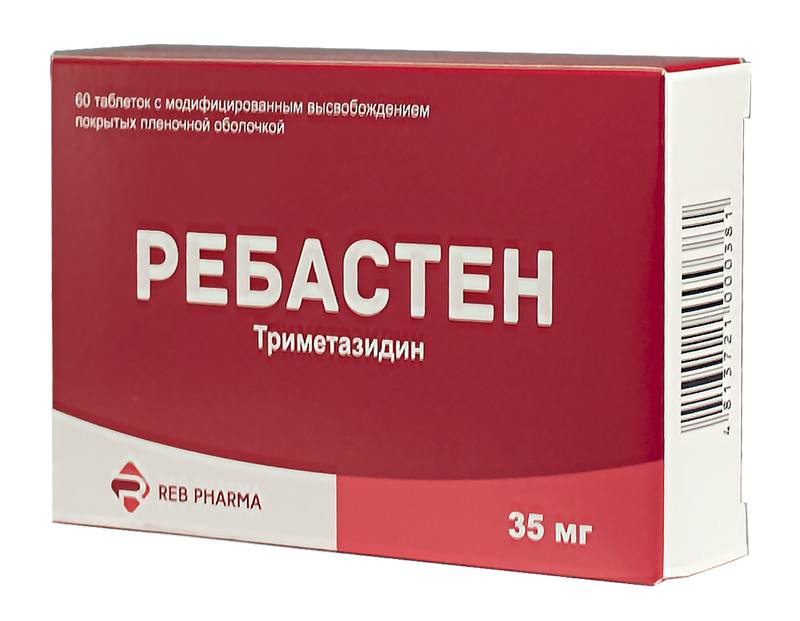


BRAND NAME: Rebasten
INTERNATIONAL NONPROPRIETARY NAME: Trimetazidine
DOSAGE FORM: Film-coated modified release tablet.
COMPOSITION:
The tablet contains:
Active substance: 35 mg Trimetazidine dihydrochloride.
Excipients: calcium hydrogen phosphate anhydrous, silicon dioxide colloidal anhydrous, polyethylene glycol, povidone, xanthan gum, magnesium stearate, polyvinyl alcohol, titanium dioxide E 17, iron oxide red E 172, talc, lecithin, glycerin.
PHARMACOTHERAPEUTIC GROUP
Other drugs for the treatment of heart diseases
ATX Code: CO 1 EB 15
PHARMACOLOGICAL FEATURES
PHARMACODYNAMICS
Trimetazidine prevents intracellular ATP concentration decrease, which contributes in energy metabolism conservation in cells exposed to hypoxia or ischemia. It provides the correct operation of ion pumps and transmembrane transport of sodium and potassium, maintaining cellular homeostasis. Trimetazidine reduces β-oxidation of fatty acids by partial inhibition of the long chain of 3-ketoacetyl-CoA-thiolase in mitochondria, resulting in an increase in glucose oxidation. In ischemic cell less oxygen amount is required to produce energy by glucose oxidation than in a process of ß-oxidation. The potentiation of glucose oxidation optimizes intracellular energy processes, thus maintaining proper energy metabolism in ischemia conditions.
PHARMACODYNAMIC EFFECTS:
In patients with coronary heart disease Trimetazidine acts as a metabolic agent, maintaining high-energy phosphate level in the cell. Anti-ischemic effects are achieved without concomitant hemodynamic effects.
PHARMACOKINETICS
Following oral administration Trimetazidine is rapidly absorbed from the gastrointestinal tract. Maximal concentration is reached in 5 hours period. In 24 hours plasma concentration remains at a level exceeded 75% of concentration determined in 11 hours period. Equilibrium concentration is reached in 60 hours period. Food does not affect pharmacokinetic parameters of Trimetazidine.
Drug distribution volume is 4.8 l/kg which provides proper diffusion in tissue. Plasma protein binding capacity is low, about 16% in vitro.
It is excreted mainly by kidneys unchanged. The half-life is 7 hours, in patients above 65 years – about 12 hours.
It was shown that in elderly patients an increase in Trimetazidine plasma concentration when taken at the dose 2 tablets a day in 2 potions is not followed by any more significant effects compared with placebo.
INDICATIONS FOR USE
Trimetazidine is prescribed for symptomatic treatment in patients with stable angina pectoris as an additional therapy with insufficient therapeutic effect of basic therapy or intolerance to other first-line antianginal drugs.
DOSAGE AND ADMINISTRATION
1 tablet of Rebasten should be taken twice a day (morning and evening) with food, without chewing and washed down with water. The drug should be prescribed for a long time period. The course duration is determined individually, if necessary and the treatment regimen can be reviewed after 3 months.
Elderly patients: in elderly patients Trimetazidine elimination period may be increased due to reduced renal function. Dose adjustment in elderly patients should be carried out with caution.
Patients with moderate impaired renal function (creatinine clearance 30-60 ml/min) are recommended to take one tablet (35 mg) in the morning with food.
SIDE EFFECT
Side effects frequency parameters stated below are defined as follows: very often (≥ 1/10); often (≥ 1/100 to <1/10); not often (≥ 1/1000 to <1/100); rarely (≥ 1/10 000, <1/1 000); very rare (<1/10 000); unknown frequency (frequency cannot be calculated from the data available).
Digestive system disorders: often – abdominal pain, diarrhea, dyspepsia, nausea, vomiting; unknown frequency – constipation.
General disorders: often – asthenia.
Central nervous system disorders: often – dizziness, headache; unknown frequency – symptoms of parkinsonism (tremor, akinesia, increased tone), instability in Romberg position and “shaky walk”, “restless legs” syndrome, other associated motor disorders, usually reversible after therapy discontinuation, sleeping disturbances (insomnia, drowsiness).
Skin and subcutaneous tissue disorders: often – skin rash, itching, urticaria; unknown frequency – acute generalized exanthematous pustulosis, Quincke edema.
Cardiovascular system disorders: rarely – palpitations, extrasystole, tachycardia, a marked decrease in blood pressure (BP), orthostatic hypotension, which may be accompanied with general weakness, dizziness or loss of balance, especially when taking antihypertensive drugs, flushing.
Hemopoietic system disorders: unknown frequency – agranulocytosis, thrombocytopenia, thrombocytopenic purpura.
Liver and biliary tract disorders: unknown frequency – hepatitis.
CONTRAINDICATIONS
• hypersensitivity to the drug components;
• pregnancy and lactation;
• Parkinson’s disease, symptoms of parkinsonism, tremor, restless legs syndrome and other related motor activity disorders.
• severe renal impairment (creatine clearance less than 30 ml/min).
PRECAUTIONARY MEASURES
Rebasten is used for basic therapy of angina pectoris, but not for angina attacks relief, not indicated as initial treatment for unstable angina or myocardial infarction.
In case of angina pectoris the treatment (drug therapy or revascularization) should be reviewed and adapted.
Rebasten can induce or worsen parkinsonism symptoms (tremor, akinesia, hypersthenia), so patients should be monitored regularly, especially the elderly. In doubtful cases patients should be referred to a neurologist for an appropriate examination.
In case of motor activity disturbances, e.g. parkinsonism symptoms, restless legs syndrome, tremors, instability in Romberg position and shaky walk Rebasten should be discontinued instantly.
Such cases are rare and symptoms usually disappear after therapy discontinuation: in most patients within 4 months after the drug withdrawal. If Parkinsonism symptoms persist for more than 4 months after the drug discontinuation, consult a neurologist.
Falling may be noted, associated with instability in Romberg position and “shaky walk” or a marked decrease in blood pressure, especially in patients on antihypertensive drugs therapy.
Due to the lack of clinical data Rebasten prescription for patients with severe impaired liver function is not recommended.
Rebasten administration for the treatment of elderly patients does not require dose adjustment.
Rebasten should be used with caution in patients over 75 years old.
Effect on ability to drive and operate machinery
Clinical studies demonstrated no effect of Trimetazidine on hemodynamic indicators, however during a post-registration period there have been recorded some cases of dizziness and drowsiness, which may affect the ability to drive and perform work required quick physical and mental reactions.
Use in pregnancy and lactation.
Due to the lack of clinical data on the drug administration in pregnant women, as a precaution, it is not recommended to use the drug in this category of patients.
Pediatric use.
There is insufficient data on the drug safety in children and adolescents under 18 years old.
OVERDOSE
There is only limited information on Trimetazidine overdose. In case of overdose, symptomatic therapy should be performed.
INTERACTION WITH OTHER DRUGS
No data available.
STORAGE AND SHELF LIFE
Store in a place protected from sunlight and moisture at a temperature not above 25°C.
Keep out of reach of children! 3 years from the production date. Not to be used after the expiration date.
PRESCRIPTION STATUS
By prescription
Manufacturer Information
Foreign production and trade unitary enterprise “Reb-Pharma”, 223216, Republic of Belarus, Minsk region, Chervensky district, Smilovichi, Sadovaya st., 1, tel./fax: (+375) 17 240 26 35,
e-mail: rebpharma@rebpharma.by, http://www.rebpharma.by
Comment type is not specified in the component properties.