
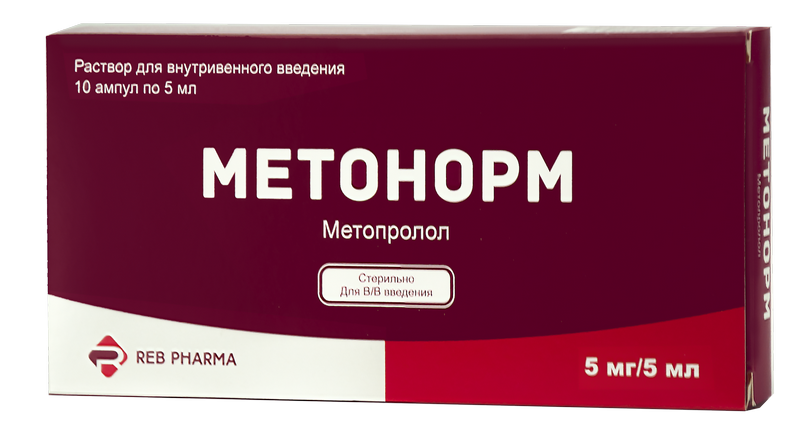
INTERNATIONAL NONPROPRIETARY NAME: Metoprolol
DRUG FORM: solution for intravenous administration.
Description: a clear, colorless solution.
COMPOSITION
1 ampoule with drug solution contains:
Active substance: Metoprolol tartrate 5.0 mg.
Excipients: sodium chloride, water for injections.
PHARMACOTHERAPEUTIC GROUP
Selective inhibitors of P-adrenoreceptors
ATC Code: C07AB02
PHARMACOLOGICAL PROPERTIES
PHARMACODYNAMICS
Metoprolol is a cardioselective inhibitor of β1-adrenoreceptors without its own sympathomimetic activity. It possesses hypotensive, antianginal and antiarrhythmic effect. It also demonstrates a slight membrane stabilizing effect and does not show the partial agonist activity.
Metoprolol decreases or inhibits stimulating effect of catecholamines formed in nervous and physical stress on cardiac activity. It means that Metoprolol is able to prevent heart rate (HR) elevation, minute volume and myocardial contractility as well as an increase in blood pressure due to a quick release of catecholamines.
Metoprolol to a less extent than non-selective β-blockers affects insulin production and carbohydrate metabolism.
PHARMACOKINETICS
Metoprolol undergoes oxidative metabolism in the liver with three major metabolites formation none of which possesses clinically significant β-inhibiting effect.
Binding with plasma proteins is low, approximately 11-12%.
Metoprolol an average half-life in plasma is 3-4 hours. Metoprolol and its metabolites are excreted by the kidneys: about 10% of the dose is excreted unchanged, the rest – in a form of metabolites.
INDICATIONS FOR USE
- supraventricular tachycardia;
- treatment and prevention of myocardial ischemia, tachycardia and pain in acute period of myocardial infarction.
DOSAGE AND ADMINISTRATION
Metonorm is developed for intravenous administration. Parenteral administration of Metonorm should be carried out under the supervision of specially trained personnel with a possibility to monitor the blood pressure, ECG and provide with resuscitation measures. The required dose should be selected individually in accordance with the following recommendations.
Supraventricular Tachyarrhythmia
At the initial stage, Metonorm is administered at a dose of 5 mg (5 ml) at rate 1-2 mg/min. Injections at this dose can be repeated every 5 minutes until the desired therapeutic effect is achieved. Usually a dose of 10-15 mg (10-15 ml) is sufficient. Due to the risk of significant drop in blood pressure intravenous administration of Metonorm in patients with systolic blood pressure below 110 mm Hg. should be carried out with extreme caution.
Maximal dose for intravenous administration is 20 mg (20 ml).
Myocardial infarction
Intravenous administration of Metonorm should be carried out in a specialized medical department in patients with stable hemodynamic state. The therapy begins with a dose of 5 mg (5 ml). The drug dose can be repeated every 2 minutes with blood pressure, heart rate and ECG control. The second or third dose should not be given if systolic blood pressure <90 mm Hg, heart rate <40 beats/min and PQ interval > 0.26 seconds, or if an increased dyspnoea or cold clammy sweat appeared. Maximal dose is 15 mg (15 ml). In 15 minutes after the last injection, 50 mg of Metoprolol tartrate should be taken orally every 6 hours for 48 hours period.
Impaired renal function
Renal function only slightly affects drug elimination rate, thus it is not necessary to adjust the dose in patients with impaired renal function.
Impaired liver function
Usually patients suffering from liver cirrhosis can take the same dose as patients with normal liver function due to Metoprolol weak binding capacity to plasma proteins. Only if there are signs of severe liver impairment (for example, patients with bypass surgery) it is necessary to consider dose reduction.
Elderly patients
Dose adjustment is not required, but dose titration should be performed with caution.
CONTRAINDICATIONS
- Hypersensitivity to drug components or other β-blockers;
- atrioventricular block of II and II degree;
- heart failure in decompensation stage;
- sick sinus syndrome (SSS)
- cardiogenic shock;
- patients with acute myocardial infarction and a heart rate of less than 45 beats/min, PQ interval more than 0.24 s or systolic blood pressure less than 100 mm Hg;
- treatment of supraventricular tachycardia in patients with systolic blood pressure less than 110 mm Hg;
- children and teenagers under 18 years old;
- serious peripheral circulatory disorders;
- untreated pheochromocytoma;
- metabolic acidosis.
SIDE EFFECT
The side effect incidence parameters used below are defined as follows: very often (> 1/10), often (from> 1/100 to <1/10), not often (from > 1/1000 to <1/100), rarely (from > 1/10000 to <1/1000), very rare (from <1/10000, including individual cases), unknown frequency - frequency parameters cannot be estimated from the data available.
Cardiovascular system disorders: often - bradycardia, postural arterial hypotension (very rarely accompanied by fainting), cold extremities, palpitations; sometimes - a temporary increase in heart failure symptoms, atrioventricular block of I degree, cardiogenic shock in patients with acute myocardial infarction; rarely - other conductions, arrhythmias.
Central and peripheral nervous system disorders: very often - increased fatigue; often - dizziness, headache; sometimes - paresthesia, convulsions, depression, low concentration, drowsiness or insomnia, nightmares; rarely – increased irritability, anxiety; very rare – loss of memory/amnesia, depression, hallucinations.
Gastrointestinal system disorders: often - nausea, abdominal pain, diarrhea, constipation; not often - vomiting; rarely - dry mouth, impaired liver function.
Hemopoietic system disorders: very rare - thrombocytopenia.
Respiratory system disorders: often - shortness of breath during physical activity; not often - bronchospasm in patients with bronchial asthma.
Musculoskeletal system disorders: very rare - arthralgia.
Sensory organs disorders: rarely - visual impairment, dryness and/or eye irritation, conjunctivitis; very rare - tinnitus, taste disturbances. Dermatological reactions: not often - skin rash (urticaria), increased sweating; rarely - hair loss; very rare - photosensitivity, psoriasis exacerbation.
Other: rarely - impotence/sexual dysfunction; not often - body weight increase
PRECAUTIONARY MEASURES
When treating patients with suspected or diagnosed myocardial infarction, the patient hemodynamic status should be carefully monitored after each dose i/v administration. The second or third dose should not be used when the heart rate is <40 beats/min, systolic blood pressure is <90 mm Hg. and PQ interval is > 0.26 seconds. Treatment should be interrupted if any dyspnoea aggravation or cold sweat is observed.
When using Metonorm for intravenous administration, as for other β-blockers, the following precautions should be established.
- In necessity to stop the treatment with Metonorm, this should be done, if possible, gradually, within 10-14 days, otherwise angina pectoris symptoms may increase along with an increased risk of myocardial infarction and sudden death. The last dose should be taken for at least 6 days period until the drug complete discontinuation. During the dose reduction period the patient should stay under medical supervision. In case of symptoms resumption it is recommended to slow down the dose reduction process.
- In case of surgical intervention it is necessary to inform the anesthetist about the patient therapy with Metonorm. For patients prepared for surgery it is not recommended to stop the treatment with β-blockers. If Metoprolol therapy is considered inappropriate it should be stopped in at least 48 hours before the general anesthesia. Administration of Metoprolol at high doses in patients planning non-cardiac surgery should be avoided as it can lead to bradycardia, arterial hypotension and stroke development, including death in patients with cardiovascular risk factors. However, some patients may use β-blockers for sedation. In these cases it is necessary to choose an anesthetic with a slight negative inotropic effect in order to minimize the risk of myocardial activity inhibition.
- Metoprolol can cause deterioration in patient’s condition in case of mild peripheral circulation disorders.
- In patients with a history of heart failure or with a decreased heart reserve the need for concomitant diuretic therapy should be considered.
- Metoprolol may cause bradycardia development in patients; in these cases the dose of Metonorm should be reduced or canceled.
- Metoprolol should be prescribed with caution in patients with the Ist degree heart block.
- In patients with Prinzmetal angina pectoris the frequency and degree of angina attacks may increase due to α-receptor-mediated constriction of coronary vessels. In this reason, non-selective β-blockers should not be prescribed for such patients. Selective inhibitors of β1-adrenoreceptors should be used with extreme caution.
- Treatment with Metoprolol can affect carbohydrates metabolism or hide the development of hypoglycemia, although this risk is less than that of non-selective inhibitors of β-adrenoreceptors.
- Metoprolol may mask early symptoms of acute hypoglycemia, such as tachycardia, as well as symptoms of thyrotoxicosis.
- Therapy with β-blockers can worsen anaphylactic reactions treatment efficacy (treatment with adrenaline with usual doses does not always result in expected therapeutic effect).
- Although selective β-blockers demonstrate a lesser effect on lung function than non-selective ones Metoprolol therapy in patients with reversible airway obstruction should be avoided unless there are good clinical reasons for their use. In these cases patients should be closely monitored. In patients with bronchial asthma or chronic obstructive pulmonary diseases an adequate bronchodilator therapy should be prescribed at the same time. It may be necessary to increase the dose of β2 receptor stimulants.
- Serious attention should be focused on patients with psoriasis before Metoprolol therapy.
- If Metonorm is prescribed to patients with pheochromocytoma, concomitant use of α-blockers should be considered.
- When using Metoprolol for patients with labile type I diabetes, hypoglycemic dose correction might be necessary.
- Verapamil should not be administered in patients on treatment with β-blockers.
- Effect on ability to drive and use machinery
When driving and being involved in potentially hazardous activities required an increased concentration and quick psychomotor reactions, it should be kept in mind that dizziness and fatigue can be observed when using the drug.
Pregnancy and lactation
Metonorm should not be prescribed during pregnancy and lactation, unless the expected benefit to the mother outweighs the potential risk to the fetus or infant.
Pediatric Use
It is contraindicated to use the drug in children and adolescents under 18 years old.
INTERACTION WITH OTHER DRUGS
Metoprolol is a substrate for the enzyme CYP2D6. Metoprolol plasma concentration may be affected by drugs that inhibit CYP2D6 activity. Examples of drugs that inhibit CYP2D6 activity are quinidine, terbinafine, paroxetine, fluoxetine, sertraline, celecoxib, propafenon and diphenhydramine. During the treatment with these agents at the beginning it may be necessary to reduce the dose of Metonorm.
The following combinations with Metonorm should be avoided:
Barbituric acid derivatives: barbiturates (tested for pentobarbital) stimulate Metoprolol metabolism by the enzyme induction.
Propafenone: in 4 patients treated with Metoprolol with propafenone Metoprolol plasma concentration increased by 2-5 times; in 2 patients side effects typical to Metoprolol had been observed. This drug interaction was confirmed in 8 healthy volunteers. It was probably based on the fact that propafenone, like quinidine inhibits Metoprolol metabolism via the cytochrome P4502D6 system. The result of this combination is probably difficult to predict as propafenone also exhibits β-blocking features.
Verapamil: in combination with P-blockers (described for atenolol, propranolol and pindolol) Metonorm may cause bradycardia and blood pressure decrease. Verapamil and β-blockers possess an additive inhibitory effect on AV conduction and sinus node function.
The following combinations with Metonorm may require dose adjustment: Amiodarone: in one study it has been shown that patients treated with Amiodarone may develop severe sinus bradycardia when used together with Metoprolol. Amiodarone has an extremely long half-life (approximately 50 days); it means that the interaction can occur for a long time after the drug withdrawal.
Class I antiarrhythmic drugs: Class I antiarrhythmic drugs and β-blockers possess an additive negative inotropic effect which may result in serious hemodynamic side effects in patients with impaired left ventricular function. You should also avoid this combination for sick sinus syndrome and impaired AV conduction. This kind of interaction is better described for Disopyramid.
Nonsteroidal anti-inflammatory drugs (NSAIDs): NSAIDs have been shown to counteract β-blockers antihypertensive effect. Indomethacin has been studied to a greater extent. Most probably this interaction does not occur with Sulindac. The study with negative interaction result was obtained for Diclofenac.
Diphenhydramine: diphenhydramine reduces (2.5 times) Metoprolol clearance to alpha-hydroxymethoprolol via CYP2D6 system in patients with accelerated hydroxylation. Metoprolol effects increase.
Cardiac glycosides: simultaneous use of digitalis glycosides and inhibitors of β-adrenoreceptors may increase atrioventricular conduction period and may also result in bradycardia manifestation.
Diltiazem: Diltiazem and β-receptor blockers possess an additive inhibitory effect on AV conduction and sinus node function. During combined treatment with Diltiazem severe bradycardia was observed (case reports). Epinephrine: after epinephrine (adrenaline) administration in patients used non-selective inhibitors of β-adrenoreceptors (including pindolol and propranolol) severe arterial hypertension and bradycardia developed (about 10 reports). These clinical observations have been confirmed in studies with healthy volunteers.
In addition it was suggested that Epinephrine with local anesthesia could provoke the development of these reactions when administered intravenously. This risk is probably less with cardioselective β-blockers. Phenylpropanolamine: Phenylpropanolamine (Norephedrine) in a single dose of 50 mg can result in pathological increase of diastolic blood pressure in healthy volunteers. Propranolol, in general, counteracts an increase in blood pressure with phenylpropanolamine. However, β-receptor blockers can provoke paradoxical hypertensive reactions in patients using high doses of phenylpropanolamine. In several cases, a hypertensive crisis has been described with phenylpropanolamine alone.
Quinidine: quinidine inhibits Metoprolol metabolism in patients with accelerated hydroxylation (more than 90% of Swedish population), which results in a significant increase in plasma levels and increased inhibition of P-receptors. The corresponding interaction can be observed with other β-blockers metabolized by the same enzyme (cytochrome P4502D6).
Clonidine: P-blockers can enhance hypertensive response at sudden withdrawal of clonidine. When it is necessary to cancel concomitant treatment with clonidine, the β-blocker should be canceled a few days before clonidine withdrawal.
Rifampicin: rifampicin can stimulate Metoprolol metabolism resulting in a decrease in its plasma concentration.
Patients on concomitant treatment with other β-blockers (e.g., eye drops) or monoamine oxidase (MAO) inhibitors should be closely monitored. The administration of inhaled anesthetics to patients on treatment with inhibitors of β-receptors enhances the cardiodepressive effect. For patients on β-blockers therapy it may be necessary to adjust the dose of oral antidiabetic drugs. Metoprolol plasma concentration may increase if taken together with cimetidine or hydralazine.
Metoprolol plasma concentration may increase if taken together with alcohol.
At concomitant administration of Metoprolol with sympathetic ganglion blockers patients should be closely monitored.
Metoprolol may interfere with lidocaine elimination.
Caution is advised when Metoprolol is prescribed to patients on β2 receptor and β1 receptor stimulants as well as dihydropyridines therapy.
It may also be necessary to adjust the dose of insulin in patients on β-blockers therapy.
Caution is advised in case of concomitant use of Metoprolol with Ergotamine.
Caution should be exercised when prescribing Metoprolol with other drugs with antihypertensive effect.
OVERDOSE
Symptoms: the most serious are cardiovascular system conditions (bradycardia, atrioventricular block of I-III degree, asystolia, marked decrease in blood pressure, weak peripheral perfusion, heart failure, cardiogenic shock), lung function impairment, apnoea, increased fatigue, impaired and loss of consciousness, tremors, convulsions, increased sweating, paresthesia, bronchospasm, nausea, vomiting, esophageal spasm, hypoglycemia or hyperglycemia, transient myasthenic syndrome. Concomitant use of alcohol, antihypertensive drugs, quinidine or barbiturates can worsen the patient’s condition.
Treatment: if necessary, secure airway (intubation) and mechanical ventilation. Terbutaline injection or inhalation should be used to stop bronchospasms.
It is necessary to replenish the circulating blood volume and infuse glucose. Atropine 1.0 – 2.0 mg intravenously; if necessary, it should be repeated (especially in case of vagal symptoms) with ECG monitoring.
In case of severe myocardial contractile function inhibition of dobutamine or dopamine infusion is indicated. Glucagon 50-150 μg/kg intravenously at 1 min interval should be injected. In some cases additional epinephrine may be effective.
In case of arrhythmias and expansion of the ventricular complex (QRS) sodium contained solutions (chloride or bicarbonate) should be infused. Artificial pacemaker insertion is advisable.
In case of cardiac arrest caused by overdose resuscitation may be needed within a few hours. Symptomatic treatment should be provided.
STORAGE AND SHELF LIFE
Store in a dark place at a temperature not above 25°C.
Keep out of reach of children! 3 years from the production date. Should not be used after the expiration date.
PRESCRIPTION STATUS
By prescription
PACKAGING
5 ml ampoules made of transparent glass with the drug solution.
10 ampules in a separator made of polyvinylchloride film.
1 separator with a leaflet into a cardboard box.
Manufacturer Information
Foreign production and trade unitary enterprise “Reb-Pharma”, 223216, Republic of Belarus, Minsk region, Chervensky district, Smilovichi, Sadovaya st., 1, tel./fax: (+375) 17 240 26 35,
e-mail: rebpharma@rebpharma.by, http://www.rebpharma.by
Comment type is not specified in the component properties.