
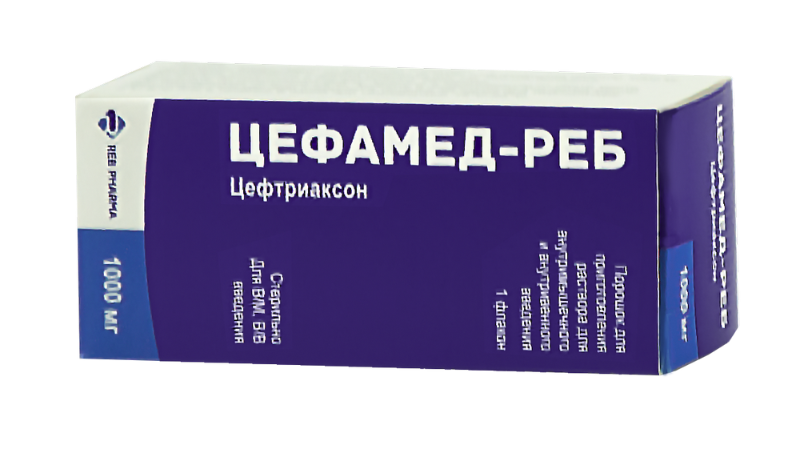
Brand Name: Cefamed-Reb
International Nonproprietary Name: Ceftriaxone
Drug form: 500 mg and 1000 mg powder for solution preparation for i.m. and i.v. injections.
Composition:
1 vial with 500 mg of drug product contains:
Active substance: Ceftriaxone (as ceftriaxone sodium) – 500.0 mg.
1 vial with 1000 mg of drug product contains:
Active substance: Ceftriaxone (as ceftriaxone sodium) – 1000.0 mg.
Pharmaceutical group
Systemic antibacterial agents.
Third generation cephalosporins. ATX Code: J01DD04
Pharmacological properties
Pharmacodynamics
Ceftriaxone bactericidal activity is based on cell membranes synthesis suppression in microorganisms. Ceftriaxone acetylates membrane-binding transpeptidases disrupting the cross-linking of peptidoglycans necessary for bacterial cell membrane strength and rigidity.
In vitro ceftriaxone is active against most gram-negative and gram-positive microorganisms. Ceftriaxone is highly resistant to most β-lactamases of gram-positive and gram-negative bacteria (penicillinases and cephalosporinases).
Ceftriaxone is usually active against the following microorganisms:
gram-positive aerobs: Staphylococcus aureus * (methicillin- susceptible strains), Staphylococci coagulase-negative* (methicillin-susceptible strains), Streptococcus pneumoniae, Streptococcus pyogenes (group A), Streptococcus agalactiae (group B), group of Streptococcus viridans;
gram-negative aerobs: Borrelia burgdorferi, Haemophilus ipfluenzae, Haemophilus parainfluenzae, Moraxella catarrhalis, Neisseria gonorrhoeae, Neisseria meningitis, Proteus mirabilis, Providencia spp., Treponema pallidum.
Indications for use
Infectious and inflammatory diseases caused by susceptible to the drug microorganisms.
Cefamed-Reb is indicated for treatment of the following infections in adults and children from birth:
- bacterial meningitis;
- community-acquired pneumonia;
- hospital-acquired pneumonia;
- acute otitis media;
- intra-abdominal infections;
- complicated urinary tract infections (including pyelonephritis);
- bone and joint infections;
- complicated skin and soft tissue infections;
- gonorrhea;
- syphilis;
- bacterial endocarditis.
Cefamed-Reb can be used for:
- treatment of chronic obstructive pulmonary disease exacerbation in adults;
- treatment of Lyme borreliosis (in early (stage II) and late (stage III) periods of the disease) in adults and children, including newborns - 15 days old;
- preoperative prevention of surgical infections;
- treatment of bacterial etiology neutropenic fever;
- treatment of bacteremia caused or presumably caused by any of the above mentioned infections.
Dosage and administration
The drug dose depends on the type, location and severity of infection, susceptibility, patient’s age and liver and kidney functions.
Route of drug administration is i.m. or i.v. (bolus or drop infusion).
In adults and children over 12 years with a body weight of 50 kg or more:
|
Dose |
Frequency |
Indication |
|
1-2 g |
Once a day |
Hospital-acquired pneumonia, chronic obstructive pulmonary disease exacerbation, intra-abdominal infections, complicated urinary tract inflammatory infections (including pyelonephritis) |
|
2 g |
Once a day |
Hospital-acquired pneumonia, complicated skin and soft tissue infections, bone and joint infections |
|
2-4 g |
Once a day |
Neutropenic fever of bacterial ethiology, bacterial endocarditis, bacterial meningitis |
The details of drug administration according to individual parameters for adults and children over 12 years old (with body weight ≥ 50 kg):
For acute otitis media treatment single dose of 1-2 g (intramuscular) is required.
For gonorrhea treatment the recommended single dose is 500 mg (intramuscular). For syphilis treatment the recommended dose is 500 mg-1000 mg once a day (up to 2 g once a day in case of neurosyphilis) for 10-14 days, however, dosage recommendations in such cases are based on limited data.
For disseminated Lyme borreliosis treatment (in early (stage II) and late (stage III) periods of the disease) the recommended dose is 2 g once a day for 14 - 21 days.
For preoperative prevention of infections the dose of 2 g is recommended once before surgery.
|
Dose |
Frequency |
Indications |
|
50-80 mg/kg |
Once a day |
Intra-abdominal infections, complicated urinary tract inflammatory infections (including pyelonephritis, community-acquired and hospital pneumonia |
|
50-100 mg/kg (maximum 4 g) |
Once a day |
Complicated infections of the skin and soft tissues, infections of bones and joints, neutropenic fever due to bacterial infection |
|
80-100 mg/kg (maximum 4 g) |
Once a day |
Bacterial meningitis |
|
100 mg/kg (maximum 4 g) |
Once a day |
Bacterial endocarditis |
The details of drug administration according to individual characteristics for children under 12 years (with body weight <50 kg)
For acute otitis media treatment it is necessary to administer a single dose of 50 mg/kg intramuscular.
For the treatment of syphilis, including neurosyphilis, the recommended dose is 75-100 mg/kg (maximum 4 g) once a day for 10-14 days. However, dose recommendations in such cases are based on limited data.
For disseminated Lyme borreliosis treatment (in early (stage II) and late (stage III) periods of the disease) the recommended dose is 50-80 mg/kg once a day for 14-21 days.
For preoperative prevention of infection a single dose of 50-80 mg/kg is recommended prior to surgery.
Children with 50 kg or more body weigh are to be prescribed adult doses.
Newborns aged 0 to 14 days:
|
Dose |
Frequency |
Indications |
|
20-50 mg/kg |
Once a day |
Intra-abdominal infections, skin and soft tissue complicated infections, complicated urinary tract inflammatory infections (including pyelonephritis), community-acquired and hospital pneumonia, bone and joint infections, neutropenic fever of bacterial ethiology. |
|
50 mg/kg |
Once a day |
Bacterial endocarditis, bacterial meningitis |
Cefamed-Reb is contraindicated in premature infants up to 41 weeks of post-conceptual age (gestational age + chronological age).
The details of drug administration according to individual characteristics in newborn children aged 0 to 14 days.
For acute otitis media treatment it is necessary to administer a single dose of 50 mg/kg intramuscular.
For the treatment of syphilis, including neurosyphilis, the recommended dose is 50 mg/kg once a day for 10-14 days. However, dose recommendations in such cases are based on limited data.
For preoperative prevention of infection a single dose of 20-50 mg/kg is recommended prior to surgery.
Elderly patients with normal liver and kidney function should be given usual dose without age adjustment.
Treatment duration is established individually. Once normal body temperature and pathogen eradication are confirmed, administration of Cefamed-Reb should be continued for at least 48-72 hours.
Patients with mild to moderate impaired liver function do not need to adjust the dose of ceftriaxone provided kidney function is normal.
Patients with impaired renal function do not need ceftriaxone dose adjustment, provided that liver function is not impaired. In cases of preterminal renal insufficiency (creatinine clearance ˂ 10 ml/min), ceftriaxone dose should not exceed 2 g per day. In dialysis patients additional drug administration after the dialysis procedure is not required. Ceftriaxone is not excreted by peritoneal dialysis or hemodialysis.
The way of solution preparation and administration
Intramuscular injections: to prepare intramuscular solution for injection Cefamed-Reb (500 mg or 1000 mg) vial content is dissolved in 2 ml or 3.5 ml of solvent respectively (water for injection).
Perform deep intramuscular injection. It is recommended to inject not more than 1000 mg into one injection site. Intravenous injection: intravenous solution concentration is 100 mg/ml. To prepare the solution for intravenous injection, Cefamed-Reb (500 mg or 1000 mg) vial content should be dissolved into 5 ml or 10 ml of water for injection.
Perform intravenous injection (preferably into large veins) slowly for 5 minutes.
Intravenous infusion: concentration of solution for intravenous infusion is 50 mg/ml. To prepare solution for intravenous infusion, Cefamed-Reb (500 mg or 1000 mg) vial content should be dissolved into 10 ml or 20 ml of water for injection.
Perform the infusion for at least 30 minutes (preferred).
In children under 12 years doses of 50 mg/kg or more should be administered by Intravenous infusion. In infants intravenous infusions should last at least 60 minutes to reduce the potential risk of bilirubin encephalopathy.
For preoperative prevention of surgical infections ceftriaxone should be administered 30-90 minutes before surgery.
Side effect
The most commonly reported adverse reactions to ceftriaxone are: eosinophilia, leukopenia, thrombocytopenia, diarrhea, skin rash and an increase in liver enzymes concentration.
The following side effects observed while using ceftriaxone that disappeared either spontaneously or after withdrawal the drug are the following:
Infections: genital mycosis; superinfection at various location caused by fungi or other resistant microorganisms is also possible.
Gastrointestinal disorders: nausea, vomiting, diarrhea, loose stool, stomatitis, glossitis, pancreatitis (probably caused by the bile duct obstruction), pseudomembranous colitis (mainly caused by Clostridium difficile).
Immune system disorders: hypersensitivity reactions, anaphylactic reactions, including anaphylactic shock, anaphylactoid reactions.
Blood and lymphatic system disorders: coagulopathy, eosinophilia, anemia (including hemolytic anemia), leukopenia, neutropenia, granulocytopenia, thrombocytopenia. Agranulocytosis has been very rarely observed (mainly occurred in 10 days of treatment and in case of ceftriaxone administration in total dose of 20 g or more).
Skin and subcutaneous tissue disorders: pruritus, urticaria, Stevens-Johnson syndrome, erythema multiforme, toxic epidermal necrolysis (Lyell's syndrome), acute generalized exanthematous pustulosis.
Renal and urinary disorders: oliguria, hematuria, glucosuria, kidney stones, mainly in children older than 3 years, who received the drug either at high daily doses (≥80 mg/kg/day), or at a total dose of more than 10 g, as well as those who had additional risk factors (including limited fluid intake, bed rest).
Hepatobiliary disorders: nuclear jaundice, precipitation of ceftriaxone-calcium salt in the gallbladder (more often in patients treated with doses exceeded the recommended standard dose), elevated liver enzymes in blood serum (AST, ALT, alkaline phosphatase).
In prospective studies in children with intravenous drug administration precipitate formation was observed with different percentage, in some studies more than 30%. The frequency of precipitate formation was less at a slow infusion rate (20-30 minutes). This effect is usually asymptomatic, but in rare cases precipitation occurs together with the following clinical symptoms: pain, nausea and vomiting.
Ear and labyrinth disorders: vestibular vertigo.
Nervous system disorders: headache, dizziness, cramps.
Respiratory, thoracic and mediastinum-related disorders: bronchospasm.
General disorders and reactions at the injection site: phlebitis, pain at the injection site, edema, shivering, pyrexia.
Laboratory test values: false positive Coombs reaction, false positive urine glucose, false positive galactosemia, an increase in serum creatinine.
Contraindication
- Hypersensitivity to ceftriaxone and other cephalosporin group antibiotics or any of the drug excipients.
- History of severe hypersensitivity (e.g., anaphylactic reactions) to other beta-lactam antibiotics (penicillins, monobactams and carbapenems).
Ceftriaxone is contraindicated in patients:
- premature newborns at post-conceptual age of up to 41 weeks (gestational age + postnatal age)*;
- mature newborns (under 28 days):
- patients with hyperbilirubinemia, jaundice, hypoalbuminemia or acidosis due to the lack of protein binding with bilirubin observed in these conditions*;
- in cases of intravenous administration of calcium or calcium-contained drugs required (or may be required) due to the risk of ceftriaxone calcium precipitates formation.
* Studies In vitro have shown that ceftriaxone can displace bilirubin from its association with serum albumin which increases the risk of bilirubin encephalopathy in these patients.
Precautions for use
Recommended doses should not be exceeded.
Hypersensitivity reactions
Ceftriaxone should be administered with caution in patients with mild hypersensitivity reactions to other beta-lactam antibiotics.
Possible risk of anaphylactic shock should be considered when prescribing ceftriaxone (as with other beta-lactam antibiotics).
Episodic cases of severe skin adverse reactions have been reported (e.g., Stevens-Johnson syndrome or Lyell’s syndrome/toxic epidermal necrolysis) but the frequency of these events is not known.
Interaction with calcium-containing solutions: cases of insoluble ceftriaxone calcium salts deposition in the lung and kidney tissue in premature and mature newborns at the age less than 1 month followed by fatal outcome have been described. Studies in vitro have shown that newborns have an increased risk of calcium ceftriaxone precipitation compared with patients from other age groups. In patients at any age, calcium-containing solutions (for example, Ringer's solution and Hartmann's solution) or other calcium-containing solutions should not be used as solvents for ceftriaxone dilution in i.v. administration. If there is no possibility to withdraw ceftriaxone from treatment in a patient required continuous nutrition, parenteral nutrition and ceftriaxone solutions can be administered simultaneously, but with the use of different intravenous systems and into different venous accesses. Another option is to suspend the parenteral nutrition solution administration for ceftriaxone administration, then thoroughly rinse the infusion system between the two solutions administration.
Colitis /overgrowth of resistant microorganisms: during ceftriaxone therapy fungal, yeast or other superinfection caused by antibiotic-resistant microorganisms may develop. Rare cases of antibiotic-associated colitis and pseudomembranous colitis development have been reported as a result of persistence of Clostridium difficile.
Immune-mediated hemolytic anemia
Pediatric use: safety and effectiveness of ceftriaxone in newborns, infants and children have been approved in therapeutic doses and described in section “Dosage and Administration”.
Studies have shown that ceftriaxone, like some other cephalosporins, can displace bilirubin from binding sites with serum albumin. Based on this knowledge, ceftriaxone should not be prescribed to mature and premature newborns due to risk of developing bilirubin encephalopathy (see section “Contraindications”).
Long-term therapy: in long-term treatment it is recommended to monitor the complete blood count regularly.
Severe impairment of liver and kidney function: in case of severe impairment of kidney or liver function it is advisable to follow special recommendations for dosage and therapy with Cefamed-Reb (see the section “Dosage and Administration”).
Laboratory test values: False positive Coombs test is possible.
Sodium Content: Cefamed-Reb contains sodium.
Biliary lithiasis: in case of shadows observed during ultrasound (echography) investigation the probability of ceftriaxone calcium salt precipitates should be considered. Shadows (dark spots) mistaken for stones in the gallbladder are found on gallbladder echograms more often with ceftriaxone dose 1000 mg per day or more. Special care should be taken when using ceftriaxone in pediatric practice. Such a precipitate disappears after ceftriaxone therapy withdrawal. In symptomatic cases it is recommended to continue conservative treatment and consider the feasibility of ceftriaxone therapy withdrawal based on a special benefit-risk assessment.
Biliary stasis: cases of pancreatitis, possibly caused by biliary tract obstruction have been reported in patients with ceftriaxone treatment. Trigger factor or cofactor of bile precipitates formation due to the treatment with ceftriaxone should not be excluded.
Nephrolithiasis: there have been reported some cases of reversible nephrolithiasis, which disappeared after ceftriaxone withdrawal. In symptomatic cases an ultrasound scan (echography) is necessary to perform.
Antibacterial range
Ceftriaxone has a limited antibacterial range of action and may not be suitable as a single drug for treatment of certain types of infections, except when the pathogen has already been confirmed. In case of polymicrobial infection when the suspected pathogens include ceftriaxone-resistant microorganisms, it is necessary to consider the possibility additional antibiotic therapy.
Use in pregnancy and lactation period
Pregnancy: Ceftriaxone crosses the placental barrier. Data on ceftriaxone use in pregnant women are limited. In animal studies ceftriaxone did not show direct or indirect adverse effect on embryo/fetus, perinatal and postpartum development. Based on this data, the use of ceftriaxone during pregnancy is possible when the expected benefit exceeds the possible risk, especially in the first trimester.
Breastfeeding period: at low concentrations ceftriaxone is excreted into milk with no expected effect on breastfeeding if taken in therapeutic doses. However the possible risk of developing diarrhea or fungal infection of mucous membranes cannot be excluded. The possibility of sensitization must be taken into consideration. You should either stop breastfeeding or stop/refrain from ceftriaxone therapy, taking into account the advantage of baby breastfeeding and woman benefit from therapy.
Fertility: studies have not shown any sign of adverse effect on male or female fertility.
Effect on ability to drive and use machines
Since the treatment with ceftriaxone may be accompanied by dizziness, this may affect the patient’s ability to drive and work with dangerous devices and mechanisms. Therefore during ceftriaxone treatment patients should be careful while driving and using mechanisms.
Interaction with other drugs
Calcium-containing drugs: calcium-containing solvents, for example Ringer's solution or Hartmann's solution should not be used for ceftriaxone solutions preparation from powder contained in vials (for intravenous administration) or further dilution of the prepared solution, due to possible precipitate formation. Ceftriaxone should not be administered simultaneously with calcium-containing intravenous solutions, including infusions of calcium-containing solutions, e.g. parenteral nutrition solutions through Y-connections. However, ceftriaxone and calcium-containing solutions can be administered to patients, except newborns, sequentially one after another, if the infusion systems are thoroughly rinsed with a compatible liquid between the treatment solutions. In newborns in vitro studies with the use of adult blood plasma and umbilical cord plasma have shown that newborns are at increased risk of precipitate formation due to ceftriaxone interaction with calcium.
Oral anticoagulants: concomitant use of ceftriaxone with oral anticoagulants (antivitamin K group of medicines) can enhance their effect and increase the risk of bleeding. Frequent monitoring of international normalized ratio (INR) and appropriate dose of antivitamin K group of medicines are recommended before and after ceftriaxone therapy.
Aminoglycosides: there is a conflicting evidence of possible increase in aminoglycosides nephrotoxicity at their simultaneous use with cephalosporins. In such cases strict clinical monitoring of aminoglycoside level (and kidney function) is required.
Chloramphenicol: In vitro study has demonstrated antagonistic effects at concomitant administration of chloramphenicol and ceftriaxone. Their clinical significance is unknown.
There have been no reports of interactions between ceftriaxone and oral calcium-containing drugs, as well as interactions between ceftriaxone given intramuscularly and calcium-containing drugs given intravenously or orally.
Strong diuretics: concomitant administration of high doses of ceftriaxone with strong diuretics (for example, furosemide) has not demonstrated renal dysfunction.
Concomitant administration of probenecid has not reduced ceftriaxone elimination.
Laboratory test value
In patients undergoing ceftriaxone treatment false positive Coombs test is possible.
Ceftriaxone may cause galactosemia false-positive test result as any other antibiotic.
False-positive test result can also be obtained in non-enzymatic determination of urine glucose. For this reason enzymatic methods should be used to determine the level of urine glucose during ceftriaxone therapy.
Storage conditions and shelf life
Store in a dark place at a temperature not more than 25°C.
Keep out of reach of children!
Shelf life – 3 years. Do not use after the expiration date indicated on the package.
The prepared solution is stable for 24 hours at a temperature range from 2 °C to 8 °C or for 6 hours at a temperature range from 15 °C to 25 °C.
Prescription status
Prescription only medicine
Packaging
Cefamed-Reb 500 mg or 1000 mg No.10
500 mg or 1000 mg powder in vials for i/m and i/v solution preparation.
10 vials with a leaflet into a cardboard box
Cefamed-Reb 500 mg or 1000 mg No.1
500 mg or 1000 mg powder in vials for i/m and i/v solution preparation.
1 vial with a leaflet into a cardboard box
Foreign production and trade unitary enterprise “Reb-Pharma”, 223216, Republic of Belarus, Minsk region, Chervensky district, Smilovichi, Sadovaya St., 1, tel./fax: (+375) 17 240 26 35,
e-mail: rebpharma@rebpharma.by,
e-mail: rebpharma@rebpharma.by,
Comment type is not specified in the component properties.