
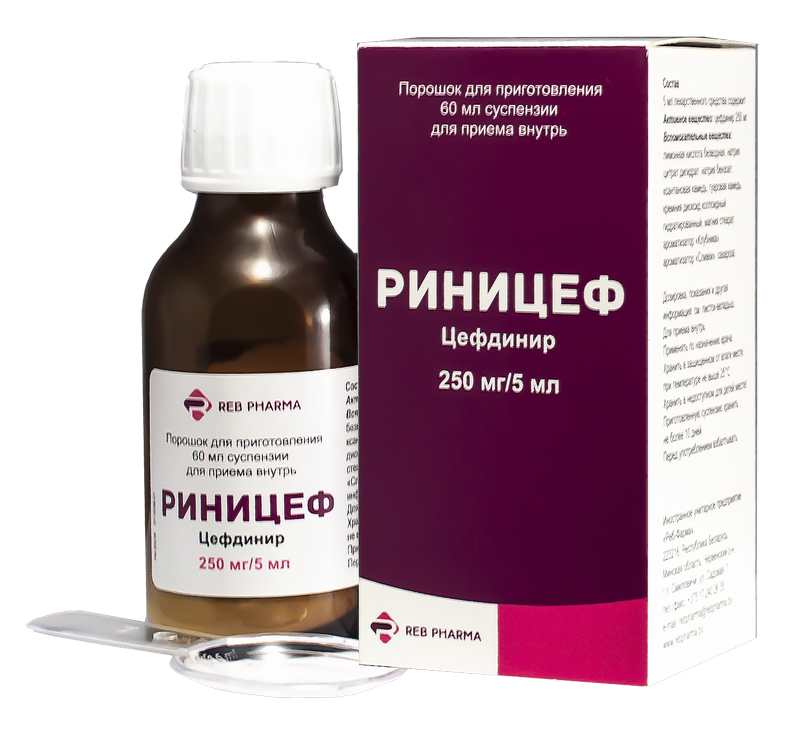
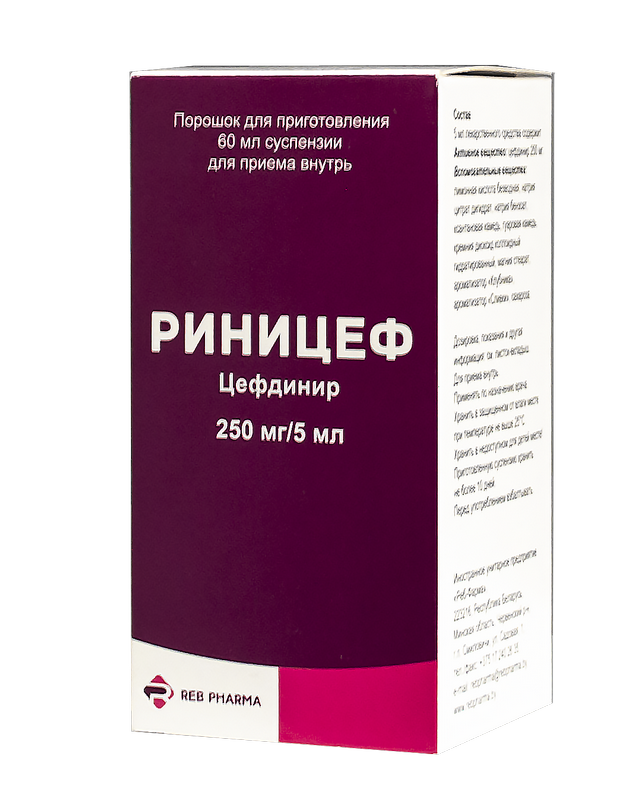


Brand Name: Rinicef
International Nonproprietary Name: Cefdinir / Cefdinir
Drug form: powder for preparation of 60 ml suspension for oral administration containing 250 mg/5 ml.
Composition:
5 ml suspension with the dose 250 mg/5 ml contains:
Active substance: cefdinir – 250 mg;
Excipients: anhydrous citric acid, sodium citrate dihydrate, sodium benzoate, xanthan gum, guar gum, hydrated colloidal silicon dioxide, magnesium stearate, “strawberry” flavor, “cream” flavor, sucrose.
Pharmacotherapeutic group
Systemic antibacterial agents. Third generation cephalosporins.
ATX Code: J01DD15
Pharmacological properties
Pharmacodynamics
An active substance cefdinir is the third generation semi-synthetic cephalosporin group antibiotic with a wide spectrum of action for oral administration. Like other cephalosporin group antibiotics, cefdinir possesses bactericidal effect against susceptible microorganisms by inhibition of bacterial cell wall peptidoglycan synthesis due to interruption of the final stage of transamination, necessary for cross-linking process. Cefdinir is resistant to many, but not all, beta-lactamases produced by gram-positive and gram-negative bacteria. As a result, many microorganisms resistant to penicillins and some cephalosporins are susceptible to cefdinir. The range of cefdinir action includes:
Aerobic gram-positive microorganisms
Staphylococcus aureus (methicillin-sensitive strains only)
Staphylococcus pneumonia (penicillin-sensitive strains only)
Staphylococcus pyogenes
Aerobic gram-negative microorganisms
Haemophilus influenza (including beta-lactamase producing strains)
Haemophilus parainfluenza (including beta-lactamase producing strains)
Moraxella catarrhalis (including beta-lactamase producing strains)
The following data have been obtained in vitro, but their clinical significance is unknown.
Minimal inhibitory concentration (MIC) of cefdinir in vitro is 1 μg/ml or less in (≥ 90%) strains of the following microorganisms; however, cefdinir safety and efficacy in treatment of infections caused by the following microorganisms have not been demonstrated in clinical studies.
Aerobic gram-positive microorganisms
Staphylococcus epidermidis (methicillin-susceptible strains only)
Streptococcus agalactiae
Streptococcus viridans
Aerobic gram-negative microorganisms
Citrobacter koseri
Escherichia coli
Klebsiella pneumonia
Proteus mirabilis
Cefdinir is not active against strains of Pseudomonas, Enterobacter, Enterococcus and methicillin-resistant strains of staphylococci.
Indications for use
Treatment of mild to moderate infections caused by susceptible microorganisms in children from 6 months to 12 years of age:
Acute bacterial otitis media caused by:
- Haemophilus influenza (including strains producing beta-lactamase)
- Streptococcus pneumonia (penicillin-sensitive strains only)
- Moraxella catarrhalis (including strains producing beta-lactamase)
Pharyngitis / tonsillitis caused by:
- Streptococcus pyogenes
Uncomplicated infections of skin and skin structures caused by:
- Staphylococcus aureus (only methicillin-sensitive strains)
- Streptococcus pyogenes
Patients with renal failure *
Daily dose in children with body weight ≥ 43 maximum should not exceed 600 mg.
In children with creatinine clearance <30 ml/ min/1.73 m2 the dose of cefdinir should be 7 mg/g (up to 300 mg) once a day.
Hemodialysis patients
Hemodialysis helps to remove cefdinir from the body. For patients on permanent hemodialysis the recommended starting dose is not more than 300 mg or 7 mg/kg taken every other day. At the end of each hemodialysis session not more than 300 mg or 7 mg/kg of cefdinir is prescribed. Further subsequent doses (not more than 300 mg or 7 mg/kg) are then prescribed every other day.
Patients with liver failure
Since cefdinir is mainly excreted by kidneys and does not undergo significant metabolism, studies on patients with impaired liver function have not been conducted. The change in dosage regimen in this category of patients is not needed.
In case of missed next dose it should be taken as soon as possible. If this dose is missed almost at the time of the next dose, skip the dose and follow the previous dosage regimen, do not double the dose to compensate the missed dose.
Preparation of suspension
The suspension is prepared immediately before the first use.
Reconstituted solution is a homogeneous light yellow colour suspension with a characteristic odor.
|
Final concentration |
Final volume |
Volume of water |
Notes |
|
125 mg/5 ml |
60 |
about 35 ml |
Gently shake the vial with powder then add the required amount of water in two portions. |
|
250 mg/5 ml |
60 |
about 35 ml |
Shake well after each portion added. The final volume of suspension is obtained by adjusting the volume to the mark on the vial. |
After mixing the suspension can be stored at room temperature (25 °C). The vial should be kept tightly closed; the bottle should be thoroughly shaken before each intake. The suspension can be used in 10 days period, after that unused suspension should be discarded.
Side effect
The safety of cefdinir suspension has been studied in clinical trials involved 2289 children with the dose administration – 14 mg/kg/day. Cefdinir is well tolerated drug and the obtained adverse reactions were mild in their manifestation and spontaneously disappeared after withdrawal. Fatal cases and disability were not registered for cefdinir. In 2% of children (40 out of 2289) cefdinir withdrawal caused by development of adverse reaction was estimated on reliable, probable, or possible connection with cefdinir administration. Most cases of withdrawal were associated with gastrointestinal tract disorders, mainly presented by diarrhea. In 0.2% of children (5 out of 2289) drug withdrawal based on skin rash developed during cefdinir administration.
Adverse reactions are classified by frequency of occurrence: very often (≥1 / 10), often (from ≥1 / 100 to <1/10), infrequently (from ≥1 / 1000 to <1/100), rarely (≥1 / 10 000, <1/1000), very rarely (<1/10 000), and frequency is unknown (the frequency cannot be estimated by available data).
Very common: diarrhea, skin rash, vomiting.
Often: cutaneous candidiasis, abdominal pain, leukopenia, vaginal candidiasis, vaginitis, altered defecation pattern, indigestion, dyskinesia, AST increased, maculo-papular rash, nausea.
Adverse reactions specific for cephalosporins
Allergic reactions, anaphylaxis, Stevens-Johnson syndrome, erythema multiform, toxic epidermal necrolysis, renal dysfunction, toxic nephropathy, liver dysfunction, including cholestasis, aplastic anemia, hemolytic anemia, hemorrhage, false positive urine glucose test, neutropenia, pancytopenia and agranulocytosis. Pseudomembranous colitis can develop during and at the end of antibiotic therapy.
The use of some cephalosporins was accompanied by seizures, especially in patients with impaired renal function, with no dose recalculation. In case of seizures developed during therapy, it is necessary to stop antibiotic therapy. If clinically necessary anticonvulsant therapy may be prescribed.
Adverse reactions obtained in post-registration period
The following adverse reactions and changes in laboratory parameters were recorded regardless their predicament to cefdinir administration : shock, anaphylaxis (in rare cases, fatal), swelling of the ligament space and face, suffocation, serum sickness-like reaction, conjunctivitis, stomatitis, Stevens-Johnson syndrome, toxic epidermal necrolysis, exfoliative dermatitis, erythema multiforme, nodal fever, acute hepatitis, cholestatic syndrome, fulminant hepatitis, liver failure, jaundice, increased amylase level, acute enterocolitis, hemorrhagic diarrhea, hemorrhagic colitis, melena, pseudomembranous colitis, pancytopenia, granulocytopenia, leukopenia, thrombocytopenia, idiopathic thrombocytopenic purpura, hemolytic anemia, acute respiratory failure, asthma attack, drug-induced pneumonia, eosinophilic pneumonia, idiopathic interstitial pneumonia, fever, acute renal failure, nephropathy, hemorrhagic tendency, blood-clotting disorder, generalized DIC-syndrome, upper gastrointestinal tract bleeding, peptic ulcer, intestinal obstruction, loss of consciousness, allergic vasculitis, possible cefdinir-diclofenac interaction, heart failure, chest pain, myocardial infarction, rhabdomyolysis, compulsory movements, hypertension.
In case of listed adverse reactions and reaction not specified in the instruction for use consult a doctor.
Contraindications
Rinicef is contraindicated in patients with a history of cephalosporin group of antibiotics and hypersensitivity to excipients contained in the drug.
Precautionary measures
Before starting Rinicef therapy it is necessary to exclude any case of hypersensitivity reaction to penicillins, cephalosporins or other drugs in a medical history.
If cefdinir should be prescribed to a patient with present hypersensitivity to penicillins, extreme caution should be exercised, due to the proved cross-hypersensitivity between beta-lactam antibiotics, which reaches 10% in patients with a history of penicillin allergic reactions.
Use in pregnancy and lactation.
Pregnancy and childbirth
In preclinical studies there hasn’t been demonstrated teratogenic effect of cefdinir when given orally to rats at doses up to 1000 mg/kg/day (70 times of the recommended maximum therapeutic doses based on mg/kg/day calculation, 11 times based on mg/m2/day calculation) or to rabbits in doses up to 10 mg/kg/day (0.7 times of the recommended maximum therapeutic dose based on mg/kg/day calculation, 0.23 times based on mg/m2/day calculation). Cefdinir did not affect females’ fertility, offspring survival ratio and parameters of their development, behavior and reproductive function.
However clinical data on cefdinir use in pregnant women are not available. Since assessment studies on cefdinir effect on animal fertility not always predictable for effect estimation on the human body, cefdinir can be prescribed during pregnancy only in case of reasonable clinical need.
There are no data on cefdinir influence on childbirth.
Lactation
When prescribed for nursing women at the dose 600 mg, cefdinir is not detected in breast milk. During lactation cefdinir is prescribed only after careful assessment of the benefit/risk ratio for mother and child.
Effect on ability to drive or operate machinery
Rinicef does not affect the ability to drive and operate machinery.
Interaction with other drugs
Concomitant administration of cefdinir and antacids leads to decrease in cefdinir absorption rate (C max and AUC) by approximately 40%. In necessity of antacids administration during the course of treatment with Rinicef it should be taken at least 2 hours before or two hours after antacids.
During the treatment with cefdinir false-positive urine ketones results may be observed in the case of nitroprusside intake but not nitro-ferrocyanide. False positive results may also be noted in urine glucose determination test when used Benedict or Fehling reagent (it is recommended to determine glucosuria by the enzymatic method only). Cephalosporins can sometimes cause positive Coombs test result.
Storage conditions and shelf life
Store in a place protected from moisture at a temperature not above 25 °C.
Keep out of the reach of children!
Shelf life – 3 years. Do not use after the expiration date indicated on the package.
Store the prepared suspension for no longer than 10 days.
Prescription Status
By prescription.
Packaging
Powder for preparation of 60 ml suspension for oral administration 125 mg/5 ml or 250 mg/5 ml in a class III lightproof glass vial, sealed with a screw cap and a ring to control vial first opening.
1 vial with a measuring spoon along with a leaflet placed in a cardboard box.
Manufacturer information
Foreign production and trade unitary enterprise “Reb-Pharma”, 223216, Republic of Belarus, Minsk region, Chervensky district, Smilovichi, Sadovaya st., 1, tel./fax: (+375) 17 240 26 35,
e-mail: rebpharma@rebpharma.by, http://www.rebpharma.by
Comment type is not specified in the component properties.