
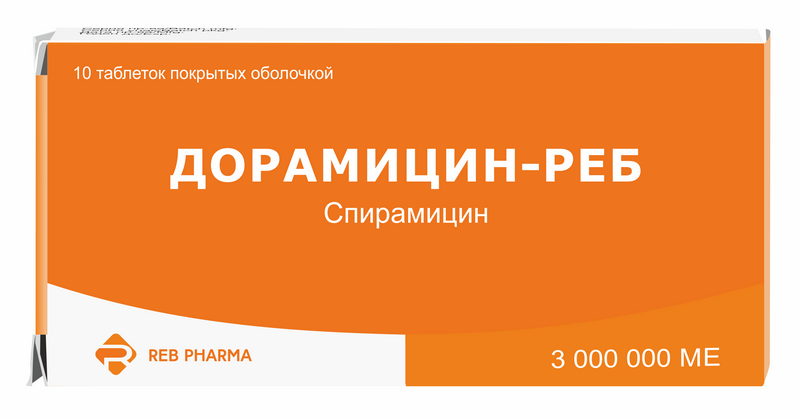
Brand Name: Doramycin-Reb / Doramycin-Reb
International Nonproprietary Name: Spiramycin / Spiramycin
Drug form: coated tablets.
Composition:
1 coated tablet contains:
Active substance: spiramycin 3,000,000 IU.
Excipients: corn starch, croscaramellose sodium, magnesium stearate, hydroxypropyl cellulose, anhydrous colloidal silicon dioxide, microcrystalline cellulose.
Tablet shell composition: polyvinyl alcohol, titanium dioxide, macrogol 400, talc.
Pharmacotherapeutic group
Antibacterial agents for systemic use. Macrolides.
ATX Code: J01FA02.
Pharmacological properties
Pharmacodynamics
Spiramycin is a macrolide group antibiotic. It acts bacteriostatically disrupting intracellular protein synthesis. Penetrates and accumulates in phagocytes (neutrophils, monocytes, peritoneal and alveolar macrobiophages). Inside phagocytes spiramycin concentrations are quite high.
Spiramycin is active against microorganisms: (minimal inhibitory concentration (MIC) ≤ 1 mg/l (more than 90% of the strains are sensitive)) streptococci sensitive to methicillin, staphylococci, enterococci, Rhodococcus equi, Branhamella catarrhalis, Bordetella pertussis, Helicobacter pylori, Campylobacter jejuni, Legionella spp., Corynebacterium diphtheriae, Moraxella spp., Mycoplasma pneumoniae, Coxiella spp., Chlamydia spp., Treponema pallidum, Borrelia burgdorferi, Leptospira spp., Propionibacterium acnes, Actinomyces spp.,Eubacterium spp., Porphyromonas spp., Mobiluncus spp., Bacteroides spp., Peptostreptococcus spp., Prevotella spp., Bacillus cereus.
The antibiotic is moderately active in vitro; positive results can be observed with antibiotic concentrations in inflammation site higher than MIC: Neisseria gonorrhoeae, Ureaplasma urealyticum, Clostridium perfringens.
Spiramycin-resistant microorganisms (MIC> 4 mg/l): (at least 50% of the strains are resistant) - methicillin-resistant staphylococci, Enterobacter spp., Pseudomonas spp., Acinetobacter spp., Nocardia spp., Fusobacterium spp., Haemophilus spp., Mycoplasma hominis, Corynebacterium jeikeium.
Spiramycin is active in vitro and in vivo against Toxoplasma gondii.
Pharmacokinetics
Absorption
Spiramycin absorbs rapidly. Following oral administration of one dose of Doramycin-Reb (6 000 000 IU), maximum spiramycin plasma concentration is about 3.3 μg/ml. Food intake does not affect the absorption.
Distribution
Plasma protein binding is low (approximately 10%). Spiramycin penetrates well into saliva and tissues. 10 days after the treatment spiramycin concentration in the spleen, liver, and kidneys is 5–7 μg/g.
Spiramycin penetrates and accumulates in phagocytes (neutrophils, monocytes and peritoneal and alveolar macrophages). It penetrates through the placental barrier (the concentration in fetus blood is approximately 50% of the concentration in the mother blood serum). Placental tissue concentrations are 5 times higher than the corresponding serum concentrations. It is excreted into breast milk.
Spiramycin does not penetrate into the cerebrospinal fluid.
Metabolism and excretion
Spiramycin is metabolized in the liver to active metabolites of unknown chemical structure. The plasma half-life is approximately 8 hours. It is excreted mainly with bile. Renal excretion is about 10% of the administered dose. The amount of spiramycin released through the intestines (with feces) is very small.
Indications for use
Infectious and inflammatory diseases caused by drug-sensitive microorganisms:
- tonsillopharyngitis caused by beta-hemolytic streptococcus A (as an alternative to treatment with beta-lactam antibiotics, especially in case of contraindications to their use);
- acute sinusitis (based on sensitivity of microorganisms most often causing this pathology, the use of the drug Doramycin-Reb is indicated in case of contraindications to treatment with beta-lactam antibiotics);
- acute bronchitis and chronic bronchitis exacerbation;
- community-acquired pneumonia in patients without risk factors for adverse outcome, severe clinical symptoms and clinical signs of pneumococcal etiology of pneumonia;
- pneumonia caused by atypical pathogens (such as Chlamydia pneumoniae, Chlamydia trachomatis, Mycoplasma pneumoniae, Legionella spp.) or suspicion of it (regardless of severity and presence or absence of risk factors for an adverse outcome);
- skin and subcutaneous tissue infections, including impetigo, ecthyma, infectious dermohypodermatitis (especially, erysipelas), secondary infected dermatoses, erythrasma;
- oral infections (including stomatitis, glossitis);
- non-gonococcal genital infections;
- toxoplasmosis, including that of pregnancy;
- musculoskeletal system and connective tissue (including periodontium) infections;
- prevention of rheumatism recurrence in patients allergic to beta-lactam antibiotics;
- eradication of Neisseria meningitidis from the nasopharynx (in case of contraindications to rifampicin) for prevention (but not treatment) of meningococcal meningitis:
in post- treatment and pre- quarantine period;
in patients who had been in contact with people excreted to the environment Neisseria meningitidis with saliva within 10 days before hospitalization.
Dosage and administration
Doramycin-Reb is taken orally with a sufficient amount of water.
Adults are prescribed 2 to 3 tablets of 3 000 000 IU (i.e. 6 000 000 – 9 000 000 IU) per day. The daily dose is divided into 2 or 3 portions. The maximum daily dose is 9 000 000 IU. The treatment duration for streptococcal tonsillitis is 10 days.
For the meningococcal meningitis prevention adults shall be prescribed 3,000,000 IU 2 times a day for 5 days.
Toxoplasmosis treatment in pregnant women:
Oral administration of spiramycin at a dose of 6 000 000 to 9 000 000 IU per day in 3-weeks course with 2 weeks interval significantly reduces the risk of fetal infection.
Patients with impaired renal function due to minor renal excretion of spiramycin do not require the dose adjustment.
Elderly patients do not require the dose adjustment.
Side effect
Gastrointestinal disorders:
- Abdominal pain, nausea, vomiting, diarrhea and, very rarely, pseudomembranous colitis.
Skin and subcutaneous tissues disorders:
- Rash, urticaria, itching.
- Very rarely, Quincke's edema, anaphylactic shock.
- Very rarely: acute generalized exanthematous pustulosis.
Nervous system disorders:
- Rare and transient paresthesias.
Hepato-biliary disorders:
- Very rarely, pathological results of liver tests.
- With an undetermined frequency, cholestatic, mixed, or, in more rare cases, cytolytic hepatitis occurs.
Blood and lymphatic system disorders:
- Very rare cases of hemolytic anemia have been reported.
Cardiac disorders:
- Frequency unknown: prolongation of QT interval is possible (several cases have been described after iv administration of spiramycin to newborns).
If side effects occur, you must stop the drug intake.
Contraindications
- Hypersensitivity to the components of the drug;
- deficiency of glucose-6-phosphate dehydrogenase (risk of acute hemolysis);
- lactation period;
- children's age (for tablets 3,000,000 IU).
Precautionary measures
During treatment with Doramycin-Reb in patients with liver diseases it is necessary to periodically monitor its function. If at the beginning of treatment generalized erythema and pustules occur, accompanied by high body temperature, acute generalized exanthematous pustulosis should be assumed; if such a reaction occurs, then treatment should be stopped, and further use of spiramycin, both with monotherapy and in combination, is contraindicated.
Very rare cases of hemolytic anemia have been reported in patients with glucose-6-phosphate dehydrogenase deficiency.
With caution, Doramycin-Reb is prescribed for obstruction of the bile ducts, with liver failure.
Despite the fact that the main interactions that contribute to lengthening the QT interval and increase the risk of ventricular arrhythmias (including “pirouette” type arrhythmias) are described with intravenous spiramycin, the use of Doramycin-Reb should be avoided:
- in combination with drugs that extend the QT interval, such as class I and III antiarrhythmic drugs, sultopride (neuroleptic of the benzamide group), vincamine i.v., citalopram, escitalopram, domperidone, prucalopride, cisapride, misolastine, bepridil, moxifloxacin, levofloxacin, erythromycin i.v., diphenyl;
- in patients with congenital syndrome of prolongation of the QT interval or caused by the use of drugs.
The risk of developing ventricular arrhythmias also increases with combined use with certain antipsychotics (chlorpromazine, levomepromazine, trifluoperazin, haloperidol, droperidol, pimozide, amisulpiride, sulpiride, etc.), halofantrine, pentamidine, methadone, and other drugs.
Caution should be given to patients with risk factors that contribute to a QT interval prolongation (for example, unadjusted electrolyte imbalance, heart diseases such as heart failure, myocardial infarction, bradycardia).
Pregnancy and lactation
Doramycin-Reb might be used during pregnancy according to indications.
When prescribed in lactation period breastfeeding should be stopped, since spiramycin might be excreted with breast milk.
Pediatric use
Doramycin-Reb is contraindicated in the form of 3,000,000 IU tablets for children under the age of 18.
Interaction with other drugs
With simultaneous use with drugs containing a combination of levodopa and carbidopa, a decrease in plasma levodopa levels was observed.
Numerous cases of increased activity of oral anticoagulants in patients receiving antibiotic therapy have been reported. The severity of infection or inflammation, the age and general condition of patients are risk factors. In this regard, it seems difficult to determine the effect of infection and its treatment on the development of INR imbalance, however, some classes of antibiotics and antibacterial agents affect MNO imbalance to a greater extent than others. These are mainly: fluoroquinolones, macrolides, cyclins, cotrimoxazole and some cephalosporins.
Storage conditions and shelf life
Store at a temperature not exceeding 25°C.
Keep out of the reach of children!
3 years from the date of production.
Do not use after the expiration date.
Prescription status
By prescription.
Packaging
5 coated tablets in a blister strip packaging of a film of polyvinyl chloride and flexible packaging based on aluminum foil.
2 blister strip packaging along with a leaflet is placed in a cardboard box.
Manufacturer Information
Foreign production and trade unitary enterprise “Reb-Pharma”, 223216, Republic of Belarus, Minsk region, Chervensky district, Smilovichi, Sadovaya str., 1, tel./fax: (+375) 17 240 26 35,
e-mail: rebpharma@rebpharma.by,
http://www.rebpharma.by
Doramycin-Reb
Infectious and inflammatory diseases caused by microorganisms sensitive to the drug.
- tonsillopharyngitis caused by beta-hemolytic streptococcus A (as an alternative to beta-lactam antibiotic treatment, especially in case of contraindications to the above);
- acute sinusitis (Doramycin-Reb is indicated in case of contraindications to beta-lactam antibiotics);
- acute bronchitis and chronic bronchitis exacerbation;
- community-acquired pneumonia in patients without adverse outcome risk factors, severe clinical symptoms and clinical signs of pneumococcal etiology pneumonia;
- pneumonia caused by atypical pathogens (such as Chlamydia pneumoniae, Chlamydia trachomatis, Mycoplasma pneumoniae, Legionella spp.);
- skin and subcutaneous tissue infections, including impetigo, ecthyma, infectious dermohypodermatitis (especially, erysipelas), secondary infected dermatoses, erythrasma;
- oral infections (including stomatitis, glossitis);
- non-gonococcal genital infections;
- toxoplasmosis, including that of pregnancy;
- musculoskeletal system and connective tissue (including periodontium) infections;
- prevention of rheumatism recurrence in patients allergic to beta-lactam antibiotics;
- eradication of Neisseria meningitidis in nasopharynx (in case of contraindications to rifampicin) for prevention (but not treatment) of meningococcal meningitis.
Подробнее
Ask a Question
Гарантия на фурнитуру 3 года
Characteristics
Trademark
REB-PHARMA
Description
Documentation
Comment type is not specified in the component properties.