
N.N. Usova*, A.N. Cukanov**, A.P. Savostin*, M.L. Struk*
*Gomel State Medical University
**RNPC Radiation Medicine and Human Ecology
Gomel, Belarus
Summary Back pain is one of the most common patients’ complaints when attending a doctor-internist. In the pain syndrome formation and chronicity the muscular-tonic syndrome plays an important role, thus pain relief can reduce the severity of clinical manifestations. The aim of this study was to evaluate the effectiveness of the central muscle relaxant Thiocolchicoside for the back pain relief. Thirty patients with vertebrogenic pain and muscle-tonic syndrome had combination treatment with Thiocolchicoside at doses 4 mg and 8 mg BID for 5 days period. According to PainDetect, DN4 and Schober test, an effective pain relief and muscle syndrome was demonstrated when using Thiocolchicoside in multimodal therapy of nonspecific back pain.
Key words: back pain, Thiocolchicoside, muscular-tonic syndrome
Rationale Back pain is on the first place in the world among noncontagious diseases accompanied by persistent health deterioration [10] and is one of the most common reasons for an appointment with a general practitioner, with up to 6-9% of adults [11].
According to a survey of more than 46 thousand of Europeans, about 24% of the population suffers from chronic back pain, while 18% worry about the lumbar pain in spine and 8% - pain in the neck [6].
This pathology entails huge economic costs, composed of both direct treatment cost and disability-related payments. According to American studies results “an average patient” suffering from chronic pain for seven years period during this time has to withstand up to three surgical interventions with an annual treatment cost ranged from 50 to 100 thousand dollars [15].
Most often back pain is a life-threatening condition; however, inadequately diagnosed and prescribed treatment significantly worsens the prognosis, contributes to the pain syndrome chronicity and also significantly reduces the patients’ quality of life.
Such structures of vertebral motor segment as muscles, pain receptors of intervertebral disc fibrous ring, facet joints, sacroiliac joints and spine ligaments are the anatomical substrates of nonspecific back pain [7]. The second mechanism of the pain syndrome development and transition into the chronic one is a muscle spasm which develops as a response to the primary nociceptive impulsion by an unconditioned reflex mechanism. Permanent muscle tension leads to the involvement of central pain generation mechanisms into the pathological process. At the same time, the so-called central sensitization process develops, represented by hyper-excitability of sensory neurons after termination of peripheral pain stimuli [1]. At the same time, signal transmission to higher levels of central nervous system is enhanced, disinhibition escalated, leading to insufficient descending antinociceptive influences [1].
Vertebral muscles are mostly involved in the pathological process, and muscle groups remote from the spinal column can also be involved. In a lower back pain the tonic muscle syndrome is most often localized in the pyriform, middle gluteal and paravertebral muscles.
Due to the mechanisms of the pain development, one of the basic drug product used in pathogenetic therapy is the central acting muscle relaxants. Moreover, many clinical recommendations in different countries of the world suggest using this group of drugs as a part of a multidisciplinary effect to enhance its effect [8, 13].
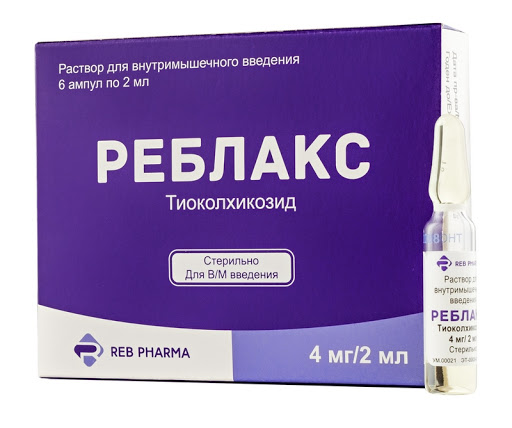
One of the central action muscle relaxants used in the muscular-tonic syndrome in neurology and rheumatology is the drug product Reblaks. An active ingredient in this drug is Thiocolchicoside, the semi-synthetic muscle relaxant derived from the natural glycoside colchicoside which exhibits selective affinity to gamma-aminobutyric acid and glycine receptors. That ensures its action at various levels of the nervous system in case of both central and peripheral genesis spasms [3, 14]. It is suggested that gamma-aminobutyric acid receptors activation occurs at the spinal cord level and contributes to the striated muscles relaxation. Glycinememic effects are manifested at the brain and spinal cord level. Thiocolchicoside possesses an anti-inflammatory, analgesic and anesthetic effect of muscle relaxant and is used in clinical practice in a number of pathologies [2, 4, 5, 9]:
- Hypertonic Muscle Spasm (spasm, contracture) against the background of diseases of the musculoskeletal system in spondylosis, cervical and lumbar syndromes, torticollis;
- Muscular-tonic syndrome in peripheral nervous system diseases: cervicobrachialgia, lumbar ischialgia;
- An increase in muscle tone of central origin, for example, in multiple sclerosis, cerebrospinal and spinal circulation disorders, tumors and the brain and spinal cord injuries;
- Rehabilitation period after traumatological and orthopedic surgeries, to eliminate muscle contractures, as well as in sport injuries;
- Hypertonic Muscle Spasm in arthrosis and rheumatic diseases.
Reblaks does not have a curariform effect, does not cause paralysis and does not affect the cardiovascular and respiratory systems. Previously, there had been some information of the drug teratogenic effect. However, recent analysis of Reblaks used in pregnant women did not have reliable confirmation of its effect thus requiring further studies in this direction [12].
Therefore, the study of Thiocolchicoside effect in spinal pathology (for pain relief and muscle-tonic syndrome) is an urgent issue in modern vertebrae neurology.
Goal of research: to evaluate the effectiveness of muscle relaxant Thiocolchicoside in a complex therapy of the low-back pain and muscular-tonic syndrome.
Materials and methods: There have been examined 30 patients with low-back pain after the outpatient and inpatient therapy in healthcare facilities in Gomel, among them 17 men and 13 women. Patients average age: 54.4 ± 15.9 yrs. According to clinical classification of neurological complications in spinal osteochondrosis the following reflex pain and muscle-tonic syndromes were found in all patients: cervicocranialgia (26.7%), cervicobrachialgia (3.3%), thoracalgia (3.3%), lumbalgia (33.3%) and lumbar ischialgia (33.3%).
The dynamics of neurological and orthopedic-traumatological status was assessed in all patients on the 6th day of treatment and during the whole treatment period.
Pain syndrome was assessed with the use of standard PainDetect and DN4 Questionnaires, filled in by the doctor [8].
The PainDetect test combines the pain distribution pattern in a form of Visual Analogue Scale (VAS) and a Questionnaire to identify spontaneous and induced symptoms of neuropathic pain. In the first block, the patient is asked to evaluate an average of daily, monthly and present pain syndrome intensity according to VAS which is represented by a segment in a straight line 10 mm long with a point indicating zero pain at one end and at the other end – the most severe pain the patient has ever experienced in all his (her) life (Huskisson E. S., 1974). In this segment the patient is offered to mark the point symbolizing the pain level. After that the distance between the “zero” point (no pain) and the point marked by the patient should be measured. The value should be written in mm. In a dynamic assessment the difference in pain intensity is considered to be objective and significant if the present VAS value differs from the previous one by more than 13 mm [8]. This block is not involved into the total score of the test.
In the second block of PainDetect, the patient is asked to choose the most characteristic picture of the pain syndrome pattern. Depending on the type of pain pattern selected, the answer is marked with a score from –1 to +1. In the third block, the patients are offered to mark pain localization in the scheme and indicate its irradiation. Notification of pain irradiation also adds 2 points to the result. The fourth block is represented by the list of neuropathic pain symptoms. In this case, the patient is offered not only to mark pain symptoms status but also the severity in a 6-point scale. Following the Questionnaire completion, points are calculated by summing up the values in blocks 2-4. If the total value exceeds 19 points, then the neuropathic pain is considered to be highly probable [7].
The DN4 Questionnaire is aimed to identify neuropathic pain and includes 4 questions; each question contains several points implying the definite answer (“yes” or “no”). The first two questions are addressed directly to the patient with description of pain characteristics and pain associated sensations. The second two questions are addressed to the doctor and designed to identify certain deviations in sensation. In case of positive answer to 4 or more points neuropathic pain should be confirmed [8].
Schober test was used for muscular-tonic syndrome objectification when 10 cm up from the spinous process of L5 vertebra are measured and marked, then the patient performs the most forward body bending. In healthy subjects, this distance increases by 4-5 cm, and in case of a muscular-tonic syndrome, it practically does not change.
The following criteria were included in the study: patients of both genders over 18 years; persons with low-back pain and a muscle-tonic syndrome; patients with informed consent forms signed. Exclusion criteria: healthy individuals; patients with hypersensitivity to the drug components; myasthenia gravis, epilepsy; pregnancy; patients on other muscle relaxants therapy. All patients treatment was performed according to the clinical protocol “Diagnosis and treatment of patients with nervous system diseases (adult population)”, approved by the Ministry of Health of The Republic of Belarus with an additional to complex therapy centrally acting muscle relaxant Thiocolchicoside (Reblaks).
Patients were divided into two groups with 15 subjects in each: the first group received 8 mg capsules of Reblaks BID (average age 51.9 ± 16.1 years, 10 men and 5 women), and the second group received 4 mg capsules BID (average age 56.8 ± 15.9 years, 7 men and 7 women). Patients had received muscle relaxant for 5 days period. The selected groups were comparable by gender, age and nosological forms. However, on the first day of therapy they were classified by the pain syndrome intensity according to VAS scale assessment: group 1 – 6.0 [6.0; 7.0] points, and group 2 – 5.0 [5.0; 6.0] (p <0.05), based on necessity to use a higher dosage of muscle relaxant in severe pain.
Drug tolerance was evaluated based on the patients’ subjective feelings and the results of objective clinical data.
All patients received an informed consent form. Statistical analysis was carried out with the use of the program “Statistica 10.0”. The results were presented in a form of arithmetic mean and standard deviation (M ± SD); in case of no correspondence to normal distribution – in a form of median (Med) and upper-lower quartile (LQ; UQ). To assess the differences in quantitative characteristics between two independent groups the Mann – Whitney test was used and the Wilcoxon test was used to assess the differences between dependent characteristics. Critical significance level of statistical “null hypothesis” was taken equal to 0.05.
Results
During the pre-treatment examination patients complained of pain in the neck, lower back pain, in some cases irradiated to the head and limbs, as well as limited movements and the spine tenderness.
An objective examination revealed pain and muscle-tonic syndromes in all patients.
Test results on the PainDetect scale are presented in Table 1.
Table 1 – Pain dynamics according to the PainDetect scale in selected groups
(Med [LQ; UQ])
|
Characteristics |
Day |
1-st group, n=15 |
2-nd group, n=15 |
Total Score, n=30 |
|
VAS at the present moment |
1 |
6,0 [6,0;7,0] |
5,0 [5,0;6,0] |
6,0 [5,0;6,0] |
|
6 |
4,0 [3,0;4,0], р=0,0007 |
3,0 [2,0;4,0] р=0,0007 |
3,0 [3,0;4,0] р=0,000008 |
|
|
VAS the most intensive pain within a month period |
1 |
8,0 [8,0;9,0] |
8,0 [7,0;8,0] |
8,0 [8,0;8,0] |
|
VAS mid-intensity pain within a month period |
1 |
6,0 [5,0;7,0] |
6,0 [5,0;6,0] |
6,0 [5,0;6,0] |
|
Resulting Score |
1 |
5,0 [4,0;9,0] |
5,0 [3,0;8,0] |
5,0 [4,0;8,0] |
|
6 |
4,0 [3,0;6,0] р=0,03 |
3,0 [1,0;6,0] р=0,008 |
3,5 [2,0;6,0] р=0,0007 |
As the Table shows, in all groups of patients significant decrease in pain was observed in accordance with the Visual-Analogue Scale.
The pain was nociceptive in character and conformed to the results of the DN4 scale, however, the neuropathic component of the pain syndrome during the treatment was decreased.
In accordance with the DN4 scale, during neuropathic pain assessment it was found that in the pain syndrome of examined patients the nociceptive component prevailed, but the neuropathic modality describing the pain significantly decreased in 6 days of treatment: the total score for 1 day therapy was 2.0 [2.0; 3, 0], and on day 6 it was 2.0 [2.0; 2.0], p = 0.005. In the first subgroup, there was a tendency for improvement observed in dynamics of neuropathic pain component (1 day – 2.0 [2.0; 2.0] points, 6 days – 2.0 [2.0; 2.0], p = 0, 07). In the second subgroup there was a significant decrease in neuropathic circle complaints (1 day – 2.0 [2.0; 3.0] points, 6 days – 2.0 [1.0; 3.0], p = 0.02).
In assessment of muscular-tonic syndrome severity, in accordance with the Schober test, on the 1-st day of therapy in all patients the result was 3.0 [2.0; 4.0] cm, but the significant decrease in paravertebral muscle defense was recorded on the 6-th day – 6.0 [5.0; 7.0] cm, p = 0.00008. In the 1-st patients group received 8 mg of Reblaks on the 1-st day of therapy the Schober test result was 3.0 [2.0; 4.0] cm, and on day 6 – 6.0 [5.0; 7.0] cm, p = 0.003. When 4 mg of Thiocolchicoside was taken in the 2nd patients group on the 1-st day of therapy, Schober test result was 3.0 [2.5; 4.0] cm and on day 6 it was 5.5 [4.5; 6.5] cm, p = 0.007 which also indicated its effectiveness.
Patients noted good tolerance of Reblaks. In only one case the treatment was discontinued due to an undesirable effect development in a form of allergic skin rash.
Conclusion Thus, multimodal therapy in patients with low-back pain the therapy with a muscle relaxant Thiocolchicoside is effective for pain relief and muscle-tonic syndrome treatment and has a good safety profile.